Khavinson bioregulators: Epithalon, Selank, Semax
TL;DR: "Bioregulators" are short regulatory peptides associated with the research school of Vladimir Khavinson and colleagues. Epithalon (AEDG), Selank and Semax are the best-known reagents — decades of Russian-language literature, distinct sequences and CAS numbers, supplied ≥99% HPLC-MS verified. In-vitro research only.
Bioregulators are a family of short regulatory peptides — most only 2 to 7 amino acids long — associated with the research school of Prof. Vladimir Khavinson and the St. Petersburg Institute of Bioregulation and Gerontology. The working hypothesis behind the programme is that tissue-specific short peptides act as gene-regulatory signals in laboratory models. Three of these compounds are catalogue staples for CIS-oriented laboratories: Epithalon, Selank and Semax.
What is a peptide bioregulator?
In the Khavinson framework a "bioregulator" is a short peptide isolated from — or modelled on — an endogenous tissue peptide, and studied for its reported ability to modulate cell function in a tissue-specific way. Epithalon is the synthetic analogue of epithalamin, a pineal-gland extract; Selank and Semax are protease-resistant analogues of the immune peptide tuftsin and the pituitary fragment ACTH(4–10) respectively. The label describes a research lineage and a mechanistic hypothesis, not a therapeutic category.
Epithalon, Selank and Semax at a glance
| Compound | Origin / parent peptide | Sequence | CAS | Studied mechanism (research models) | Purity |
|---|---|---|---|---|---|
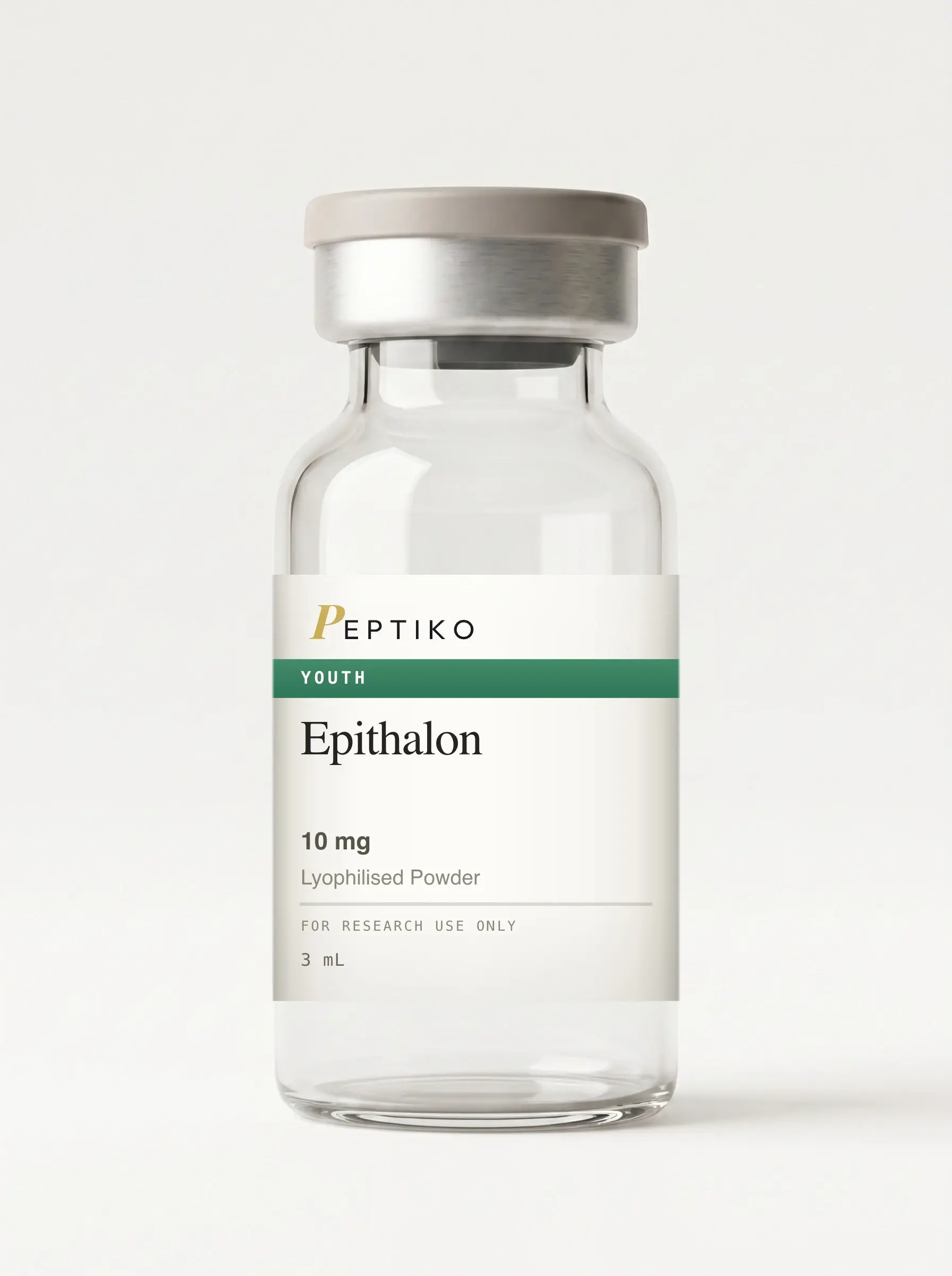
| Epithalon (Epitalon, AEDG) | Analogue of pineal epithalamin | Ala-Glu-Asp-Gly | 307297-39-8 | Telomerase activation; circadian melatonin normalisation | ≥99% HPLC-MS |
| Selank | Analogue of tuftsin (immune tetrapeptide) | Thr-Lys-Pro-Arg-Pro-Gly-Pro | 129954-34-3 | GABAergic modulation; immunomodulation | ≥99% HPLC-MS |
| Semax | Analogue of ACTH(4–10) fragment | Met-Glu-His-Phe-Pro-Gly-Pro | 80714-61-0 | BDNF / NGF upregulation; neuroprotection | ≥99% HPLC-MS |
Where the Khavinson peptides come from
The programme traces to Soviet-era work at the Military Medical Academy in Leningrad and produced roughly 20 short "cytomax/cytogen" peptides across several decades. Epithalon (Ala-Glu-Asp-Gly, CAS 307297-39-8) is the most studied in gerontology models, cited for telomerase activation in cell culture and normalisation of the circadian melatonin curve in aged-rodent models. Selank (CAS 129954-34-3) adds a Pro-Gly-Pro tail to tuftsin and is studied in GABAergic and immunomodulation models. Semax (CAS 80714-61-0) is an ACTH(4–10) analogue studied in neurotrophic (BDNF/NGF) and neuroprotection models. Outside the Russian Federation all three are reported almost exclusively as research compounds.
Why the CIS research literature matters
Unusually for short peptides, these compounds carry decades of publications — largely Russian-language, in journals such as the Bulletin of Experimental Biology and Medicine and Eksperimental'naya i Klinicheskaya Farmakologiya. Selank and Semax are even listed on Russia's Vital and Essential Drugs registry. A researcher working only from English-language databases sees a fraction of the primary literature; the mechanistic and pharmacokinetic detail lives in the original CIS sources. Reading those sources — or working from careful translations — is the difference between informed protocol design and guesswork.
Why these compounds are a CIS-market moat
For laboratories across the CIS and Eastern Europe, the Khavinson peptides are native to the regional literature in a way Western catalogues rarely reflect. Many EU-facing reagent suppliers under-stock them or list them without batch documentation. A supplier in Moldova that stocks Epithalon, Selank and Semax together meets a demand that is culturally and scientifically anchored in the region. That regional depth, not price, is the durable differentiator.
Purity and Certificate of Analysis
Each compound is supplied as a lyophilised reagent verified to ≥99% HPLC-MS. We do not currently issue a third-party certificate of analysis, and would rather say so than imply one. Semax warrants a specific note: it contains methionine, which is susceptible to oxidation, so a real COA should include a methionine-oxidation check alongside the HPLC chromatogram and mass-spectrometry confirmation.
Explore the individual reagents — Epithalon, Selank and Semax — or read the focused comparison, Selank vs Semax, for the mechanistic contrast between the two nootropic peptides.
Research Use Only. All information here is for in-vitro research and educational purposes. Epithalon, Selank and Semax are research reagents — not medicines, dietary supplements or diagnostics — and are not intended for human or animal administration. For qualified laboratories only.
For in-vitro research and laboratory use only. Not for human or animal consumption.