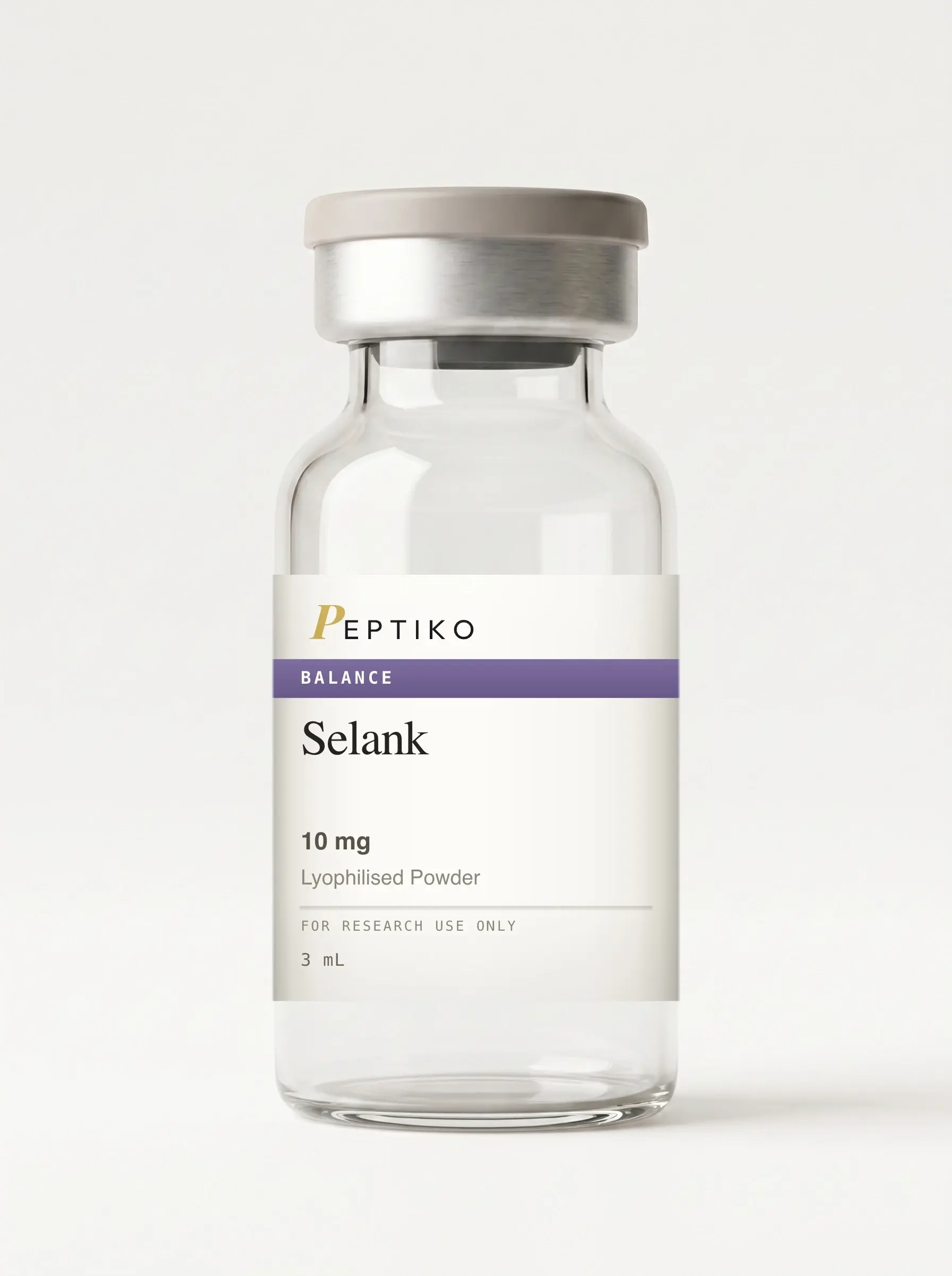
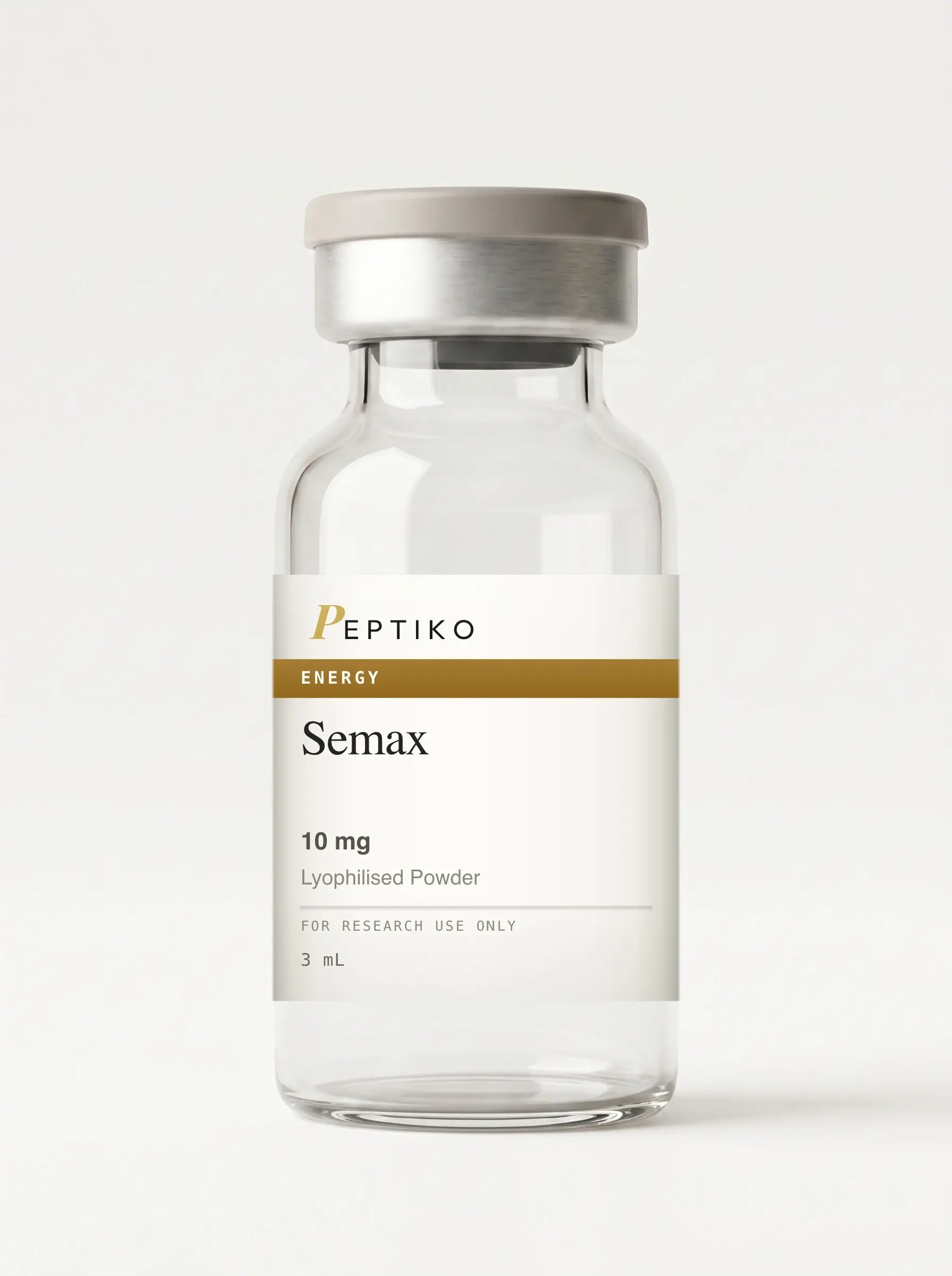
Selank vs Semax: the difference in plain English
In short: Selank and Semax are two different short peptides created at the same institute. Selank is built on tuftsin, a small peptide linked to the immune system. Semax is built on a piece of the hormone ACTH. Selank is studied more often in experiments on anxiety and immunity, Semax in experiments on memory and the protection of nerve cells. We supply both for laboratory research only.
First, two words you will meet below. A peptide is a short chain of amino acids, the building blocks proteins are made of. Selank and Semax each have just seven amino acids in their chain. In vitro means "in glass": experiments on cells and tissue in a laboratory, not on people.
Where Selank and Semax come from
Both peptides were developed at the Institute of Molecular Genetics of the Russian Academy of Sciences. Both have an unusually long publication history: decades of Russian-language papers, both preclinical (cells and animals) and clinical. In Russia both are registered as medicines. Outside Russia they are studied almost only as research compounds.
They share one design trick. The natural peptides they are made from are broken down by blood enzymes within minutes. So both were given the same three-amino-acid "tail": proline, glycine, proline (Pro-Gly-Pro). It protects the molecule from being broken down quickly.
What Selank is
Selank is a synthetic peptide of seven amino acids: Thr-Lys-Pro-Arg-Pro-Gly-Pro. It is built on tuftsin (Thr-Lys-Pro-Arg), a natural four-amino-acid peptide. Tuftsin is cut from antibodies in the spleen and lasts only minutes in blood plasma. Selank is tuftsin plus the protective Pro-Gly-Pro tail.
Most of the work on Selank concerns the GABA system, the brain's main "braking" system for signals. Experiments in rats describe Selank strengthening the binding of GABA to its receptors in the hippocampus (a receptor is a protein on a cell that takes in a signal, the way a lock takes a key). An indirect effect on serotonin and dopamine turnover is described too. The second line of work is the immune system: profiles of cytokines and interferons, the immune system's signalling proteins. That is why Selank is studied in animal models of anxiety and in work on immune regulation.
- Sequence: Thr-Lys-Pro-Arg-Pro-Gly-Pro
- Molecular weight: 751.9 Da (the dalton is the unit of molecular mass)
- CAS: 129954-34-3 (the substance's number in the international chemical registry)
- Half-life in published estimates: 10–30 minutes (the time it takes for half the substance to break down)
What Semax is
Semax is also a synthetic seven-amino-acid peptide: Met-Glu-His-Phe-Pro-Gly-Pro. It is built on the ACTH(4–7) fragment, meaning amino acids four to seven of adrenocorticotropic hormone (ACTH). ACTH is a pituitary hormone that triggers cortisol production in the body. The literature often calls Semax an ACTH(4–10) analogue, because activity in the nervous system was described long ago for that longer fragment. One important detail: Semax has none of the parent hormone's hormonal action, meaning it does not affect cortisol production.
Research on Semax centres on neurotrophins, the proteins that support the growth and survival of nerve cells. Animal experiments describe a rise in the two main neurotrophins, BDNF and NGF, in cells of the hippocampus and cortex. Effects on enkephalin turnover and antioxidant activity through nitric-oxide pathways are described as well. Hence the models it is studied in: memory and learning, protection of nerve cells (neuroprotection) and ischaemia, which means a disrupted blood supply to the brain.
Semax has one feature that matters for quality. Its chain contains the amino acid methionine, which oxidises easily. Oxidised Semax is already a slightly different molecule. That is why methionine oxidation is checked separately when Semax purity is tested.
- Sequence: Met-Glu-His-Phe-Pro-Gly-Pro
- Molecular weight: 813.9 Da
- CAS: 80714-61-0
- Half-life in published estimates: 15–30 minutes
The main differences in one table
| What we compare | Selank | Semax |
|---|---|---|
| Built on | Tuftsin, a 4-amino-acid immune peptide | The ACTH(4–7) hormone fragment |
| Sequence | Thr-Lys-Pro-Arg-Pro-Gly-Pro | Met-Glu-His-Phe-Pro-Gly-Pro |
| Molecular weight | 751.9 Da | 813.9 Da |
| CAS | 129954-34-3 | 80714-61-0 |
| Linked systems | GABA (indirectly), serotonin and dopamine | Melanocortin receptors, neurotrophins (indirectly) |
| Research focus | The GABA system, immune signals | BDNF and NGF, protection of neurons |
| Typical models | Anxiety, behaviour, immunity | Memory, learning, neuroprotection, ischaemia |
| Quality watch-point | — | Methionine oxidises easily |
| Status in Russia | Registered as a medicine | Registered as a medicine |
| Our purity | ≥99% by HPLC-MS | ≥99% by HPLC-MS |
| Our vial | 10 mg, lyophilised | 10 mg, lyophilised |
Selank or Semax: which is chosen for research
The choice depends on what is being studied, not on which peptide is "stronger". If the model is about anxiety, behaviour or immune regulation, Selank turns up more often in the literature. If it is about memory, learning, protecting nerve cells or ischaemia, Semax does. In comparative work, laboratories sometimes put both peptides in separate arms of the experiment.
Have they been studied together?
Yes, in preclinical models. Their mechanisms differ: the two peptides act on different receptor systems, so such work treats their effects as complementary rather than overlapping. Some Russian papers describe combined protocols, but direct comparisons outside that literature are still scarce. A 2020 paper studied the effects of both peptides with one method, functional connectomics, looking at how the links between brain regions change (PMID 32342318).
Why the Russian literature matters
Most of the papers on both peptides appeared in Russian-language journals: the Bulletin of Experimental Biology and Medicine, the S. S. Korsakov Journal of Neurology and Psychiatry, and Experimental and Clinical Pharmacology. Anyone searching only English-language databases sees just part of the work. The key data on pharmacokinetics (how a substance spreads and breaks down in the body) and on experimental methods sit in the Russian sources. So when planning work it pays to read the originals or their translations.
Purity and paperwork
For both peptides, confirmed purity of at least 99% by HPLC-MS matters. HPLC (high-performance liquid chromatography) separates what is in a sample and shows what share of it is the intended peptide. MS (mass spectrometry) weighs the molecules and confirms that it is that exact peptide. Typical impurities are shortened chains left behind when synthesis does not run to completion. For Semax, oxidised methionine joins the list. A good certificate of analysis (COA) for Semax shows the chromatogram, the mass spectrum and a check for methionine oxidation.
To be straight about us: we do not currently have independent laboratory testing for every batch, and we will not promise a certificate of analysis. How to read a certificate when a seller does provide one is covered in "How to read a peptide COA".
Frequently asked questions
Are Selank and Semax the same thing?
No. They are two different molecules built on different bases: Selank comes from tuftsin, Semax from a fragment of the hormone ACTH. What they share is the institute that created them and the protective Pro-Gly-Pro tail.
Which is better, Selank or Semax?
There is no "better" here: they are tools for different research models. Selank appears more often in work on anxiety and immunity, Semax in work on memory and nerve-cell protection.
Can they be studied together?
Preclinical work has studied them both separately and together. We do not advise on use: our compounds are for in-vitro laboratory research only.
In what form do you sell them?
A 10 mg vial, lyophilised: a freeze-dried powder. It is not pharmacy drops and not a ready-made solution. How a research vial differs from the pharmacy product is covered in "Semax and Selank: pharmacy drops vs a research vial".
How should the vial be stored?
Keep the dry vial at 2–8 °C (an ordinary fridge) in the dark, and at −20 °C for long-term storage. The details are in the peptide storage guide.
How to order
Price and availability are on the Selank and Semax pages and in the block at the top of this article. You can order on the site or through the Telegram bot. We deliver within Moldova in 1 business day and you pay the courier on delivery. Before delivery we call you to confirm the order.
Sources
- Functional Connectomic Approach to Studying Selank and Semax Effects. Dokl Biol Sci, 2020. PMID 32342318
- Semax, synthetic ACTH(4-10) analogue, attenuates behavioural and neurochemical alterations following early-life fluvoxamine exposure in white rats. Neuropeptides, 2021. PMID 33418449
- Selank, a Peptide Analog of Tuftsin, Attenuates Aversive Signs of Morphine Withdrawal in Rats. Bull Exp Biol Med, 2022. PMID 36322304
For in-vitro research and laboratory use only. Not for human or animal consumption.