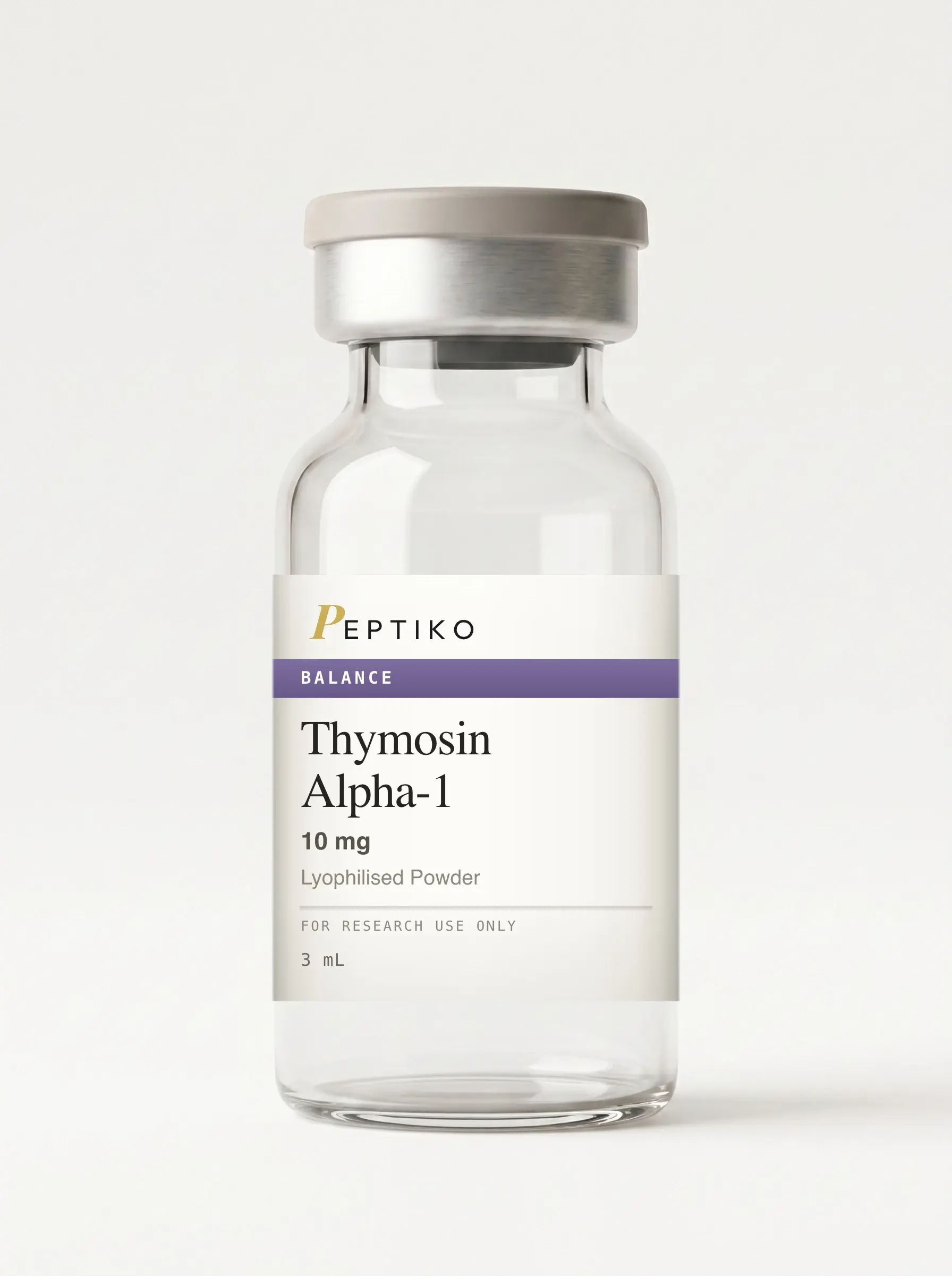
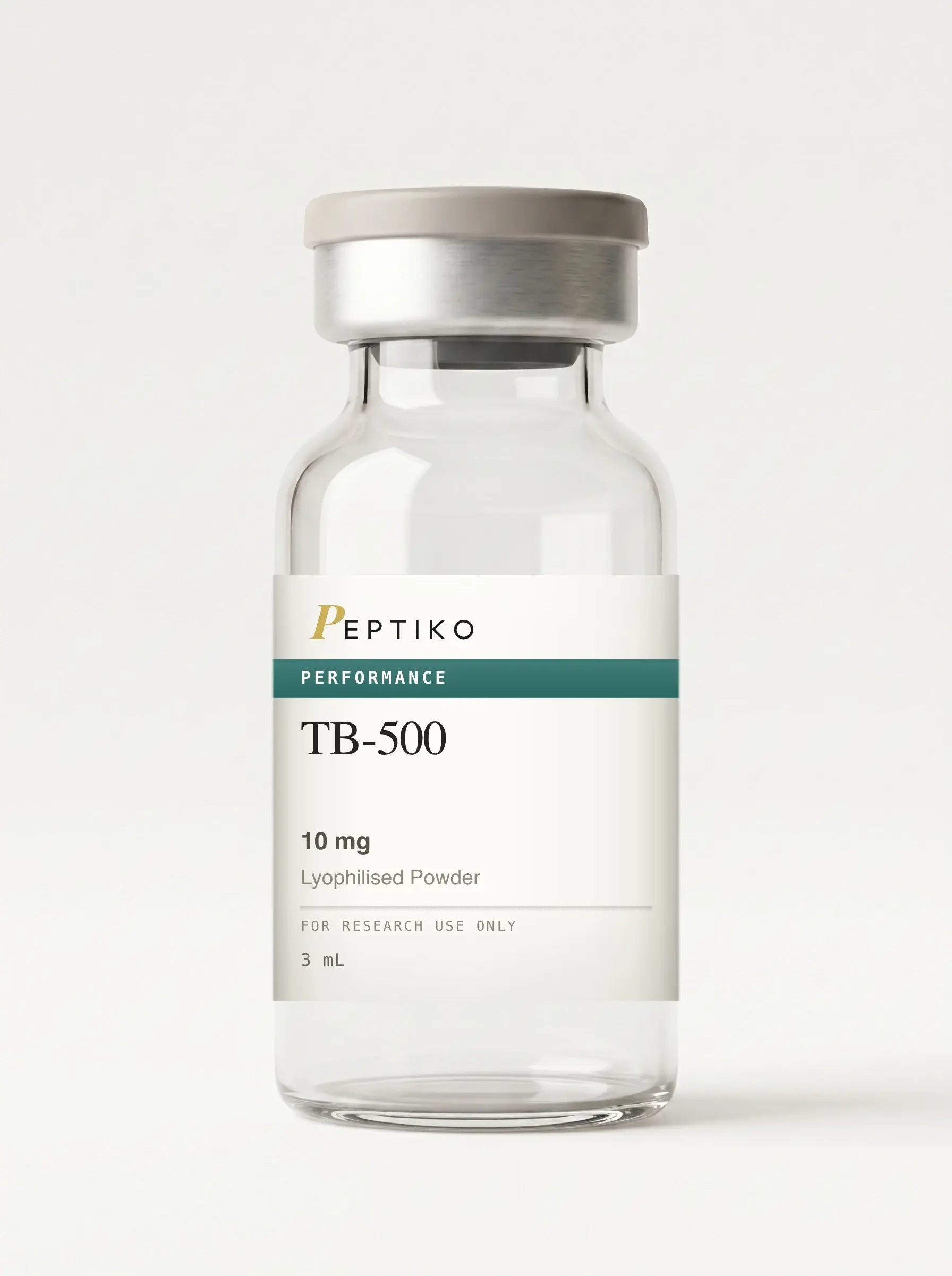
Thymosin alpha-1 vs thymosin beta-4: the difference
In short: thymosin alpha-1 and thymosin beta-4 are two different peptides that share only a name. Thymosin alpha-1 is a 28-amino-acid chain studied in work on the immune system. Thymosin beta-4 (called TB-500 in research supply) is a 43-amino-acid chain that binds actin, a protein of the cell's "skeleton". We supply both for in-vitro laboratory research only.
Why the names are so alike
Both peptides were found in the same material. In the 1960s and 1970s, Allan Goldstein's research group studied an extract of the thymus, the gland in which immune cells mature. The extract was split into fractions, and one of them was named "thymosin fraction 5". Several peptides were isolated from it and called thymosins. The Greek letters alpha, beta and gamma were given according to how the peptides behaved during separation. The letter is just a label in a laboratory classification, not a sign of kinship.
It later turned out that these peptides are unrelated in structure and function. Thymosin beta-4 proved not to be a "thymus peptide" at all: it is present in almost every cell in the body. But the names stuck, hence the confusion.
A few words to make it clear
- A peptide is a short chain of amino acids, the building blocks proteins are made of.
- The thymus is an organ behind the breastbone in which T cells, some of the key cells of immunity, are "trained".
- Actin is the protein a cell builds its inner framework from. Actin filaments are constantly assembled and taken apart, which lets the cell change shape and move.
- Cytokines are the signalling proteins immune cells use to "talk" to one another.
Thymosin alpha-1: what it is
Thymosin alpha-1 is a peptide of 28 amino acids. It is formed from a larger protein, prothymosin alpha. Our reagent is a synthetic copy of this peptide, assembled chemically.
The literature describes it as an immunomodulator, meaning a substance that influences how the immune system works rather than simply "stimulating" it. Laboratory work studies it through several readouts: signalling through Toll-like receptors (the sensors immune cells use to recognise microbes), T-cell maturation, the activity of natural killer cells (cells that destroy infected cells) and the set of cytokines cells release.
In a number of countries thymosin alpha-1 is registered as a medicine. Our vial is not a medicine but a reagent for in-vitro experiments, meaning "in glass".
Thymosin beta-4 (TB-500): what it is
Thymosin beta-4 is a peptide of 43 amino acids found in many cell types. Its main known role is binding actin. One thymosin beta-4 molecule holds one "free" actin molecule (so-called G-actin). This is how a cell keeps a reserve of actin from which it can quickly build new filaments when needed. That is why the literature describes thymosin beta-4 as a regulator of actin dynamics rather than as a molecule that switches on a receptor.
Through actin it is linked to how cells move. So it is studied in models of cell migration, the growth of new blood vessels (angiogenesis) and signals linked to tissue repair. The molecule has an actin-binding region and a short fragment at its start, Ac-SDKP, which is studied on its own.
The name TB-500 is used in research supply. It usually means the full-length sequence of thymosin beta-4, which is what we supply.
The main differences in one table
| What we compare | Thymosin alpha-1 | Thymosin beta-4 (TB-500) |
|---|---|---|
| Chain length | 28 amino acids | 43 amino acids |
| Where it comes from in the body | The protein prothymosin alpha | Present in almost every cell |
| Main known role | Immune-system signalling | Binds actin, the cell's framework |
| What is studied | T cells, natural killer cells, Toll-like receptors, cytokines | Cell migration, angiogenesis, tissue repair |
| Formula | C129H215N33O55 | C212H350N56O78S |
| Molecular weight | 3108.3 Da | 4963 Da |
| CAS | 62304-98-7 | 77591-33-4 |
| Our vial | 10 mg, lyophilised | lyophilised; the vial mass is on the TB-500 page |
| Purity | ≥99% by HPLC-MS | ≥99% by HPLC-MS |
The dalton (Da) is the unit of molecular mass. CAS is the substance's number in the international chemical registry, which makes it easy to check exactly which compound is meant.
How researchers choose between them
The choice is not about which is "better" but about what is being studied. If the question concerns the immune system (T cells, cytokines, recognising microbes), thymosin alpha-1 is the one found in the literature. If it concerns how cells move, how they build their framework, how vessels grow and how tissue repairs in a model, it is thymosin beta-4. The molecules are different, and one cannot stand in for the other.
Thymosin beta-4 is often compared with another peptide, BPC-157. That comparison is covered in "BPC-157 and TB-500: the difference in mechanism".
How to store the vials
Keep both dry vials at 2–8 °C (an ordinary fridge), and at −20 °C for the long term. Thymosin beta-4 should also be protected from light. Once dissolved, the solution is kept at 2–8 °C, avoiding repeated freezing and thawing. Ordinary temperatures in transit do the dry powder no harm. The details are in the peptide storage guide.
Frequently asked questions
Are thymosin alpha-1 and TB-500 the same thing?
No. They are two different peptides: 28 and 43 amino acids, different sequences, different jobs in the cell. All they share is a name inherited from the thymus extract.
Is TB-500 thymosin beta-4?
In research supply, TB-500 usually means a synthetic copy of the full thymosin beta-4 sequence, 43 amino acids. That is what ours is.
Why is thymosin beta-4 called a thymosin if it is everywhere?
Because it was first isolated from a thymus extract. Only later did it turn out to be present in almost every cell.
Are they medicines?
Thymosin alpha-1 is registered as a medicine in some countries; thymosin beta-4 is not. We supply both as reagents for in-vitro laboratory research only and do not advise on use.
How to order
Prices and availability are on the thymosin alpha-1 and TB-500 pages and in the block below this article. If a compound is out of stock, you can sign up there to be told when it is back. You can order on the site or through the Telegram bot. We deliver within Moldova in 1 business day and you pay the courier on delivery. Before delivery we call you to confirm the order.
Sources
- Thymosin alpha-1. Am J Health Syst Pharm, 2001. PMID 11381492
- Aging and Thymosin Alpha-1. Int J Mol Sci, 2025. PMID 41373628
- beta-Thymosins. Ann N Y Acad Sci, 2007. PMID 17468232
- The beta-thymosin enigma. Ann N Y Acad Sci, 2007. PMID 17495248
For in-vitro research and laboratory use only. Not for human or animal consumption.