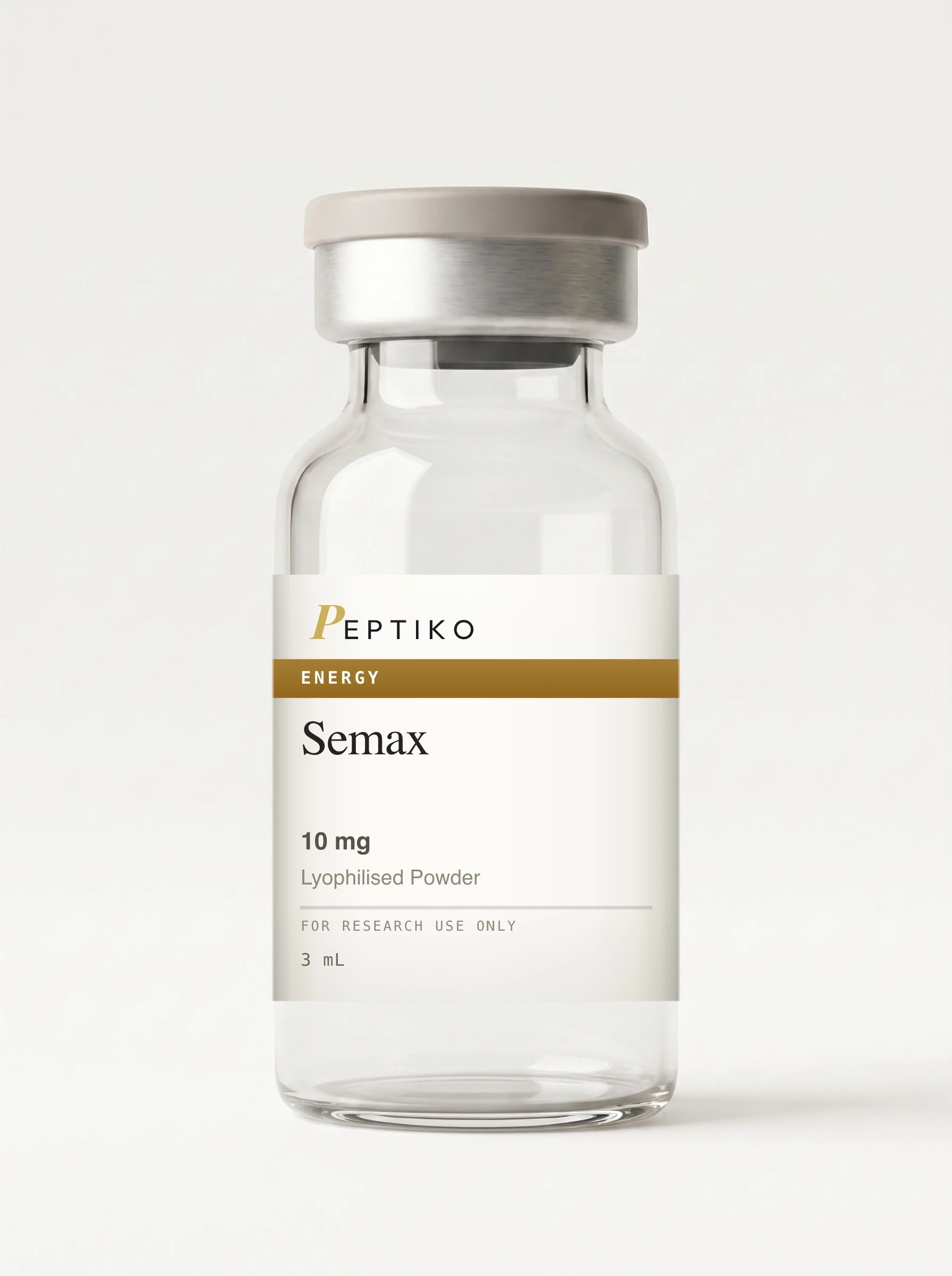
Semax
ACTH(4-10)-derived peptide. Studied for cognitive and neuroprotective pathways — a Russian-developed research peptide.
Pay on deliveryDelivered in 1 business dayFree from 1000 lei
For in-vitro research and laboratory use only. Not for human or animal consumption.
- ≥99% purity by HPLC-MS · lot number on every vial
- Delivery in Moldova: 1 business day
- Cash to the courier on delivery
- + bacteriostatic water free with this order
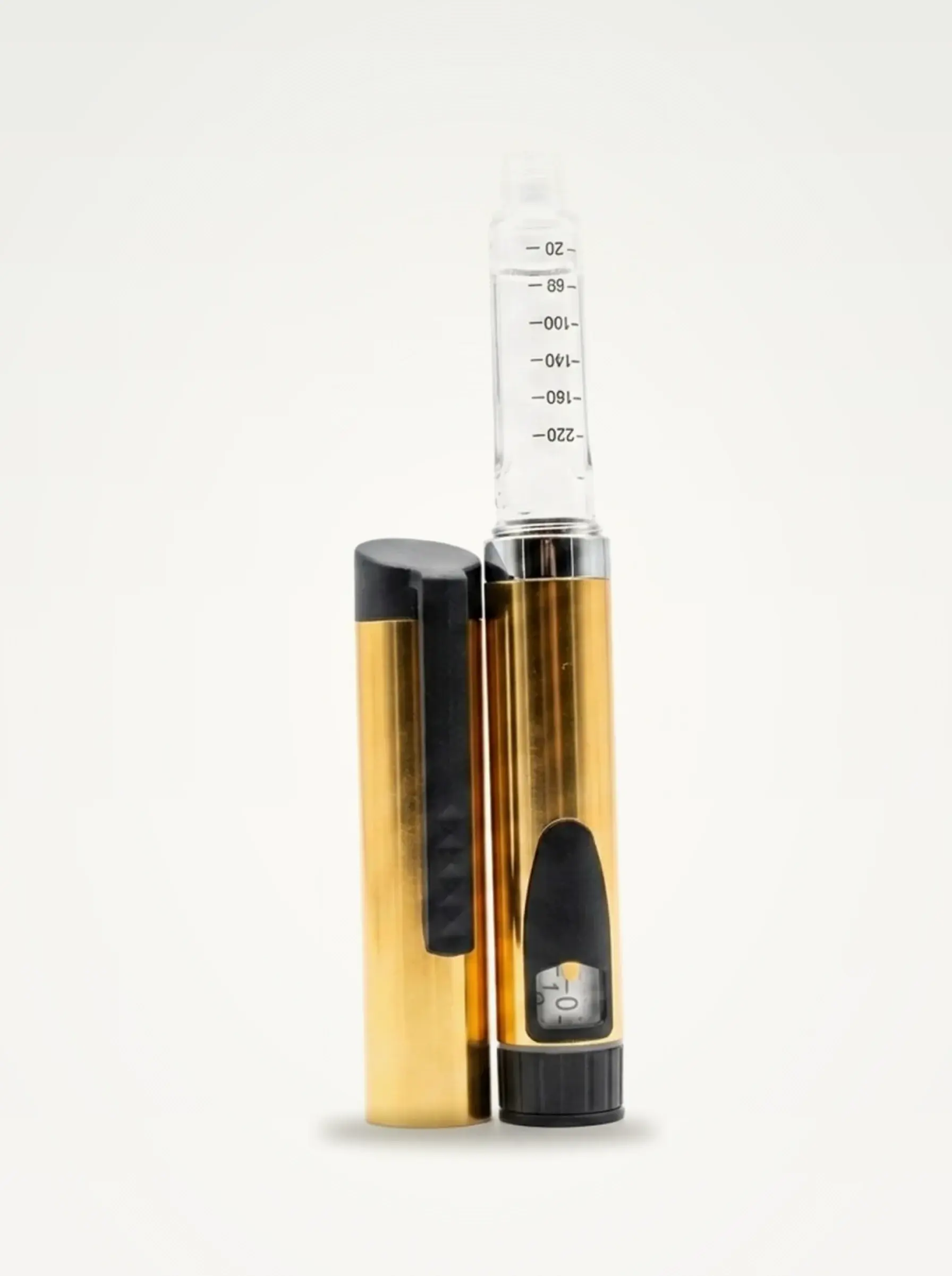 Injection Penreusable device · 800 lei
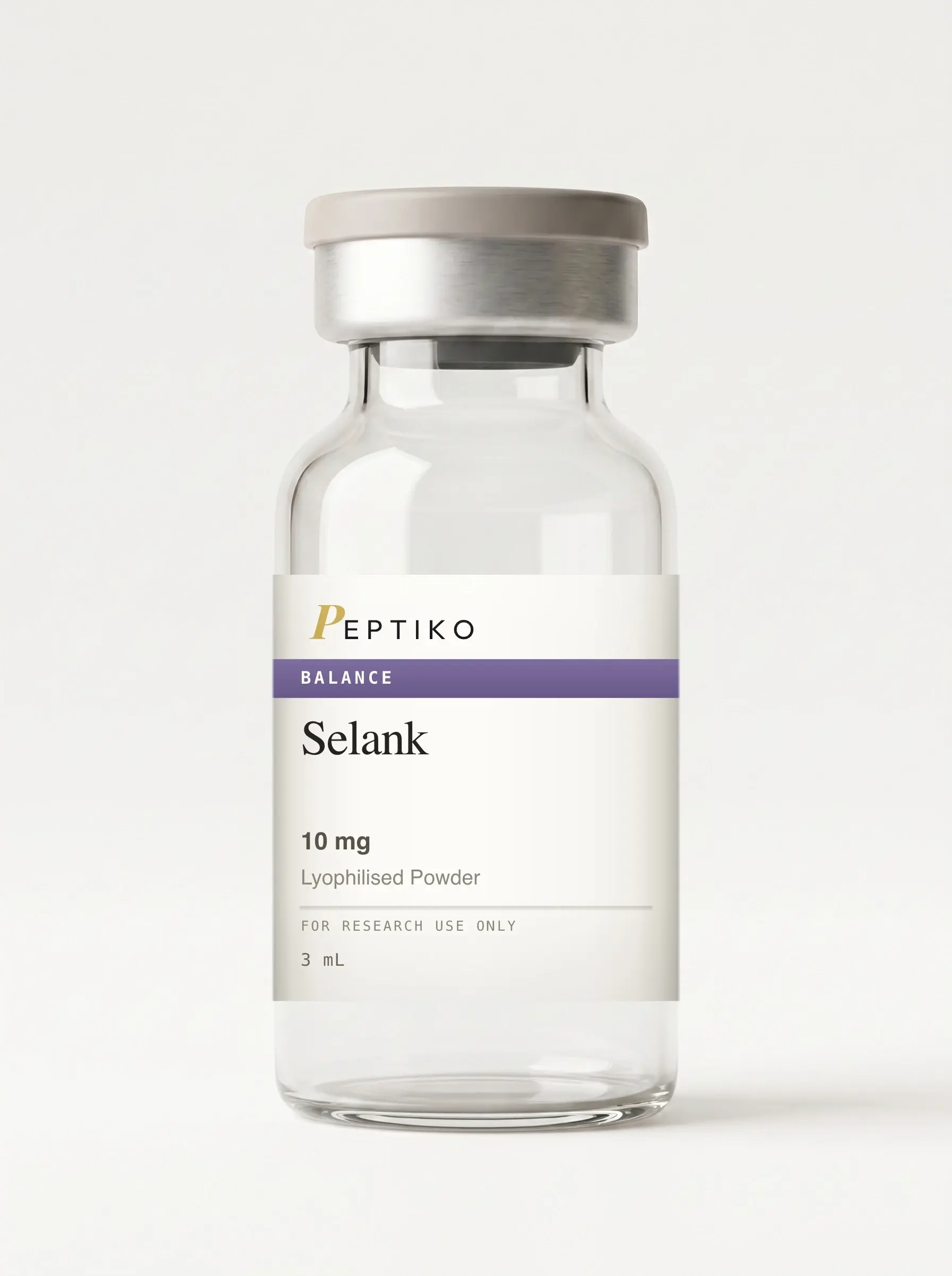
- Purity
- ≥99% HPLC-MS verified
- CAS
- 80714-61-0
- Storage
- Lyophilised: 2–8 °C, protect from light (−20 °C for long-term, ≥24 months). Reconstituted: 2–8 °C.
- Formats
- 10mg vial
Courier delivery anywhere in Moldova. Lyophilized peptides travel at ambient temperature.
Selank vs Semax: the difference in plain English →Overview
Semax is a synthetic peptide built on the ACTH(4-7) fragment with a stabilising Pro-Gly-Pro tail attached, which slows enzymatic breakdown. Unlike the parent hormone it carries none of ACTH's corticotropic signalling. It is among the most frequently cited subjects in the Russian neuropeptide literature and is stocked by laboratories as a reference compound for in-vitro neuropeptide work. Supplied lyophilised at ≥99% HPLC-MS.
Mechanism
Semax is a synthetic heptapeptide, Met-Glu-His-Phe-Pro-Gly-Pro: the ACTH(4-7) fragment of corticotropin with a C-terminal Pro-Gly-Pro tripeptide attached, a tail described as slowing enzymatic breakdown of the fragment. The literature is not even settled on the parent fragment — one of the cited titles calls the molecule an ACTH(4-10) analogue — which is worth knowing when reading the older work. Unlike the parent hormone, corticotropic activity is not attributed to it. No single canonical receptor runs through the cited papers. The most recent target-identification study, in a mouse spinal-cord-injury model, arrives at the μ-opioid receptor by network pharmacology and docking, then traces the signal onward to the ubiquitin-specific protease USP18, to deubiquitination of the fat-mass-and-obesity-associated protein FTO, and to suppression of lysosomal membrane permeabilization and the pyroptosis that follows it, with reduced oxidative stress as the proximate readout. A separate strand — review commentary rather than primary data — attributes the neuroactive effects instead to BDNF and HGF/c-Met neuroplasticity signalling. A third strand is neurochemical rather than receptor-level: in rats, brain biogenic-amine content shifts. In healthy human volunteers the only readout available here is a network one, a change in resting-state functional connectivity between the right amygdala and right temporal cortex. These three accounts have not been reconciled into one mechanism.
Molecular identity
- Sequence
- Met-Glu-His-Phe-Pro-Gly-Pro
- Formula
- C37H51N9O10S
- Molecular weight
- 813.9 g/mol
- CAS
- 80714-61-0
- PubChem CID
- 9811102
What it acts on
- μ-opioid receptor (Oprm1) — network pharmacology and molecular docking in a 2025 mouse spinal-cord-injury study nominate this receptor as a candidate target of the peptide, by computational inference rather than by any binding assay; it is the only concrete receptor assignment anywhere in this reference set.
- USP18 and downstream deubiquitination of FTO — the same study reports that the peptide regulates the ubiquitin-specific protease USP18, and a USP18 knockdown experiment is offered as confirmation that this node is involved in the recovery effect; the abstract does not state that knockdown abolished the effect.
- Lysosomal membrane permeabilization and the pyroptosis that follows it — reported as suppressed in injured cord tissue and in a PC12 neuroinflammation model, downstream of reduced oxidative stress.
- BDNF and HGF/c-Met neuroplasticity signalling — a 2026 orthopaedic review groups the compound with other neuroactive peptides that it describes as acting through these pathways.
- Brain monoamine systems — in rats, the literature reports normalisation of biogenic-amine levels that had been altered by neonatal SSRI exposure.
What the studies report
Each item below summarises the paper it is numbered to, written from that paper's own abstract. The badge says how the evidence was produced.
- 1.human studyDokl Biol Sci (2020)
A placebo-controlled resting-state fMRI study in 52 healthy participants comparing Semax, Selank and placebo. Each participant was scanned before administration and twice at short intervals afterwards; the predefined regions of interest were the amygdala and the dorsolateral prefrontal cortex in both hemispheres. Between-group and between-condition differences appeared in connectivity between the right amygdala and a right-hemisphere temporal region spanning the fusiform, inferior and middle temporal and parahippocampal gyri. The authors present this as a first observation of its kind; the analysis is restricted to the predefined regions, the participants are healthy, and the outcome is a connectivity measure with no behavioural or clinical endpoint attached to it.
- 2.animal modelBr J Pharmacol (2025)
A spinal-cord-injury study in female C57BL/6 mice with a thoracic-level impact, supported by a PC12 cell neuroinflammation model. Functional recovery was scored by Basso scale, footprint analysis and inclined-plane testing, with immunofluorescence, Western blot, RT-qPCR and transmission electron microscopy for markers. The paper reports improved functional recovery and suppression of pyroptosis linked to lysosomal membrane permeabilization, by way of reduced oxidative stress, and identifies USP18 as a regulated node — a USP18 knockdown experiment is reported as confirming the peptide's role in recovery, not as abolishing it. The μ-opioid receptor is nominated as a target by network pharmacology and molecular docking, that is by computational inference rather than by direct binding; the work uses animals of one sex only, and the authors frame the conclusion as a suggested potential rather than a demonstrated one.
- 3.
A narrative review of therapeutic peptides in orthopaedics. Semax appears as one entry in a broad survey, grouped with selank and dihexa among neuroactive peptides that the authors describe as enhancing BDNF and HGF/c-Met signalling relevant to neuroplasticity, set against a general background of PI3K/Akt, mTOR, MAPK, TGF-β and AMPK pathways. The review contains no primary data on this compound, and the authors state directly that although preclinical work looks promising, clinical trials are currently lacking.
- 4.animal modelNeuropeptides (2021)
A developmental study in white rats. Pups were exposed neonatally to the SSRI fluvoxamine or to vehicle, and Semax or vehicle followed; behaviour and monoamine content in brain structures were assessed in the second month of life. Fluvoxamine exposure produced lasting impairment of the emotional response to stress and novelty, delayed acquisition of a food-motivated maze task, and altered monoamine levels in one- and two-month-old animals. In the peptide-treated group the authors report reduced anxiety-like behaviour, better learning, and biogenic-amine levels closer to control. The paper itself states that the mechanisms of SSRI action on the developing brain remain largely unknown, so the protective interpretation rests on a hypothesis about serotonin in development rather than on any target measured in the study.
Used in research on
What this does not establish
The cited evidence does not establish clinical efficacy for anything. The single human study is exploratory, in healthy volunteers, and measures resting-state connectivity rather than any clinical outcome; the review included here states outright that clinical trials of these peptides are lacking. The one molecular target on offer, the μ-opioid receptor, comes from network pharmacology and docking in a single mouse study using animals of one sex, and has not been confirmed by direct binding work. The BDNF/c-Met account is review commentary, not primary data — no cited study measures neurotrophin expression — and the monoamine results belong to rat developmental pharmacology. The literature is not even consistent about which ACTH fragment the molecule derives from.
Research applications
In vitro, Semax is stocked as a reference compound for neuropeptide and neurotrophic-signalling research. Built on the ACTH(4-7) fragment with a stabilising Pro-Gly-Pro tail, it is used in cell-based assays that read out BDNF and NGF expression, in panels examining monoamine turnover, and in peptidase-stability studies that probe how the Pro-Gly-Pro tail slows enzymatic breakdown. Because it carries none of the parent hormone's corticotropic activity, it also serves as a fragment-versus-parent reference in ACTH-analogue selectivity work. All such use is confined to in-vitro laboratory study.
Reconstitution
Supplied lyophilised. For laboratory preparation, reconstitute the powder with sterile bacteriostatic water to a working stock, keep the reconstituted solution at 4 degrees C, and prepare assay dilutions in the buffer specified by your protocol; protect from light and store the sealed lyophilised vial at −20 °C until use. For in-vitro research use only, not for human or animal administration.
Storage & handling
Lyophilised: 2–8 °C, protect from light (−20 °C for long-term, ≥24 months). Reconstituted: 2–8 °C.
Research literature
Selected peer-reviewed literature describing this compound. Peptiko supplies peptides for in-vitro research; these papers characterise the compound, not this product.
- 1.Functional Connectomic Approach to Studying Selank and Semax Effects. Dokl Biol Sci (2020)
- 2.Semax peptide targets the μ opioid receptor gene Oprm1 to promote deubiquitination and functional recovery after spinal cord injury in female mice. Br J Pharmacol (2025)
- 3.Therapeutic Peptides in Orthopaedics: Applications, Challenges, and Future Directions. J Am Acad Orthop Surg Glob Res Rev (2026)
- 4.Semax, synthetic ACTH(4-10) analogue, attenuates behavioural and neurochemical alterations following early-life fluvoxamine exposure in white rats. Neuropeptides (2021)
Frequently asked questions
What is Semax?
Semax is a synthetic peptide built on the ACTH(4-7) fragment with a stabilising Pro-Gly-Pro tail that slows enzymatic breakdown; it carries none of the parent hormone's corticotropic activity. Laboratories stock it as an in-vitro reference compound for neuropeptide research. Supplied lyophilised at ≥99% HPLC-MS.
Is Semax for human use?
No. It is a research-use-only reagent for in-vitro laboratory study. It is not a pharmaceutical, supplement, or medicine, and not for human or veterinary use.
How is purity verified?
Purity is at least 99% by HPLC-MS.
What is the CAS number?
CAS 80714-61-0.
Do you ship from Moldova?
Yes. We deliver by courier anywhere in Moldova, one business day after we confirm the order, and you pay the courier in cash. Lyophilized peptides travel at ambient temperature: a freeze-dried cake needs no cold chain.
Reviews
Be the first to review Semax.
Order on Telegram, or add it to the cart and check out on the site. Cash to the courier on delivery — nothing is paid in advance.