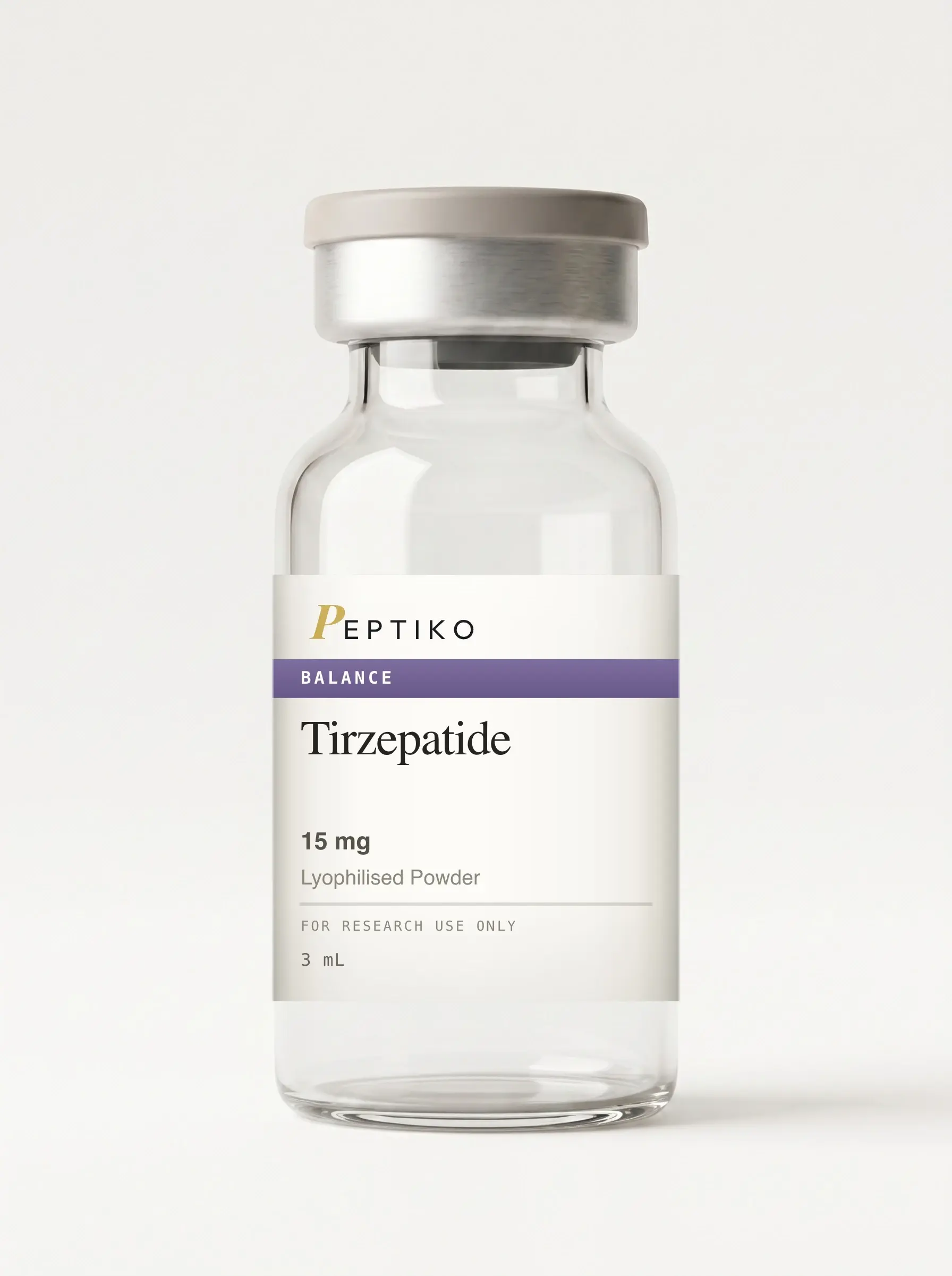
Tirzepatide in plain English: what the molecule is
In short: tirzepatide is a synthetic peptide of 39 amino acids. One molecule switches on two receptors for gut hormones, GIP and GLP-1, which is why it is called a dual agonist. It was developed by Eli Lilly under the code LY3298176. We supply tirzepatide as a reagent for in-vitro laboratory research. It is not a pharmacy medicine.
Tirzepatide is one of the most asked-for peptides in our catalogue, and it is also the one people are most confused about: what the substance is, how it differs from the medicine in a pharmacy, and how it differs from retatrutide. Here it is step by step, without scientific jargon.
Five words that make the rest clear
- Amino acids are small molecules, the building blocks every protein is made of.
- A peptide is a short chain of amino acids. Tirzepatide is a chain of 39.
- A receptor is a protein on the surface of a cell that takes in a signal. Think of it as a lock that fits one particular key.
- An agonist is a key molecule that switches a receptor on. A "dual agonist" switches on two different receptors.
- Incretins are gut hormones released after a meal that take part in regulating blood sugar. The main ones are GLP-1 and GIP.
What the molecule does
The natural hormones GLP-1 and GIP each have their own receptors on cells, and normally each hormone switches on only its own receptor. Tirzepatide is built so that one molecule fits both "locks" and switches both receptors on. Hence the name: a dual GIP and GLP-1 receptor agonist.
Both receptors belong to one class: class B G-protein-coupled receptors (GPCRs). When such a receptor is switched on, the cell makes the signalling molecule cAMP and passes the command on. That signal is exactly what laboratory experiments measure.
How the molecule is built
It starts from the sequence of the natural hormone GIP, changed in several places so that the molecule also switches on the GLP-1 receptor. Three details are worth knowing:
- Two "non-standard" Aib amino acids (aminoisobutyric acid), which natural proteins do not contain. Aib protects the molecule from the enzyme DPP-4, which destroys natural GLP-1 and GIP within minutes.
- A fatty-acid "tail". A fatty-acid residue with 20 carbon atoms (C20, a fatty diacid) is attached to one amino acid of the chain through a short linker. Laboratory models study it as the part that helps the molecule bind to albumin, the main protein in blood plasma.
- One chain, nothing assembled. It is a single peptide, not a mixture of two substances: the same molecule switches on both receptors.
| Parameter | Value |
|---|---|
| What it is | Synthetic peptide, dual GIP and GLP-1 receptor agonist |
| Chain length | 39 amino acids |
| Formula | C225H348N48O68 |
| Molecular weight | 4813 Da (the dalton is the unit of molecular mass) |
| CAS | 2023788-19-2 (its number in the international chemical registry) |
| Research code | LY3298176 |
| Our vial | 15 mg, lyophilised |
| Purity | ≥99% by HPLC-MS |
What laboratories do with it
For laboratories, tirzepatide is a reference agonist: a standard with a well-known profile. New molecules are compared against it, or it is used to check that an assay system works properly. Typical experiments:
- receptor binding: how firmly the molecule sits on the GIP receptor and on the GLP-1 receptor;
- cAMP reporter assays: cells that give a stronger signal the more cAMP there is;
- β-arrestin reporter assays: β-arrestin "switches off" a receptor after use, and this happens differently for different compounds;
- selectivity panels: a comparison of which receptor the compound switches on more strongly.
The work is done in cell-based and cell-free systems in vitro, meaning "in glass".
Semaglutide, tirzepatide, retatrutide: the difference
| Compound | Receptors switched on | Which |
|---|---|---|
| Semaglutide | 1 | GLP-1 |
| Tirzepatide | 2 | GIP and GLP-1 |
| Retatrutide | 3 | GIP, GLP-1 and glucagon |
A detailed comparison of the last two is in "Retatrutide vs tirzepatide: the difference, plainly". All three compounds and the published clinical trials are in the article on semaglutide, tirzepatide and retatrutide.
Pharmacy tirzepatide and a research vial are not the same thing
Since 2022 tirzepatide has been registered as a medicine in the United States and the European Union. Pharmacies sell it under the manufacturer's brand names: in a finished pharmaceutical form, with a patient leaflet, on a doctor's prescription.
Our vial is something else: a lyophilised (freeze-dried) powder for laboratory experiments. It is not a medicine and does not replace one, and we do not claim it is the same product.
How to store the vial
Keep the dry vial at 2–8 °C (an ordinary fridge), protected from light. For the long term, −20 °C keeps the powder for at least 24 months. Once dissolved, the solution is kept at 2–8 °C. Ordinary temperatures in transit do the dry vial no harm. The details are in the peptide storage guide.
Frequently asked questions
Is tirzepatide a hormone?
It is a synthetic peptide, a hormone analogue. It is built on the natural hormone GIP but changed so that it also switches on the GLP-1 receptor and lasts longer before it breaks down.
Is your tirzepatide a pharmacy medicine?
No. We supply a research reagent in a vial. It is not a medicine, not a supplement and not an equivalent of any particular pharmacy product.
Does tirzepatide come as tablets?
We supply only the lyophilised powder in a 15 mg vial. We have no other forms.
How does tirzepatide differ from retatrutide?
Tirzepatide switches on two receptors (GIP and GLP-1); retatrutide switches on three, adding the glucagon receptor.
Do you advise on use?
No. Our tirzepatide is a reagent for in-vitro laboratory research only, and we do not advise on use.
How to order
The current price and availability are on the tirzepatide page and in the block below this article. You can order on the site or through the Telegram bot. We deliver within Moldova in 1 business day and you pay the courier on delivery. Before delivery we call you to confirm the order. Bacteriostatic water comes free with peptides: one bottle per 1–3 vials.
Sources
- Tirzepatide for Obesity Treatment and Diabetes Prevention. N Engl J Med, 2025. PMID 39536238
- Tirzepatide as Compared with Semaglutide for the Treatment of Obesity. N Engl J Med, 2025. PMID 40353578
- Tirzepatide for Metabolic Dysfunction-Associated Steatohepatitis with Liver Fibrosis. N Engl J Med, 2024. PMID 38856224
For in-vitro research and laboratory use only. Not for human or animal consumption.