Retatrutide: what this peptide is, in plain English
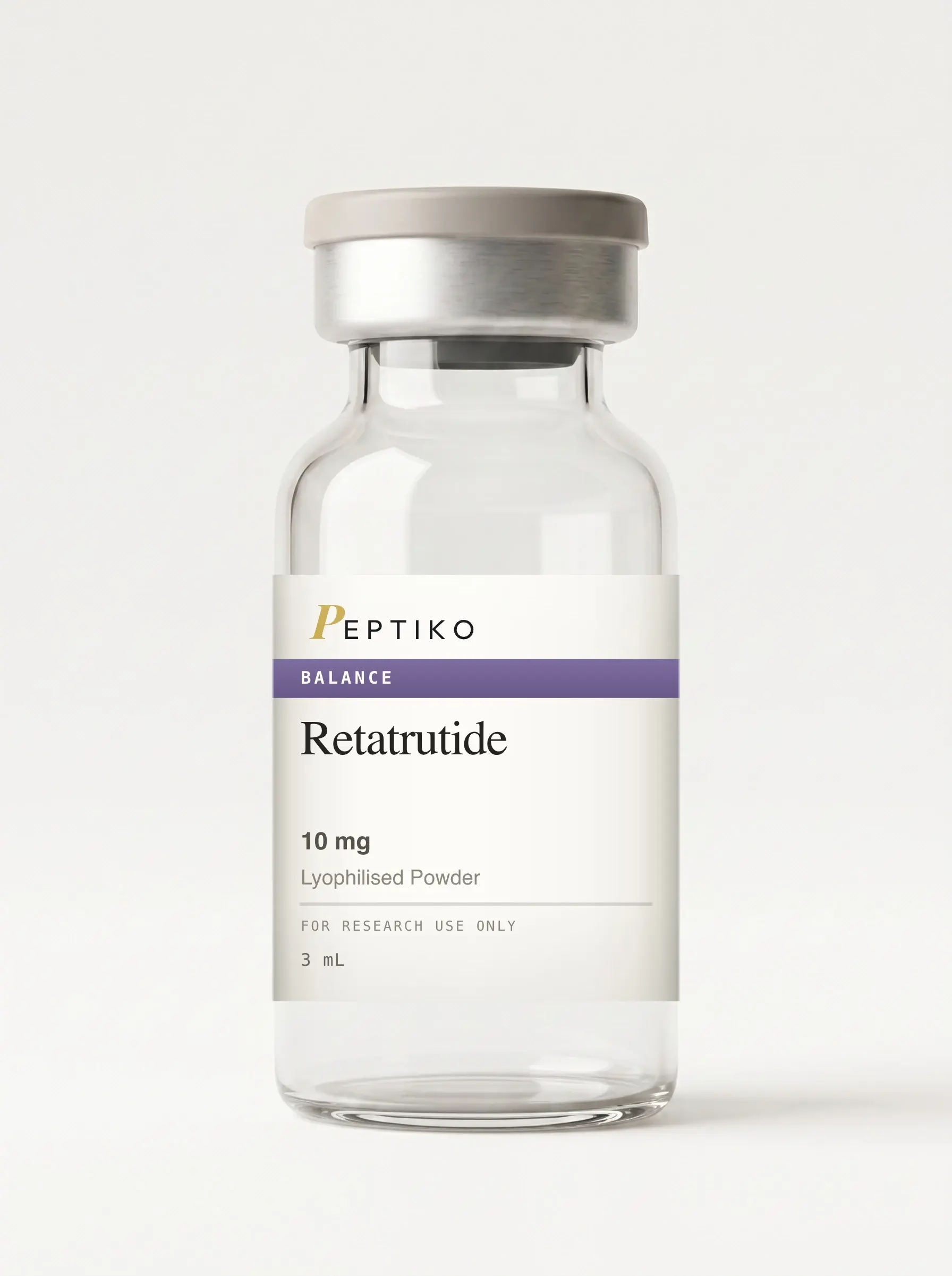
In short: retatrutide is a synthetic peptide that switches on three receptors with one molecule: GIP, GLP-1 and the glucagon receptor. It was developed by Eli Lilly under the code LY3437943 and is the first triple agonist of its kind. We supply retatrutide as a reagent for in-vitro laboratory research only.
Metabolic peptide research was long led by two compounds: semaglutide, which acts on one receptor (GLP-1), and tirzepatide, which acts on two (GLP-1 and GIP). Retatrutide is the next step: a third target added to those two. Below is what that means in plain terms.
A few words we cannot do without
- A peptide is a chain of amino acids, like a protein but shorter. Retatrutide has about 39 amino acids.
- A receptor is a protein on the surface of a cell that takes in a signal, like a lock that fits its own key.
- An agonist is a key molecule that switches a receptor on. A "triple agonist" switches on three different receptors.
- Incretins are gut hormones released after a meal that take part in regulating blood sugar. The main ones are GLP-1 and GIP. Glucagon is a related hormone made by the pancreas.
Three receptors: what each one does
Retatrutide is interesting because it touches three systems at once. In the body each of these receptors has its own role:
- The GLP-1 receptor (GLP-1R). Takes part in releasing insulin in response to blood sugar, holds back glucagon release, slows the emptying of the stomach and carries the signal of fullness.
- The GIP receptor (GIPR). Boosts insulin release, may act on fat tissue directly and takes part in the central, meaning brain-level, regulation of appetite.
- The glucagon receptor (GCGR). In fat tissue it is linked to heat production (thermogenesis) and the breakdown of fat (lipolysis); overall it raises the energy the body uses.
This describes how the receptors themselves work in the body. It does not describe what our reagent does: the vial holds a laboratory reagent for in-vitro experiments, not a medicine.
How it differs from tirzepatide
Tirzepatide switches on two receptors, GIP and GLP-1. Retatrutide switches on the same two and a third, the glucagon receptor. The glucagon arm is exactly what sets it apart from tirzepatide. On its own, glucagon raises blood sugar, the opposite of insulin. In retatrutide the GLP-1 and GIP arms hold that rise back, so what the glucagon arm adds, as the published work describes it, is mainly heat production and fat breakdown. A detailed comparison with a table is in "Retatrutide vs tirzepatide: the difference, plainly". All three generations, semaglutide included, are side by side in the article on semaglutide, tirzepatide and retatrutide.
What the published phase 2 trials showed
What is known about retatrutide rests on two phase 2 clinical trials published in 2023. Phase 2 is the stage at which a drug candidate is tested in hundreds of participants under medical supervision. Below are the figures from those papers, as the authors reported them.
- The obesity trial (Jastreboff et al., New England Journal of Medicine, 2023). In the highest-exposure group, body weight fell by 24.2% over 48 weeks. The primary endpoint, the main measure fixed in advance, was 17.5% at week 24. At the time it was the best result among published incretin compounds. The response grew with exposure across the four groups studied. Side effects were those typical of the GLP-1 class: mainly nausea and vomiting, mostly early on and passing.
- The type 2 diabetes trial (Rosenstock et al., The Lancet, 2023). In the highest-exposure group, over 36 weeks HbA1c fell by about 2.0% and body weight by about 17%. HbA1c is a measure of average blood sugar over the past few months.
These are results of clinical trials of a drug candidate in people. They do not apply to our reagent and are not a recommendation.
Phase 3: the TRIUMPH programme
The phase 3 registration programme is called TRIUMPH (trials TRIUMPH-1 to -5) and is ongoing. Phase 3 is the last stage before a filing for approval, larger and longer than phase 2. The 2023 phase 2 trials are separate from it. As of this update, no trial comparing retatrutide head to head with tirzepatide has been published. The rationale and design of the programme are described in their own paper (PMID 41090431).
How laboratories use retatrutide
In the laboratory, retatrutide serves as a reference agonist, a standard with a known profile. New molecules are compared against it in receptor-binding experiments, in cAMP and β-arrestin reporter assays, and in panels that put all three receptors in one system. cAMP is the signalling molecule a cell makes when a receptor is switched on; β-arrestin is the protein that later switches the receptor off. Retatrutide is useful wherever the contribution of the glucagon arm has to be separated from that of GLP-1 and GIP.
Typical open questions: how much the glucagon receptor adds to heat production on top of GLP-1 and GIP, and how switching on all three receptors changes the way the liver handles fat. These questions reach beyond metabolism, into research on fatty liver disease (MASH), cardiovascular risk and neurodegenerative models in which metabolism plays a part.
Our vial at a glance
| Parameter | Value |
|---|---|
| Research code | LY3437943 |
| CAS | 2381089-83-2 |
| Targets | GIP, GLP-1, glucagon (triple agonist) |
| Form | Lyophilised: a freeze-dried powder |
| Vial | 10 mg |
| Purity | ≥99% by HPLC-MS |
| Storing the dry vial | 2–8 °C in the dark; −20 °C for the long term |
Frequently asked questions
Is retatrutide a medicine?
No. As of this article retatrutide is a drug candidate in phase 3 trials. What we sell is a reagent for in-vitro laboratory research, not a medicine and not a supplement.
How does retatrutide differ from tirzepatide?
Tirzepatide switches on two receptors (GIP and GLP-1); retatrutide switches on three, adding the glucagon receptor.
Where do the figures in this article come from?
From the published phase 2 clinical trials: Jastreboff et al. (NEJM, 2023) and Rosenstock et al. (The Lancet, 2023). We only report them.
Do you advise on use?
No. Our retatrutide is a reagent for in-vitro laboratory research only, and we do not advise on use.
How to order
Price and availability are on the retatrutide page and in the block below this article. You can order on the site or through the Telegram bot. We deliver within Moldova in 1 business day and you pay the courier on delivery. Before delivery we call you to confirm the order.
Sources
- Jastreboff A. M. et al. Triple-Hormone-Receptor Agonist Retatrutide for Obesity — A Phase 2 Trial. N Engl J Med, 2023. PMID 37366315
- Rosenstock J. et al. Retatrutide, a GIP, GLP-1 and glucagon receptor agonist, for people with type 2 diabetes: a phase 2 trial. The Lancet, 2023.
- Retatrutide for the treatment of obesity, obstructive sleep apnea and knee osteoarthritis: Rationale and design of the TRIUMPH registrational clinical trials. Diabetes Obes Metab, 2026. PMID 41090431
For in-vitro research and laboratory use only. Not for human or animal consumption.