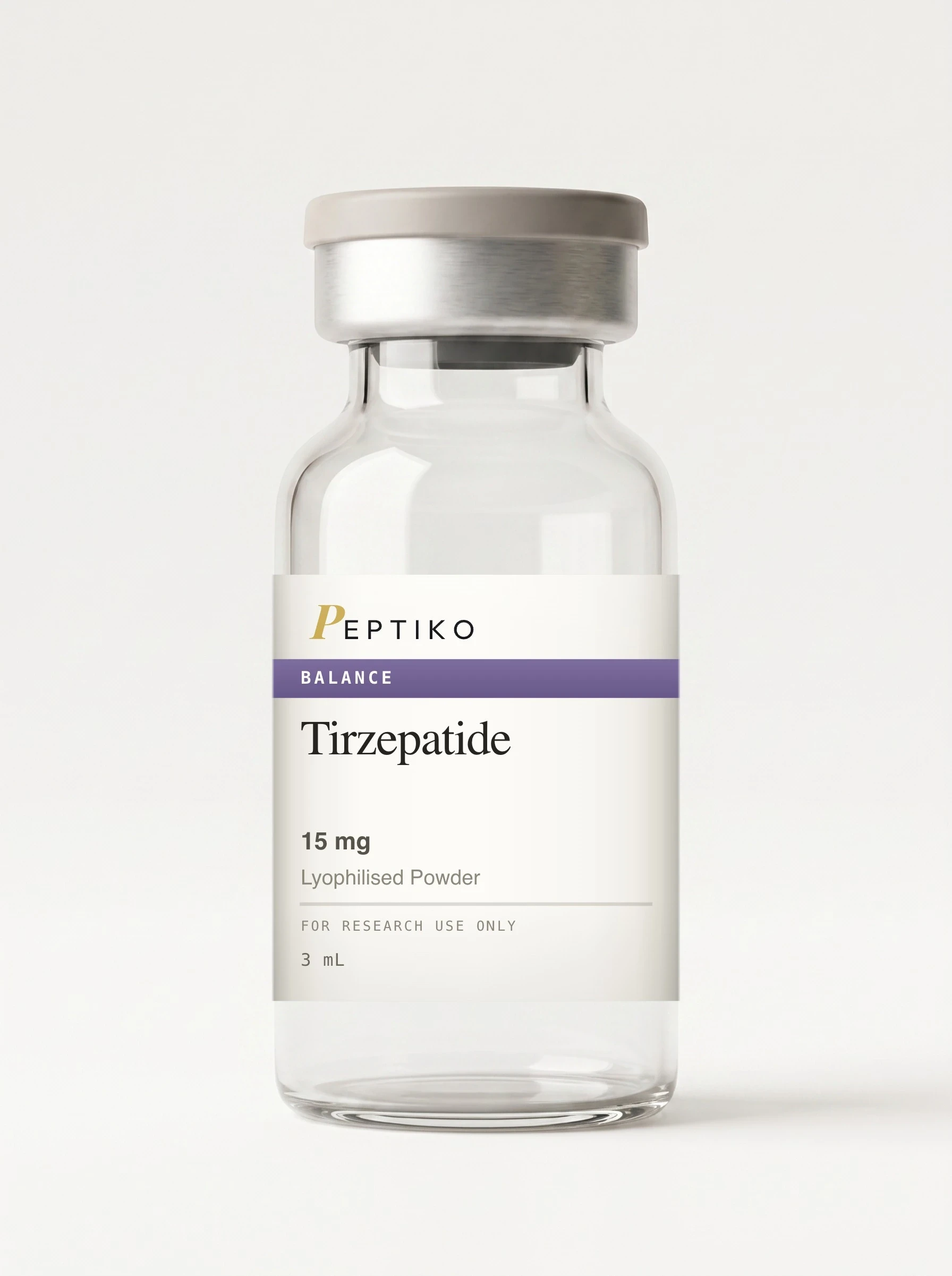
Tirzepatide
Dual GIP/GLP-1 receptor agonist peptide. Reference compound for in-vitro metabolic receptor-signalling research.
For in-vitro research and laboratory use only. Not for human or animal consumption.
- ≥99% purity by HPLC-MS · lot number on every vial
- Delivery in Moldova: 1 business day
- Cash to the courier on delivery
- + bacteriostatic water free with this order
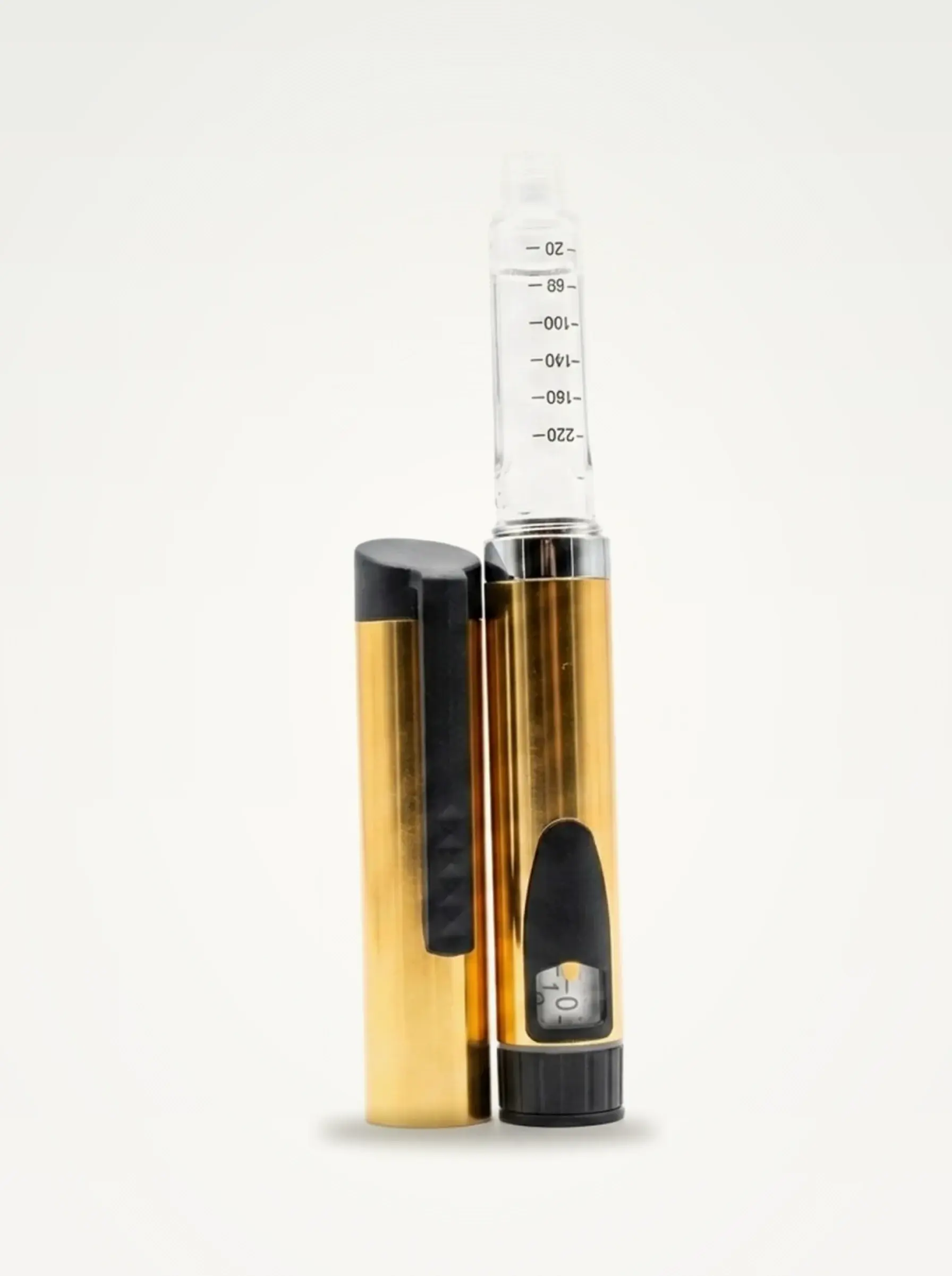 Injection Penreusable device · 800 lei
- Purity
- ≥99% HPLC-MS verified
- CAS
- 2023788-19-2
- Storage
- Lyophilised: 2–8 °C, protect from light (−20 °C for long-term, ≥24 months). Reconstituted: 2–8 °C.
- Formats
- 15mg vial
Courier delivery anywhere in Moldova. Lyophilized peptides travel at ambient temperature.
Tirzepatide in plain English: what the molecule is →Overview
Tirzepatide is a synthetic peptide that engages two incretin receptors at once — GIP and GLP-1. That dual-receptor profile is what distinguishes it from single-target GLP-1 analogues, and it makes the compound a common reference agonist in in-vitro metabolic receptor-signalling work.
Mechanism
Tirzepatide is a synthetic, laboratory-designed peptide of roughly 4.8 kDa (C225H348N48O68, CAS 2023788-19-2) built to act on two receptors of the incretin family at once rather than on one. Both targets — the GIP receptor and the GLP-1 receptor — are class-B G-protein-coupled receptors, related closely enough that a single engineered chain can satisfy both, and that is the point of the structure: one molecule carries two incretin signals where earlier analogues carried one. At each receptor the proximal step is Gs coupling — adenylate cyclase is activated and intracellular cAMP rises — and that rise is the readout when the compound is used as a reference agonist in cAMP-accumulation assays. Downstream the two receptors diverge: β-arrestin recruitment and receptor-internalisation kinetics differ between GIPR and GLP-1R, and differ again from what single-target GLP-1 agonists produce. It is that divergence, not the shared cAMP step, that makes the compound useful in receptor-selectivity and biased-signalling panels. One qualification belongs in the same paragraph: the papers cited below are clinical-endpoint studies measuring body weight, progression to type 2 diabetes and liver histology, not receptor occupancy, so the signalling account given here rests on the compound's pharmacological characterisation and not on the evidence summarised underneath it.
Molecular identity
- Formula
- C225H348N48O68
- Molecular weight
- 4813 g/mol
- CAS
- 2023788-19-2
- PubChem CID
- 166567236
What it acts on
- GLP-1 receptor (GLP-1R) — a class-B G-protein-coupled receptor; the cited literature characterises the compound as an agonist here, with Gs-coupled adenylate-cyclase activation and cAMP accumulation as the proximal readout.
- GIP receptor (GIPR) — the second incretin receptor engaged by the same chain; simultaneous occupancy of GIPR and GLP-1R is the property that separates the compound from single-target GLP-1 analogues in comparative panels.
- Gs–adenylate cyclase–cAMP axis — the shared downstream output of both receptors, and the signal measured in the cAMP-accumulation reporter assays that use this compound as a reference agonist.
- β-arrestin recruitment and receptor internalisation — reported to run with receptor-specific kinetics that also differ from those of single-target GLP-1 agonists, which is why the compound appears in biased-signalling and selectivity work rather than only in binding assays.
What the studies report
Each item below summarises the paper it is numbered to, written from that paper's own abstract. The badge says how the evidence was produced.
- 1.human studyN Engl J Med (2025)
SURMOUNT-1, a phase 3 double-blind randomised placebo-controlled trial, reported here at three years. Of 2539 participants with obesity, the 1032 who also had prediabetes were followed on three ascending dose arms or placebo to week 176, then through a 17-week off-treatment period. Mean weight change at week 176 ran from about -12% in the lowest-dose arm to about -20% in the highest, against -1.3% on placebo, and type 2 diabetes was diagnosed in 1.3% of treated participants versus 13.3% on placebo (hazard ratio 0.07). The reported endpoints are the trial's key secondary endpoints, the analysis covers only the prediabetes subgroup, and — apart from coronavirus disease 2019 — gastrointestinal events were the most common adverse events and clustered during dose escalation; the trial was funded by the manufacturer.
- 2.human studyN Engl J Med (2025)
SURMOUNT-5, a phase 3b head-to-head trial of tirzepatide against semaglutide in 751 adults with obesity but without type 2 diabetes, each compound given at its maximum tolerated level and assessed at week 72. Least-squares mean weight change was -20.2% versus -13.7%, and waist circumference -18.4 cm versus -13.0 cm, both favouring tirzepatide; participants in that group more often reached reductions of at least 10%, 15%, 20% and 25%. The design's own declared weakness is that it was open-label — neither participants nor investigators were blinded to which compound was given — and the trial was funded by Eli Lilly, which manufactures tirzepatide but not the comparator compound.
- 3.human studyN Engl J Med (2024)
SYNERGY-NASH, a phase 2 dose-finding, double-blind, placebo-controlled trial in 190 participants with biopsy-confirmed metabolic dysfunction-associated steatohepatitis and stage F2 or F3 fibrosis, assessed at week 52. Resolution of steatohepatitis without worsening of fibrosis was reached in 10% on placebo against 44% to 62% across the ascending dose arms; improvement of at least one fibrosis stage was 30% on placebo against 51% to 55%, with confidence intervals whose lower bounds fall to around one percentage point. Only 157 of the 190 participants had evaluable week-52 biopsies and the missing values were imputed on the assumption that they would follow the placebo pattern; the authors state directly that larger and longer trials are needed.
- 4.human studyJAMA (2024)
SURMOUNT-CN, a phase 3 randomised double-blind placebo-controlled trial at 29 centres in China in 210 adults with obesity, or with overweight plus at least one weight-related comorbidity, diabetes excluded; every arm also received a lifestyle intervention, with assessment at week 52. Mean weight change was -13.6% and -17.5% in the two dose arms against -2.3% on placebo, and 85.8% to 87.7% of treated participants reached a reduction of at least 5% against 29.3% on placebo. The trial is small by phase 3 standards, confined to one population and one year, and gastrointestinal events were again the most frequent treatment-emergent adverse events, with under 5% leading to treatment discontinuation.
Used in research on
What this does not establish
Every paper cited here is a human trial reporting clinical endpoints — body weight, progression to type 2 diabetes, liver histology — in supervised patient populations, and each of the three that names a funder names the manufacturer. None is a mechanistic study: this reference set contains no receptor-binding, cAMP or β-arrestin data at all, so the dual-agonist account of the signalling rests on characterisation published elsewhere rather than on the evidence above. The trials carry limits their own authors name: the head-to-head comparison was open-label, the steatohepatitis trial was phase 2 with 33 of its 190 week-52 biopsies missing and imputed, and the longest follow-up reports secondary endpoints in a single subgroup. Nothing in this literature concerns the behaviour of a research reagent in vitro, and none of it transfers to one.
Research applications
In vitro, tirzepatide is used as a reference agonist for studying the GIP and GLP-1 receptors together: cAMP-accumulation assays, beta-arrestin-recruitment reporters, receptor-binding studies, and receptor-selectivity panels that compare single- and dual-agonist profiles. It appears across incretin-signalling and metabolic-receptor research, where its dual-receptor profile serves as a benchmark against single-target GLP-1 analogues.
Reconstitution
Supplied lyophilised. For laboratory preparation, reconstitute with sterile bacteriostatic water to a working stock, keep the reconstituted solution at 4 degrees C, and prepare assay dilutions in the buffer specified by your protocol. For in-vitro research use only, not for human or animal administration.
Storage & handling
Lyophilised: 2–8 °C, protect from light (−20 °C for long-term, ≥24 months). Reconstituted: 2–8 °C.
Research literature
Selected peer-reviewed literature describing this compound. Peptiko supplies peptides for in-vitro research; these papers characterise the compound, not this product.
- 1.Tirzepatide for Obesity Treatment and Diabetes Prevention. N Engl J Med (2025)
- 2.Tirzepatide as Compared with Semaglutide for the Treatment of Obesity. N Engl J Med (2025)
- 3.Tirzepatide for Metabolic Dysfunction-Associated Steatohepatitis with Liver Fibrosis. N Engl J Med (2024)
- 4.Tirzepatide for Weight Reduction in Chinese Adults With Obesity: The SURMOUNT-CN Randomized Clinical Trial. JAMA (2024)
Frequently asked questions
What is Tirzepatide?
A synthetic dual-receptor agonist peptide that binds the GIP and GLP-1 incretin receptors, supplied as a lyophilised reagent for in-vitro laboratory research.
Is it for human use?
No. It is a research-use-only reagent for in-vitro laboratory study. It is not a pharmaceutical, supplement, or medicine, and not for human or veterinary use.
How is purity verified?
Purity is at least 99% by HPLC-MS.
What is the CAS number?
CAS 2023788-19-2.
Do you ship from Moldova?
Yes. We deliver by courier anywhere in Moldova, one business day after we confirm the order, and you pay the courier in cash. Lyophilized peptides travel at ambient temperature: a freeze-dried cake needs no cold chain.
Reviews
Be the first to review Tirzepatide.
Order on Telegram, or add it to the cart and check out on the site. Cash to the courier on delivery — nothing is paid in advance.