How to store peptides: fridge, freezer and solution
In short: keep the dry peptide vial in the fridge at 2–8 °C, in the dark; for the long term, in the freezer at −20 °C. Dissolve it at room temperature with bacteriostatic water run down the side of the vial, and do not shake it. Keep the finished solution in the fridge, and split it into portions before freezing.
Most results that cannot be repeated in peptide work come from one of two mistakes. The first: the vial was stored so that heat broke the peptide down. The second: during dissolving, microbes got into the solution or the peptide took an acidity "shock". Both mistakes are completely avoidable. Below is how to handle a vial so the peptide stays usable for its whole stated shelf life.
What a lyophilised powder is
Peptides are supplied lyophilised. That is a dry powder from which the water was removed by freeze-drying: the solution is frozen, then the ice is evaporated under vacuum. What remains at the bottom of the vial is a white "cake" or a loose powder. Dry, a peptide is far more stable than in solution. That is why a dry vial travels safely at ordinary temperature and needs no cold chain.
How to store a dry vial
Stored correctly, a dry vial stays stable for the whole period stated on its certificate of analysis. The rules are simple:
- Everyday storage: 2–8 °C, an ordinary fridge. For long-term storage, −20 °C or colder; a standard freezer will do.
- Be careful with frost-free freezers. They defrost themselves from time to time, and the temperature inside swings.
- For up to 30 days most peptides are fine in the fridge (2–8 °C). But if there is room in the freezer, −20 °C is better.
- What to avoid: direct light, moisture and moving the vial in and out of the cold often. Every spell at room temperature costs the peptide days of shelf life. Open the vial only next to a desiccant, a substance that soaks up moisture.
Which peptides are especially sensitive
Some amino acids oxidise easily, meaning oxygen spoils them: methionine, cysteine and tryptophan. Peptides containing them keep better under an inert gas, argon or nitrogen, where practical. Another sensitive group is peptides with disulfide bridges, internal "staples" between two sulfur atoms (AOD-9604, for example). They need strict temperature control to keep the bridge intact.
How to dissolve a peptide
Dissolving (scientifically: reconstitution) is the moment of highest contamination risk in a vial's life. The order that keeps the risk to a minimum:
- Let the vial and the solvent reach room temperature. Cold solvent on a cold powder dissolves it unevenly, and some spots get an acidity "shock" (pH stress).
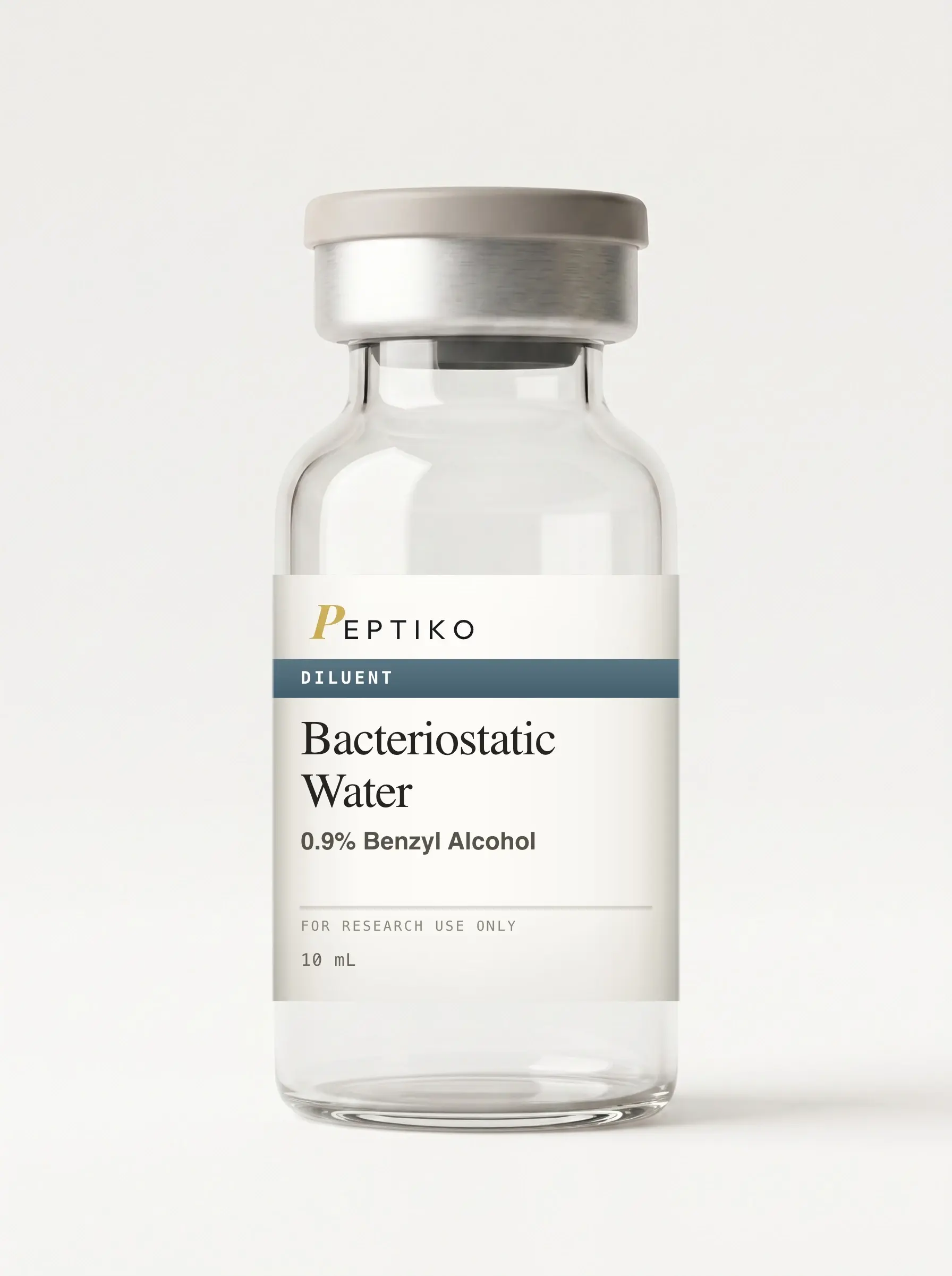
- Choose the solvent. If the solution will be kept longer than 7 days, use bacteriostatic water (BAC water): sterile water with 0.9% benzyl alcohol, which stops bacteria from multiplying. If everything happens the same day, sterile water without a preservative will do.
- Run the solvent down the side of the vial, not straight onto the cake. A direct stream can foam the peptide and some of it is lost.
- Swirl gently; do not shake. Shaking damages sensitive peptides and spreads them over the walls.
- Wait 60–120 seconds before drawing the solution. Most peptides dissolve fully in that time. If particles are still visible after 5 minutes, do not use the vial.
More about the water itself is in "Bacteriostatic water: what it is". The step-by-step walk-through with the maths is in the reconstitution guide.
How to work out the concentration
The vial is labelled with the mass of peptide, say 5 mg or 10 mg. The concentration of the solution depends on how much solvent you add. Concentration is how much substance there is in one millilitre:
| Mass in the vial | Solvent volume | Solution concentration |
|---|---|---|
| 5 mg | 1 mL | 5 mg/mL |
| 5 mg | 2 mL | 2.5 mg/mL |
| 10 mg | 2 mL | 5 mg/mL |
| 10 mg | 5 mL | 2 mg/mL |
When precision matters, allow for the water content stated on the certificate of analysis. A lyophilised powder always holds a little water. A vial labelled "5 mg" with 6% water contains 4.7 mg of peptide and 0.3 mg of bound water. For most purposes the error is negligible; for analytical chemistry it is not.
How long a finished solution keeps
- In the fridge (2–8 °C), made with bacteriostatic water: typically 30–60 days for most peptides. Those with methionine or cysteine sit nearer the lower end.
- In the freezer: most peptides survive one freeze and thaw. Repeated cycles break them down quickly. If the solution will be needed several times, split it into portions (aliquots) before freezing.
- At room temperature: no longer than the work session itself.
- Throw the solution away if it turns cloudy, shows particles or changes colour from clear or pale.
Clean technique
Even bacteriostatic water does not protect against every microbe. Wipe the vial's rubber stopper with isopropyl alcohol before each needle puncture, use a fresh needle every time, and keep the reconstituted vial upright with its cap intact. Contamination is the quiet variable that spoils every later assay.
The recommended solvent volume for each compound is given on its page in the catalogue.
Frequently asked questions
Should the dry vial go in the fridge as soon as it arrives?
Yes, that is best. Ordinary temperatures in transit do the powder no harm, but it should be stored at 2–8 °C, and at −20 °C for the long term.
Is a kitchen fridge good enough?
Yes, an ordinary fridge gives the 2–8 °C you need. Keep the vial in its box or somewhere dark, away from the door, where the temperature swings most.
Can a dissolved peptide be frozen?
Once, usually yes. To avoid thawing the whole solution several times, split it into portions beforehand.
Why is bacteriostatic water better than plain sterile water?
It contains 0.9% benzyl alcohol, which stops bacteria from multiplying. That is why a solution made with it can be stored and used more than once. Sterile water without a preservative is good for one day only.
How to order
All the compounds and the bacteriostatic water are in the catalogue. Bacteriostatic water comes free with peptides (one bottle per 1–3 vials) and is also sold on its own. You can order on the site or through the Telegram bot. We deliver within Moldova in 1 business day and you pay the courier on delivery. Before delivery we call you to confirm the order.
For in-vitro research and laboratory use only. Not for human or animal consumption.