KLOW in plain English: what one 80 mg vial holds
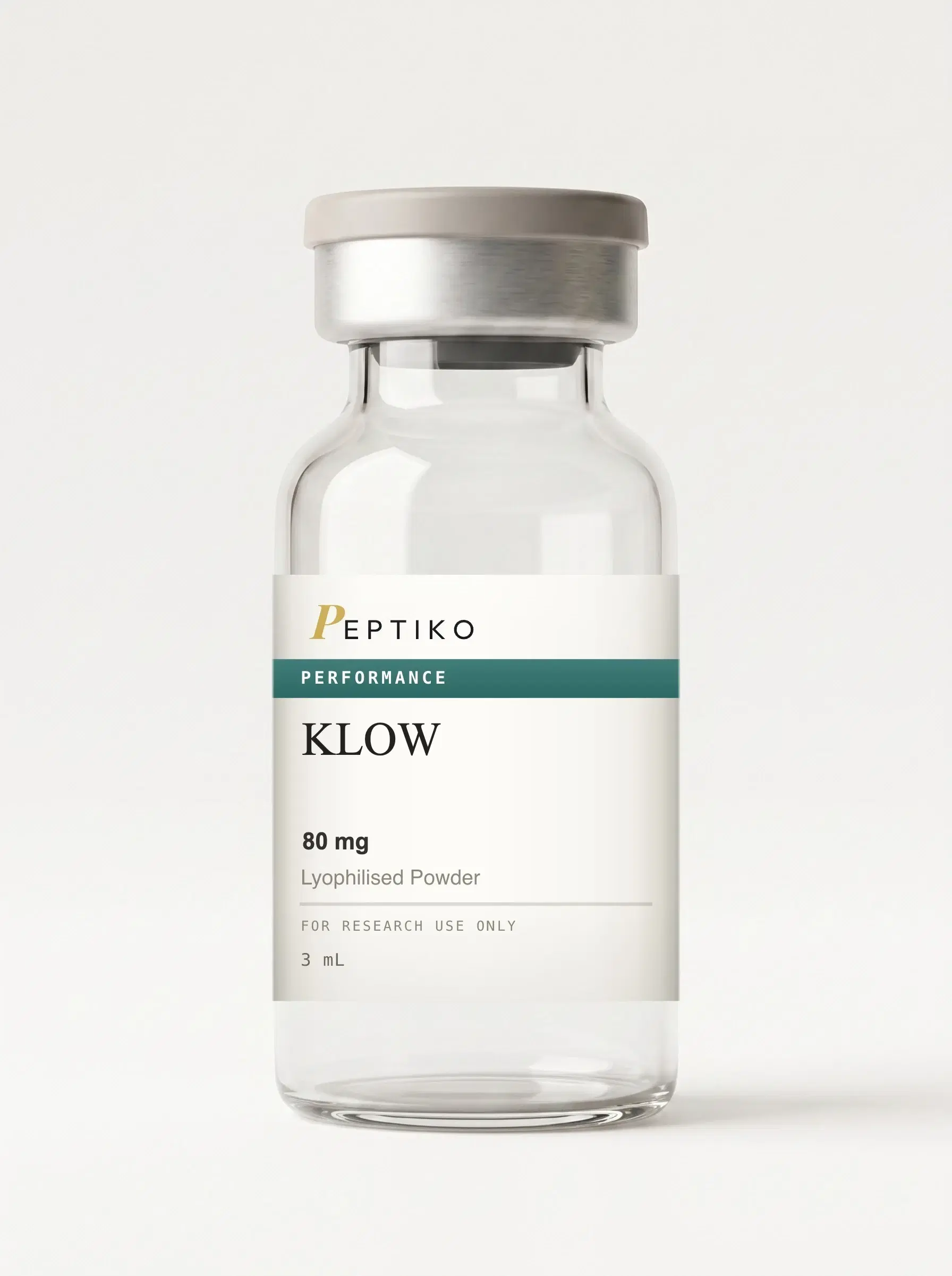
In short: KLOW is not one molecule but a blend of four peptides in a single vial: GHK-Cu 50 mg, BPC-157 10 mg, TB-500 10 mg and KPV 10 mg, 80 mg in all. Each part is studied in research on tissue repair and inflammation, and BPC-157 and TB-500 have also been studied together. We supply KLOW for in-vitro laboratory research only.
A few words you need first
- A peptide is a short chain of amino acids, the building blocks of proteins.
- Fibroblasts are connective-tissue cells that make collagen, the main protein of the scaffold of skin and tendons.
- Actin is the protein of the cell's inner skeleton. Its filaments are constantly built and taken apart, which is how a cell moves.
- NF-κB is a switch protein that turns on inflammation genes in a cell.
- Preclinical data are results from experiments on cells and animals; they do not carry over directly to people.
Why the parts of KLOW are researched
GHK-Cu: chronic wounds and skin
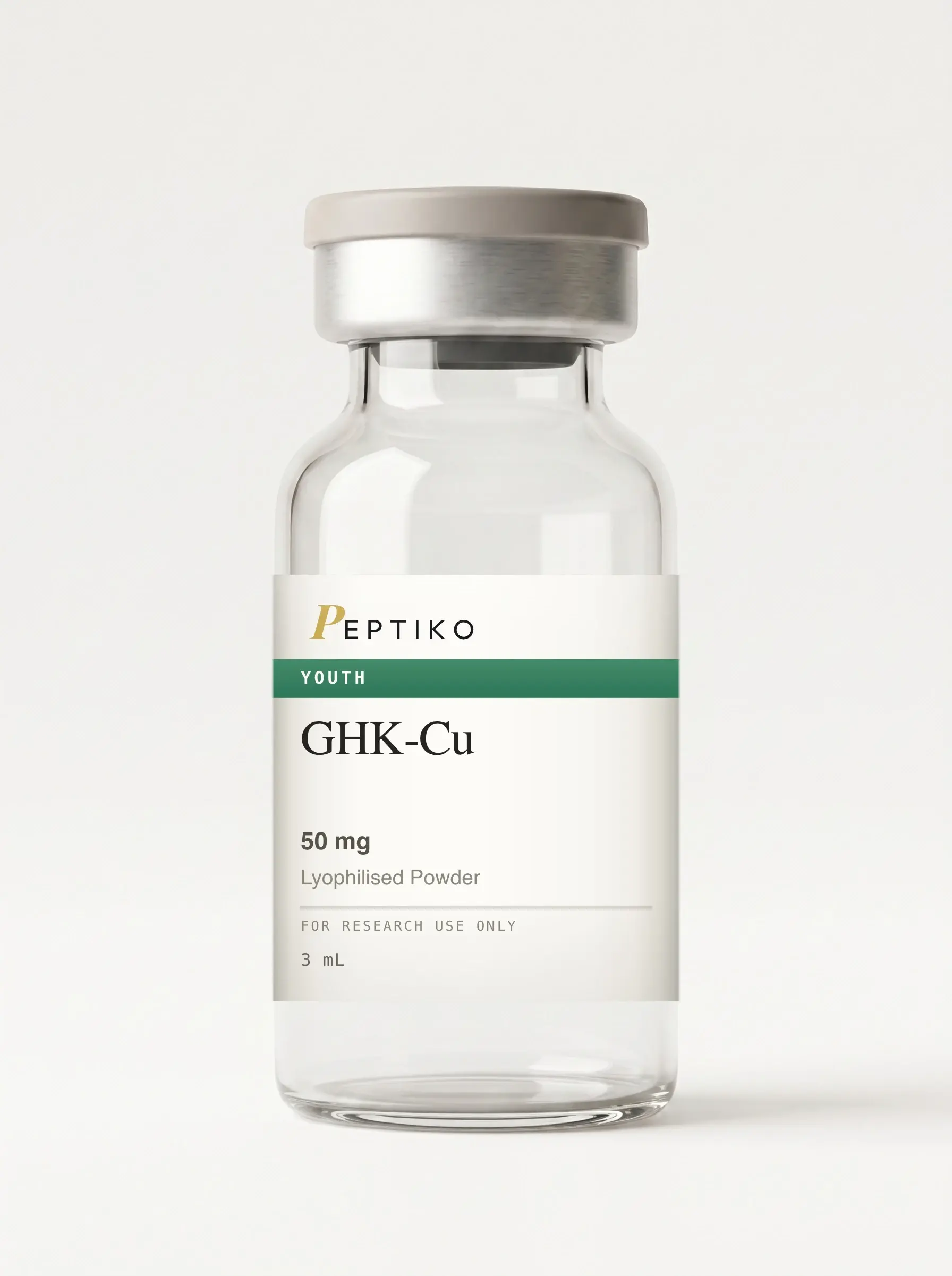
GHK is a tripeptide described in human serum in 1973 (PMID 4349963); GHK-Cu is its complex with a copper ion. Work on it is aimed at chronic wounds, such as diabetic foot ulcers, and at skin repair. In fibroblast cultures (1988) the complex stimulated collagen synthesis, most strongly at 10⁻⁹ mol/L (PMID 3169264). In rats (2003), a poorly perfused wound had shrunk by 64.5% by day 13, against 45.6% with the peptide-free base (PMID 14648529). In people, a multicentre randomised study (1994) in diabetic foot ulcers reported that the area of plantar ulcers shrank by a median of 98.5%, against 60.8% with the peptide-free base (PMID 17147644). GHK-Cu is not registered as a medicine. More in "GHK-Cu vs GHK: the copper peptide difference".
BPC-157: tendons, muscle, bone and the stomach
BPC-157 is a peptide of 15 amino acids that the literature describes as isolated from human gastric juice (PMID 40005999). Work on it is aimed at injuries of tendons, ligaments, muscle, bone and the lining of the stomach and gut. A 2025 systematic review gathered 36 studies, mostly preclinical: in animal models, the reviewers report, BPC-157 improved functional, structural and biomechanical outcomes in injuries of muscle, tendon, ligament and bone (PMID 40756949). Another 2025 review finds the first three pilot studies in people, none of which reported adverse effects (PMID 40789979): 11 of 12 patients who had BPC-157 alone reported in a phone survey that their knee pain had eased markedly (34324435), 10 of 12 women with interstitial cystitis reported that their symptoms had gone completely (39325560), and in two healthy adults, heart, liver, kidney and thyroid markers and blood glucose did not change (40131143). BPC-157 is not yet approved as a medicine (PMID 40005999). More in "BPC-157: what this peptide is and what is known".
TB-500: blood vessels, wounds, cornea, tendons
TB-500 is a synthetic peptide of seven amino acids, Ac-LKKTETQ. It is residues 17–23 of thymosin beta-4, a protein of 43 amino acids: the very stretch the protein uses to bind actin. In 2012 this molecule was identified in the product sold as TB-500 and synthesised (PMID 22962027). Work on it is aimed at the growth of blood vessels, wound healing and tissue repair. In 2003 researchers showed that the protein's ability to grow blood vessels depends on this very stretch: in tests of how the cells lining blood vessels move, the fragment acted almost exactly like the whole protein, while peptides without it were inactive (PMID 14500546). In aged, 26-month-old mice the same chain, LKKTETQ, sped up the healing of skin wounds comparably to the whole protein (PMID 12581423). In human liver stellate cells, which make scar tissue in fibrosis, residues 17–23 held back the cells' activation, collagen output, division and migration (PMID 30063851). In 2025 a hydrogel carrying TB-500 boosted the migration and division of human corneal cells, and in a model of an alkali burn of the cornea it sped up the regrowth of its surface layer and reduced inflammation (PMID 41359360). In rats whose Achilles tendon had been cut and repaired (2026), TB-500 made the tendon significantly stronger and better structured (PMID 42542926). A 2024 study mapped what TB-500 breaks down into: neither it nor its breakdown products were toxic to fibroblasts, and one of them, Ac-LKKTE, sped up healing in a wound model (PMID 38382158). The parent protein, thymosin beta-4, has reached a phase 3 trial: in neurotrophic keratopathy, a persistent corneal defect closed completely within 4 weeks in 6 of 10 patients against 1 of 8 on placebo (PMID 36613994). TB-500 is not approved as a medicine.
KPV: gut inflammation
KPV is the tail end of alpha-melanocyte-stimulating hormone (α-MSH): its last three amino acids, lysine, proline and valine. It is studied in models of inflammatory bowel disease, the group that includes ulcerative colitis and Crohn's disease. KPV enters human gut epithelial cells and T cells through the PepT1 transporter; in these cells, at nanomolar concentrations, it blocked the NF-κB and MAP kinase signalling pathways and cut the release of inflammatory cytokines, and in mice it reduced chemically induced colitis (PMID 18061177). A 2010 review notes that KPV lacks the stretch needed to bind any known melanocortin receptor yet keeps almost all of the hormone's anti-inflammatory activity, without the hormone's effect on pigmentation (PMID 21222263). In a 2008 study, its protective effect in colitis held even in mice whose melanocortin receptor MC1R did not work (PMID 18092346). For now KPV is studied in cells and animals.
All of this is research on separate molecules, as the authors reported it, mostly in cells and animals; animal data do not carry over directly to people. These results do not describe our reagent and are not a recommendation.
What is in one vial
| Part | In the vial | Chain length | Molecular mass | CAS |
|---|---|---|---|---|
| GHK-Cu | 50 mg | 3 amino acids and a copper ion | 402.9 Da | 89030-95-5 |
| BPC-157 | 10 mg | 15 amino acids | 1419.5 Da | 137525-51-0 |
| TB-500 | 10 mg | 7 amino acids | 889.0 Da | 885340-08-9 |
| KPV | 10 mg | 3 amino acids | 342.4 Da | 67727-97-3 |
| Total | 80 mg | — | — | — |
The dalton (Da) is the unit of molecular mass; CAS is the substance's number in the international chemical registry.
What is known about the blend itself
KLOW is a market name, not a scientific term. All four parts are studied in the same field, tissue repair and inflammation, and BPC-157 and TB-500 have also been studied as a pair. In a 2026 experiment in 32 rats whose Achilles tendon had been cut and repaired, both peptides, the authors conclude, improved the structure of the healing tendon, and TB-500 also made it significantly stronger; in the group given both together, the tendon structure was significantly better than in controls too (PMID 42542926). Everything published so far concerns the parts of KLOW and this pair. How BPC-157 and TB-500 differ is covered in "BPC-157 vs TB-500: how the two peptides differ".
A blend called GLOW is sold too: sellers use the name for the same parts without KPV, that is GHK-Cu, BPC-157 and TB-500. KLOW is GLOW plus KPV. Both are market names that no standard fixes, and proportions differ from seller to seller, so compare the milligrams of each part.
How to store the vial
KLOW is a lyophilisate, a freeze-dried powder. Keep the dry vial in the dark at 2–8 °C (an ordinary fridge), or at −20 °C for the long term. Once dissolved, keep the solution at 2–8 °C for no more than two weeks. Ordinary temperatures in transit do the dry vial no harm. The details are in the peptide storage guide.
Frequently asked questions
What is in KLOW?
GHK-Cu 50 mg, BPC-157 10 mg, TB-500 10 mg and KPV 10 mg in one 80 mg vial. Right now TB-500 and KPV are available from us only as part of KLOW.
How does KLOW differ from GLOW?
By one part: GLOW is the market name for a blend of GHK-Cu, BPC-157 and TB-500, and KLOW adds KPV, which is studied in models of gut inflammation.
What is known about combining the parts of KLOW?
Each part is studied in research on tissue repair and inflammation, and BPC-157 and TB-500 have also been studied as a pair: in rats whose Achilles tendon had been repaired, both peptides, alone and together, improved its structure (PMID 42542926).
Do you advise on use?
No. KLOW is a reagent for in-vitro laboratory research only, and we do not advise on use.
How to order
The current price and availability are on the KLOW page and in the block below this article. GHK-Cu is also sold as a vial of its own, on the GHK-Cu page; if it has run out, you can sign up there to hear when it is back. You can order on the site or through the Telegram bot. We deliver within Moldova in 1 business day, you pay the courier on delivery, and delivery is free from 1000 lei. Before delivery we call you to confirm the order. Bacteriostatic water comes free with peptides: one bottle per 1–3 vials.
Sources
- Stimulation of collagen synthesis in fibroblast cultures by the tripeptide-copper complex glycyl-L-histidyl-L-lysine-Cu2+. FEBS Lett, 1988. PMID 3169264
- Effects of BPC-157 and TB-500 on Achilles tendon healing in rats: A histopathological and biomechanical study. Jt Dis Relat Surg, 2026. PMID 42542926
- PepT1-mediated tripeptide KPV uptake reduces intestinal inflammation. Gastroenterology, 2008. PMID 18061177
For in-vitro research and laboratory use only. Not for human or animal consumption.