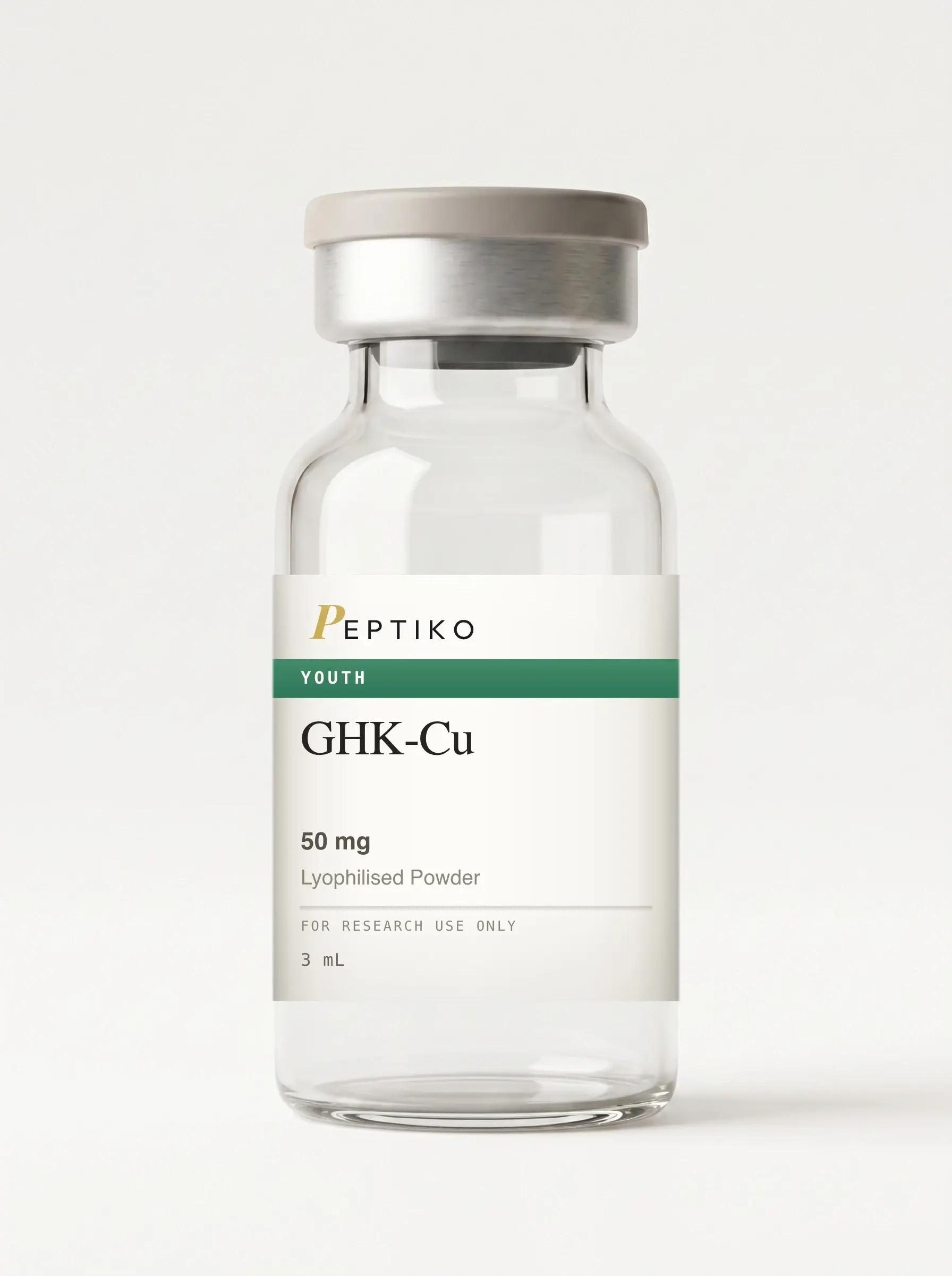
GHK-Cu vs GHK: the copper peptide difference
TL;DR: GHK-Cu is a naturally occurring copper-binding tripeptide (Gly-His-Lys) complexed with Cu(II). First isolated from human plasma, it is studied in collagen-synthesis, extracellular-matrix remodelling and dermatological-research models. Supplied as a research reagent for in-vitro laboratory use only.
GHK-Cu (CAS 89030-95-5) is the copper(II) complex of the tripeptide glycyl-L-histidyl-L-lysine — GHK for short (free-peptide CAS 49557-75-7). It was first reported by Loren Pickart in 1973 as a factor in human plasma that influenced how liver tissue behaved in culture, and it has since become one of the most-studied short peptides in the matrix-biology and dermatological-research literature. In the laboratory it is handled purely as a research compound.
What is GHK-Cu?
GHK is a three-residue sequence — glycine, histidine, lysine — that occurs naturally in human plasma, saliva and urine. The literature reports that its plasma concentration is highest in early adulthood and declines with age, one reason it has attracted interest as a signalling molecule in tissue-remodelling research. On its own the bare tripeptide is only part of the story: its characteristic activity in cell studies is tied to its ability to bind copper.
Why does the copper complex matter?
GHK has an unusually high affinity for copper(II). The histidine imidazole nitrogen, the terminal α-amino group of glycine and a deprotonated backbone amide nitrogen coordinate the Cu(II) ion in a roughly square-planar geometry, giving the complex its characteristic blue tint. This is not incidental — much of the reported activity in collagen and antioxidant models is attributed to the copper-bound form rather than the free peptide, because GHK-Cu is thought to act partly as a physiological carrier that shuttles copper to and from cells. Copper itself is a cofactor for enzymes such as lysyl oxidase (collagen cross-linking) and superoxide dismutase (antioxidant defence), which places the complex at the intersection of several studied pathways.
| Property | GHK-Cu |
|---|---|
| Origin | Naturally occurring; first isolated from human plasma (Pickart, 1973) |
| Sequence | Gly-His-Lys (glycyl-L-histidyl-L-lysine) |
| CAS (copper complex) | 89030-95-5 |
| CAS (free peptide, GHK) | 49557-75-7 |
| Molecular formula (GHK) | C14H24N6O4 · 340.4 Da (free tripeptide) |
| Metal centre | Cu(II), coordinated via His imidazole, Gly α-amino and a backbone amide N |
| Studied mechanisms | Collagen/elastin synthesis, ECM remodelling (MMP/TIMP), antioxidant, wound-repair signalling |
| Purity standard | ≥99% HPLC-MS verified |
What pathways has GHK-Cu been studied in?
In cell and preclinical models — not in humans — GHK-Cu has been associated with a broad set of tissue-remodelling readouts. Reported observations in the literature include:
- Increased expression of collagen (types I and III), elastin and proteoglycans such as decorin in cultured fibroblasts.
- Modulation of matrix metalloproteinases (MMPs) and their inhibitors (TIMPs), a balance central to extracellular-matrix turnover.
- Antioxidant activity, including associations with superoxide-dismutase pathways and reduced oxidative markers in model systems.
- Anti-inflammatory signalling and modulation of wound-repair and angiogenesis markers (e.g. VEGF) in dermatological-research and matrix-biology models.
- Broad gene-expression modulation — transcriptome studies have reported GHK influencing the expression of thousands of genes in cultured cells.
These are research findings in defined model systems and carry no therapeutic, diagnostic or human-use meaning.
GHK vs GHK-Cu: what's the difference?
The two terms are often used loosely. GHK is the free tripeptide; GHK-Cu is the same peptide complexed with a copper(II) ion at roughly 1:1 stoichiometry. Because copper is central to the mechanisms above, most published dermatological and matrix-biology work uses the copper complex specifically, and a reagent labelled simply "GHK" may or may not be pre-complexed. For reproducible research it matters which form you hold, and the copper content should be stated on the certificate of analysis.
Purity, copper stoichiometry and COA
GHK-Cu should be supplied at ≥99% HPLC-MS verified purity. Two quality parameters are specific to this compound: the copper-to-peptide ratio (the complex should be stoichiometric, not carrying a large excess of free copper) and the absence of truncated or des-amino peptide impurities from incomplete synthesis. The characteristic royal-blue colour of a correctly formed complex is a useful visual cue but is not a substitute for analytical data. If a working stock is prepared, it should be a single in-vitro reconstitution into an appropriate solvent, following your institutional protocol.
Every batch of GHK-Cu in the Peptiko catalogue is ≥99% HPLC-MS verified. We do not currently issue a third-party certificate of analysis, and would rather say so than imply one.
Researchers working on complementary tissue-remodelling and repair-signalling models often also reference BPC-157 and CJC-1295.
For in-vitro research and laboratory use only. Not for human or animal consumption.