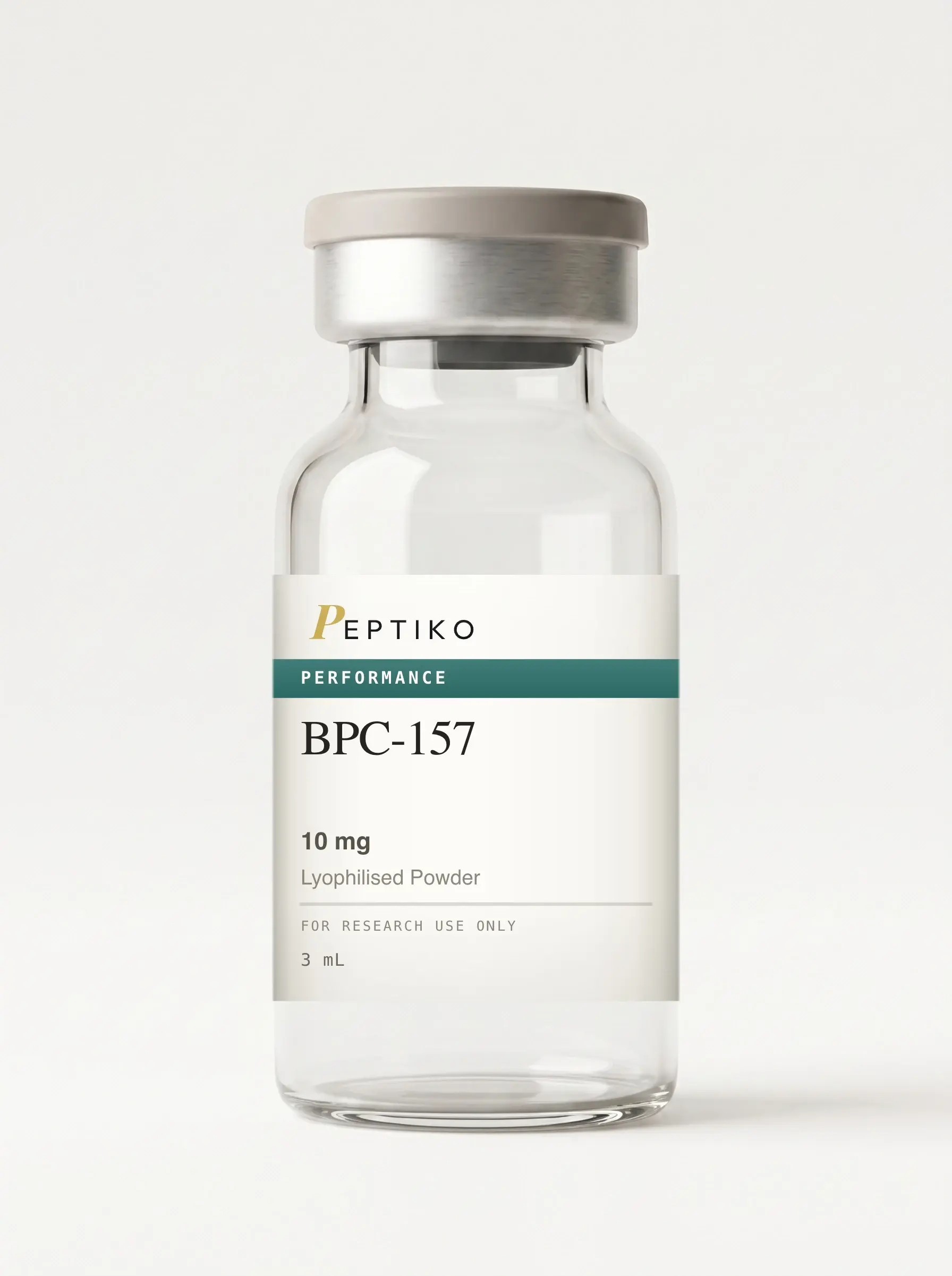
BPC-157: what this peptide is and what is known
What Is BPC-157?
BPC-157 (Body Protection Compound 157) is a synthetic pentadecapeptide consisting of 15 amino acids. Its sequence — Gly-Glu-Pro-Pro-Pro-Gly-Lys-Pro-Ala-Asp-Asp-Ala-Gly-Leu-Val — is derived from a partial sequence of a protective protein naturally present in human gastric juice. First identified and characterized by researchers at the University of Zagreb in the early 1990s, BPC-157 has since become one of the most extensively studied peptides in regenerative and gastrointestinal research.
Unlike many research peptides that are analogues of endogenous hormones, BPC-157 is classified as a gastric pentadecapeptide. It is stable in gastric juice — a property that distinguishes it from most peptides, which are rapidly degraded in acidic environments. This stability has made it a subject of particular interest in gastrointestinal tract research models.
Research Use Only. BPC-157 is not an approved drug and is not intended for human or animal use. All information presented in this guide is drawn from published pre-clinical research and is intended for educational and in vitro laboratory research purposes only.
Research Background and Published Studies
The body of published research on BPC-157 spans more than three decades and includes hundreds of peer-reviewed papers, primarily originating from the laboratory of Professor Predrag Sikiric at the University of Zagreb, Department of Pharmacology. While the majority of this work has been conducted in rodent models and in vitro systems, the breadth of tissue types and injury models examined is notable.
Tendon and Ligament Repair
Some of the earliest and most replicated BPC-157 research focused on tendon healing. Studies have examined the Achilles tendon transection model in rats, reporting accelerated tendon-to-bone healing and improved biomechanical properties of repaired tissue. The peptide has been observed to promote fibroblast outgrowth and the formation of organized collagen fibres in tendon explant cultures. Research in medial collateral ligament (MCL) injury models has demonstrated similar findings, with treated tissue showing improved structural integrity compared to controls.
Muscle Tissue Research
BPC-157 has been studied in crush injury and transection models of skeletal muscle. Published findings include accelerated restoration of muscle function, reduced formation of fibrotic scar tissue, and increased angiogenesis within the injury site. Research in the quadriceps muscle crush model demonstrated improved muscle fibre continuity and reduced inflammatory infiltrate in treated groups.
Gastrointestinal Tract
Given its gastric origin, BPC-157 has been extensively investigated in gastrointestinal injury models. Research areas include ethanol-induced gastric lesions, NSAID-induced mucosal damage, inflammatory bowel disease models (both ulcerative colitis and Crohn's analogues), esophageal and intestinal anastomosis healing, and short bowel syndrome models. The peptide has demonstrated cytoprotective properties across these models, with researchers noting accelerated mucosal healing and reduced inflammatory markers.
Angiogenesis
Multiple studies have documented BPC-157's pro-angiogenic properties. In the chicken chorioallantoic membrane (CAM) assay — a standard model for evaluating angiogenic potential — BPC-157 significantly increased new vessel formation. This angiogenic activity is considered central to its observed effects across tissue types, as enhanced blood supply is a prerequisite for effective tissue repair in most systems.
Bone and Joint Research
Preclinical research has explored BPC-157 in the context of bone fracture healing, segmental bone defects, and osteogenic differentiation. Published findings include accelerated callus formation and improved bone mineral density at fracture sites. Research in pseudoarthrosis models has also yielded positive results. In adjuvant arthritis models, BPC-157 demonstrated anti-inflammatory effects and reduced joint destruction.
Mechanism of Action
BPC-157 does not appear to operate through a single receptor-ligand mechanism. Instead, its effects are mediated through the modulation of multiple signalling pathways and growth factor systems. This multi-target activity is consistent with the broad range of tissue types in which it has demonstrated effects.
Growth Factor Modulation
Research indicates that BPC-157 upregulates the expression of growth hormone receptors in tendon fibroblasts and other cell types. It has been shown to increase the expression and activity of several key growth factors, including VEGF (vascular endothelial growth factor), FGF-2 (fibroblast growth factor 2), and EGF (epidermal growth factor). This upregulation of angiogenic and mitogenic growth factors is considered a primary driver of its regenerative profile.
Nitric Oxide System
BPC-157 interacts with the nitric oxide (NO) system in a modulatory manner. Research has demonstrated that it can counteract both NO-synthase blockade (L-NAME-induced hypertension) and excessive NO states (L-arginine-induced hypotension) in experimental models. This bidirectional modulation of the NO system is unusual among peptides and suggests BPC-157 may act as a homeostatic regulator of NO-mediated signalling rather than a simple agonist or antagonist.
FAK-Paxillin Pathway
A significant area of mechanistic research involves the focal adhesion kinase (FAK) and paxillin pathway. BPC-157 has been shown to promote the phosphorylation of FAK and its downstream target paxillin in tendon fibroblasts. The FAK-paxillin signalling cascade is critical for cell adhesion, migration, and survival — processes fundamental to tissue repair. Activation of this pathway promotes fibroblast migration into wound sites and enhances the formation of new extracellular matrix.
Dopaminergic and Serotonergic Systems
BPC-157 research extends into neurotransmitter system interactions. Published studies have documented modulatory effects on both the dopamine and serotonin systems. In dopamine-depleted models, BPC-157 demonstrated protective effects on dopaminergic neurons. These findings have led to research exploring its potential relevance to nerve injury and neuroprotection research models.
Disclaimer: The mechanisms described above are drawn from published pre-clinical research (primarily rodent models and in vitro systems). These findings have not been confirmed in human clinical trials. This information is provided for research and educational purposes only.
Compound Specifications
| Full Name | Body Protection Compound 157 |
|---|---|
| CAS Number | 137525-51-0 |
| Sequence | Gly-Glu-Pro-Pro-Pro-Gly-Lys-Pro-Ala-Asp-Asp-Ala-Gly-Leu-Val |
| Molecular Weight | 1419.53 g/mol |
| Molecular Formula | C62H98N16O22 |
| Form | Lyophilised powder (white to off-white) |
| Purity | ≥99% (HPLC-verified) |
| Solubility | Soluble in water, bacteriostatic water, sterile saline |
What the Published Literature Covers
Everything summarised above sits at the pre-clinical stage. The BPC-157 corpus is built on rodent models and cell-culture systems, and there is no controlled human clinical literature to weigh it against. For a researcher deciding whether the compound is worth bench time, the shape of that corpus is more informative than any single headline result.
Three structural features make the published work difficult to compare paper to paper:
- Heterogeneous models. Achilles transection, gastric lesion, colitis, fracture and CAM assays each answer a different question. A result in one model tells you very little about another.
- Varying endpoints. One paper scores histology, the next measures tensile strength, a third reports biomarker panels. Without a shared endpoint there is no common scale on which to rank the findings.
- Concentrated authorship. A large share of the corpus traces back to a small number of research groups, and independent replication outside those groups is thinner than the total citation count suggests.
Group sizes are frequently small, and null results are under-represented in the way they are across most pre-clinical literature. Taken together, this means the BPC-157 literature reads better as a set of exploratory signals than as a settled body of evidence, and any claim built on it should be qualified accordingly.
Gastric Stability
One physicochemical property recurs throughout the literature and is genuinely relevant to laboratory handling: BPC-157 is reported to remain stable in human gastric juice, which is uncommon for a peptide of this length. That stability is a property of the molecule itself rather than a claim about what it does in any system, and it is the characteristic most often cited as distinguishing BPC-157 from other fragments derived from gastric juice.
This guide deliberately does not reproduce study parameters. Researchers designing work with BPC-157 should read the primary literature directly (PubMed indexes the corpus under CAS 137525-51-0) and work within their own institutional review and regulatory framework.
Reconstitution
BPC-157 is supplied as a lyophilised (freeze-dried) powder and must be reconstituted with an appropriate solvent before use in research applications.
Recommended Solvents
- Bacteriostatic water (BAC water): Sterile water containing 0.9% benzyl alcohol as a preservative. The preservative inhibits microbial growth in reconstituted working solutions held for in-vitro research; store and aliquot per your institutional protocol.
- Sterile water for injection: Suitable for single-use or same-day applications. Contains no preservative, so reconstituted solutions should be used promptly.
Reconstitution Procedure
- Allow the lyophilised vial to reach room temperature before opening (approximately 15–20 minutes). This prevents condensation from contacting the powder.
- Using a sterile syringe, draw the desired volume of BAC water or sterile water.
- Insert the needle through the vial stopper and direct the water stream against the glass wall of the vial — not directly onto the powder cake.
- Allow the water to flow gently down the side of the vial. Do not shake or vortex.
- Gently swirl the vial until the powder is fully dissolved. The solution should be clear and colourless.
For precise concentration calculations, use the Peptiko Reconstitution Calculator to determine the exact volume of solvent needed for your target concentration.
Storage and Handling
Lyophilised (Unreconstituted) Powder
- Temperature: Store at −20°C for long-term storage (up to 24–36 months). Short-term storage at 2–8°C (refrigerated) is acceptable for periods up to 3 months.
- Light: Protect from direct light. UV radiation can degrade peptide bonds. Store in the original opaque container or wrap vials in aluminium foil.
- Moisture: Keep sealed and dry. Store with silica desiccant packets. Allow vials to equilibrate to room temperature before opening to prevent condensation.
Reconstituted Solution
- Temperature: Refrigerate at 2–8°C. Do not freeze reconstituted solutions, as freeze-thaw cycles can cause peptide aggregation and loss of activity.
- Shelf life: Approximately 28 days in BAC water when stored at 2–8°C. Solutions prepared with sterile water (no preservative) should be used within 24–48 hours or aliquoted and frozen.
- Handling: Use sterile technique when preparing and aliquoting reconstituted working solutions for in-vitro research.
Storage Note: Peptide stability is highly temperature-dependent. Consistent storage conditions are more important than achieving the lowest possible temperature. Avoid storing vials in freezer doors where temperature fluctuates with opening.
Purity Considerations
Purity is a critical factor in research peptide sourcing. Impurities — including truncated sequences, deletion peptides, racemized amino acids, and residual solvents — can introduce confounding variables into research outcomes.
HPLC Verification
High-Performance Liquid Chromatography (HPLC) is the standard analytical method for determining peptide purity. A research-grade BPC-157 preparation should demonstrate ≥99% purity by HPLC, with the chromatogram showing a single dominant peak at the expected retention time. The remaining <1% should consist only of minor process-related impurities, not structurally related compounds that could exhibit biological activity.
Mass Spectrometry Confirmation
HPLC alone confirms purity but not identity. Mass spectrometry (MS) must be used to verify that the molecular weight of the compound matches the theoretical mass of BPC-157 (1419.53 g/mol). The combination of HPLC purity and MS identity confirmation constitutes a complete Certificate of Analysis (COA).
What to Look For in a COA
- Purity ≥99% by HPLC with a clear, single-peak chromatogram
- Observed molecular weight matching theoretical (±0.1 Da)
- Batch/lot number traceable to your specific vial
- Testing performed by an accredited third-party laboratory (not in-house)
- Test date within the last 12 months
All Peptiko BPC-157 is HPLC-MS verified. We do not currently issue a third-party certificate of analysis, and would rather say so than imply one. Questions about a specific vial can go to info@peptiko.md.
Safety Profile in Published Research
Published toxicology studies in rodent models have reported no observed adverse effects at doses substantially exceeding those used in efficacy studies. LD50 has not been established, as no lethal dose was reached in standard acute toxicity protocols. No organ toxicity, mutagenicity, or carcinogenicity signals have been reported in the published literature.
It is important to note that these safety findings are limited to pre-clinical animal models. No controlled human safety data exists in the peer-reviewed literature. Researchers should exercise appropriate caution and follow all institutional safety protocols when handling research peptides.
RESEARCH USE ONLY. BPC-157 is sold exclusively for in vitro research and laboratory use. It is not an approved drug, dietary supplement, or food additive. It is not intended for human or animal consumption, diagnosis, or therapeutic application. Researchers are responsible for compliance with all applicable laws and institutional regulations.
BPC-157 at Peptiko
HPLC-verified, ≥99% purity. Delivered across Moldova in 1 business day.
View CatalogFor in-vitro research and laboratory use only. Not for human or animal consumption.