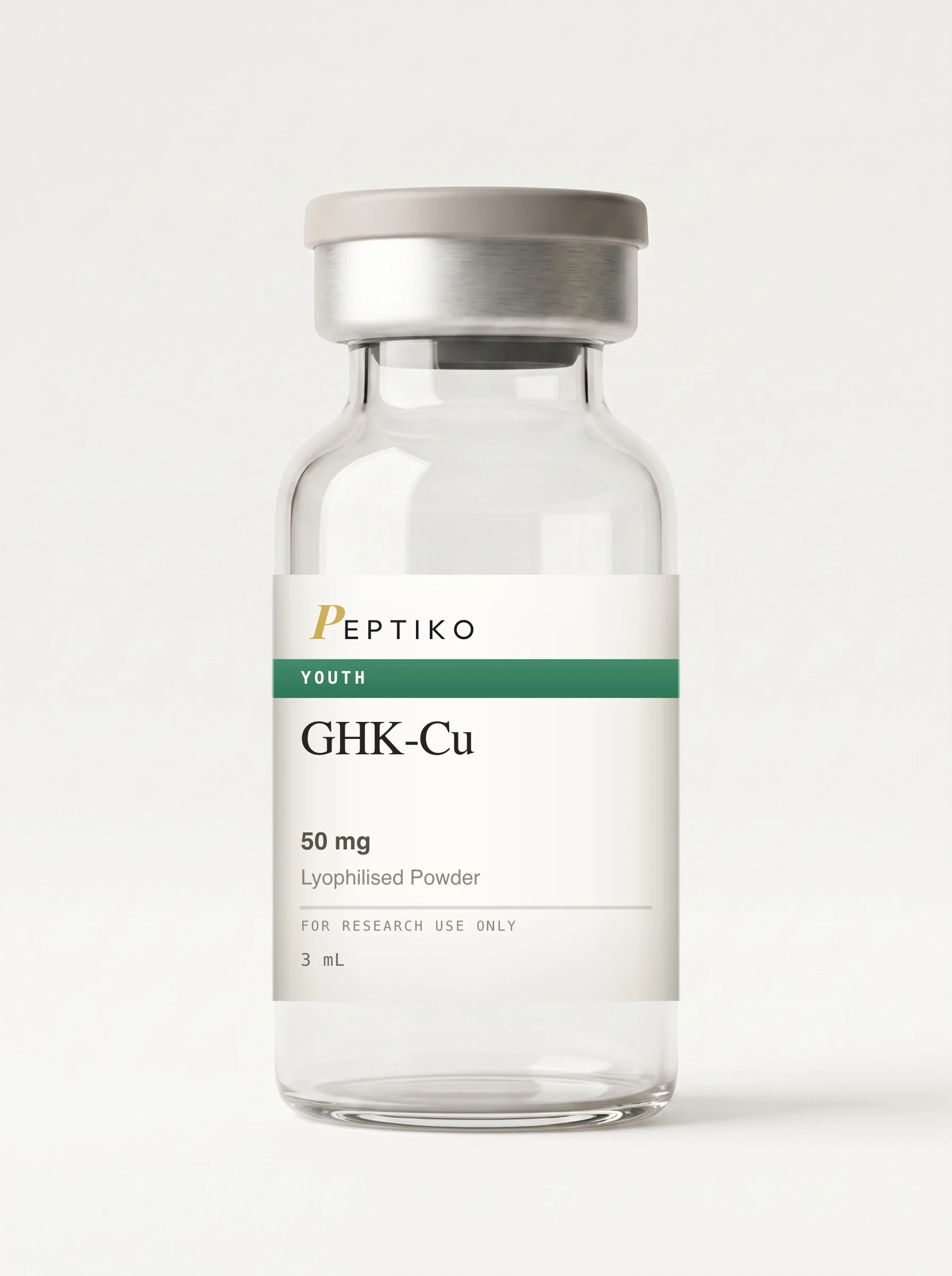
GHK-Cu
Copper-binding peptide. Studied for collagen synthesis and tissue-remodelling pathways in dermatological research.
Pay on deliveryDelivered in 1 business dayFree from 1000 lei
For in-vitro research and laboratory use only. Not for human or animal consumption.
- ≥99% purity by HPLC-MS · lot number on every vial
- Delivery in Moldova: 1 business day
- Cash to the courier on delivery
- + bacteriostatic water free with this order
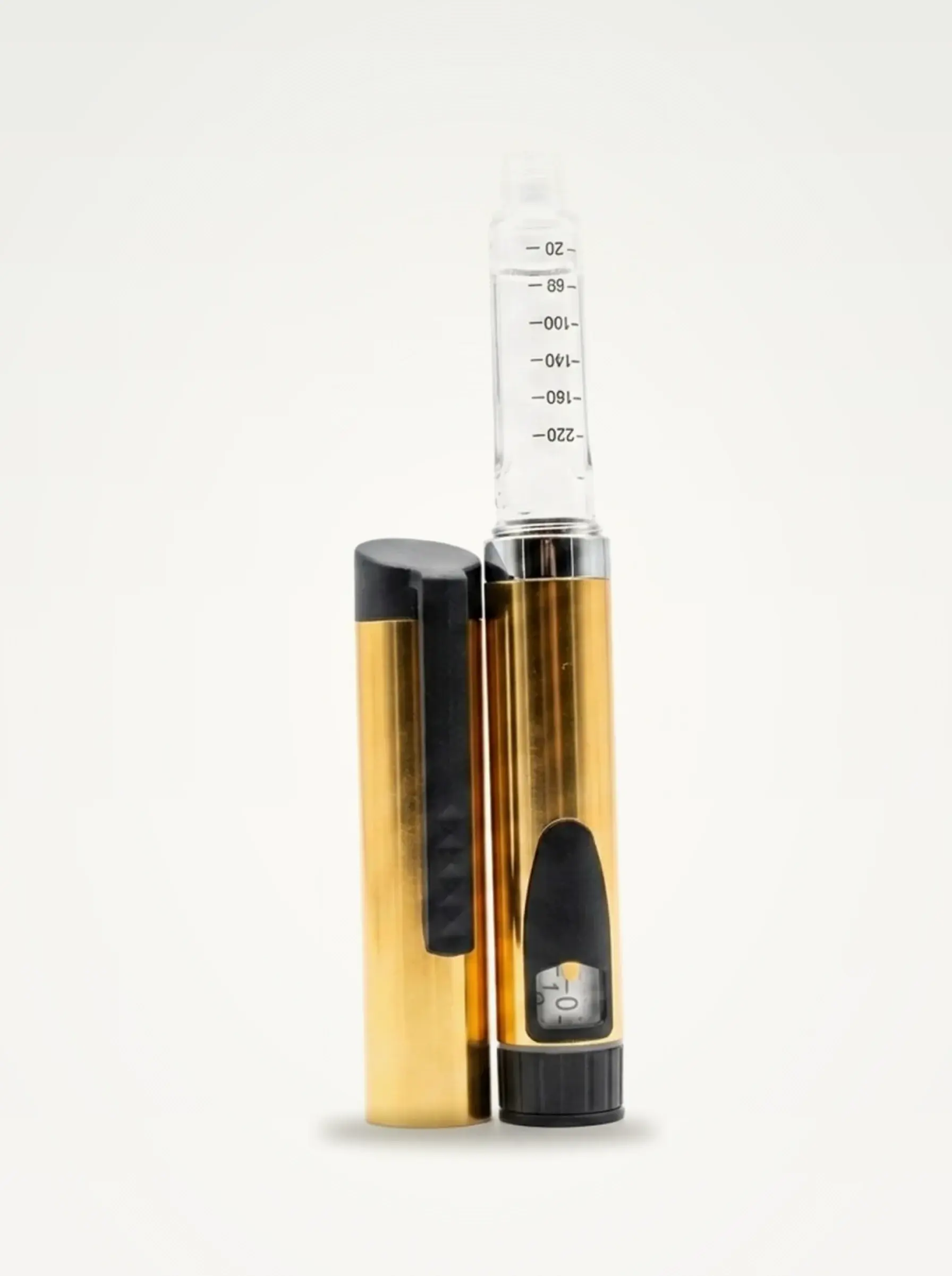 Injection Penreusable device · 800 lei
- Purity
- ≥99% HPLC-MS verified
- CAS
- 89030-95-5
- Storage
- Lyophilised: 2–8 °C (−20 °C for long-term). Reconstituted: 2–8 °C, ≤2 weeks.
- Formats
- 50mg vial
Courier delivery anywhere in Moldova. Lyophilized peptides travel at ambient temperature.
GHK-Cu vs GHK: the copper peptide difference →Overview
GHK-Cu is a naturally occurring copper-binding tripeptide, which is why laboratories study its role in collagen synthesis and extracellular-matrix remodelling. In cell and preclinical research it has been associated with increased collagen and elastin expression, antioxidant and anti-inflammatory activity, and modulation of wound-repair signalling — making it one of the most-studied peptides in dermatological and matrix-biology research.
Mechanism
GHK is a tripeptide present in human plasma, saliva and urine, reported at around 200 ng/ml at age 20 and around 80 ng/ml by age 60. It has a very high affinity for copper(II) and circulates as the chelate. The mechanism described in the literature is therefore a copper-delivery mechanism: the complex acts as a modulator of the matrix-remodelling machinery — stimulating synthesis and breakdown of collagen and glycosaminoglycans at once — rather than as a straightforward growth stimulus.
Molecular identity
- Sequence
- Gly-His-Lys · Cu(II)
- Formula
- C14H23CuN6O4+
- Molecular weight
- 402.92 g/mol
- CAS
- 89030-95-5
- PubChem CID
- 71587328
What it acts on
- Cu(II) chelation — GHK binds copper in a 3N1O coordination geometry; the copper complex, not the bare tripeptide, is what the biological literature describes.
- Matrix metalloproteinases and their tissue inhibitors — reported to modulate both sides of the remodelling balance rather than only building matrix.
- Fibroblast matrix output — collagen, dermatan sulfate, chondroitin sulfate and decorin synthesis.
- Chemotaxis of immune and endothelial cells toward the site of injury.
What the studies report
Each item below summarises the paper it is numbered to, written from that paper's own abstract. The badge says how the evidence was produced.
- 1.animal modelAging Pathobiol Ther (2020)
Reports the age-related decline of serum GHK and summarises antioxidant and anti-inflammatory effects in vitro and in vivo. The cognitive observation is explicitly preliminary and in aging mice; the authors position the whole paper as a rationale for further preclinical and clinical study, not as a result.
- 2.in vitroBiomed Res Int (2015)
A review of the skin-regeneration literature. GHK is reported to stimulate both synthesis and breakdown of collagen and glycosaminoglycans, to modulate metalloproteinases and their inhibitors, to stimulate decorin, and to restore replicative vitality to fibroblasts after radiation exposure.
- 3.computationalComput Biol Chem (2020)
A computational study — ligand field molecular mechanics, DFT and semi-empirical methods — establishing the geometry of the copper site. Four equatorial bonds in 3N1O coordination stay stable across the simulation; the fifth, apical, is fluxional. Structure work, with no biological readout.
- 4.in vitroInt J Mol Sci (2020)
Finds that cis-urocanic acid also coordinates Cu(II) and that GHK, copper and urocanic acid form a ternary complex. The authors argue this species may be partly responsible for the biological effects attributed to GHK — that is, the active entity may not be the binary chelate assumed elsewhere.
Used in research on
What this does not establish
Most of the cited work is in vitro, computational, or in animals, and the cosmetic-formulation claims in the literature concern topical products, not this reagent. Even the identity of the active species is unsettled: one of the papers above argues it may be a ternary complex rather than the GHK-Cu chelate.
Research applications
In vitro, GHK-Cu is used as a reference copper-binding tripeptide for studying collagen-synthesis and extracellular-matrix-remodelling pathways: cell-culture assays of collagen and elastin expression, antioxidant-activity panels, inflammatory-signalling readouts, and copper-transport / matrix-synthesis studies that examine how copper peptides influence tissue-renewal pathways. It anchors much dermatological and matrix-biology research and serves as a reference point in fibroblast and wound-repair-signalling models studied in vitro.
Reconstitution
Supplied lyophilised. For laboratory preparation, reconstitute the lyophilised powder with sterile bacteriostatic water to a working stock, keep the reconstituted solution at 4 degrees C, and prepare assay dilutions in the buffer specified by your protocol. For in-vitro research use only, not for human or animal administration.
Storage & handling
Lyophilised: 2–8 °C (−20 °C for long-term). Reconstituted: 2–8 °C, ≤2 weeks.
Research literature
Selected peer-reviewed literature describing this compound. Peptiko supplies peptides for in-vitro research; these papers characterise the compound, not this product.
- 1.The potential of GHK as an anti-aging peptide. Aging Pathobiol Ther (2020)
- 2.GHK Peptide as a Natural Modulator of Multiple Cellular Pathways in Skin Regeneration. Biomed Res Int (2015)
- 3.Theoretical study of copper binding to GHK peptide. Comput Biol Chem (2020)
- 4.Ternary Cu(II) Complex with GHK Peptide and Cis-Urocanic Acid as a Potential Physiologically Functional Copper Chelate. Int J Mol Sci (2020)
Frequently asked questions
What is GHK-Cu?
GHK-Cu is a naturally occurring copper-binding tripeptide that laboratories study in collagen-synthesis and extracellular-matrix-remodelling models. Peptiko supplies it strictly as an in-vitro reference reagent.
Is it for human use?
No. It is a research-use-only reagent for in-vitro laboratory study. It is not a pharmaceutical, supplement, or medicine, and not for human or veterinary use.
How is purity verified?
Purity is at least 99% by HPLC-MS.
What is the CAS number?
CAS 89030-95-5.
Do you ship from Moldova?
Yes. We deliver by courier anywhere in Moldova, one business day after we confirm the order, and you pay the courier in cash. Lyophilized peptides travel at ambient temperature: a freeze-dried cake needs no cold chain.
Reviews
Be the first to review GHK-Cu.
Order on Telegram, or add it to the cart and check out on the site. Cash to the courier on delivery — nothing is paid in advance.