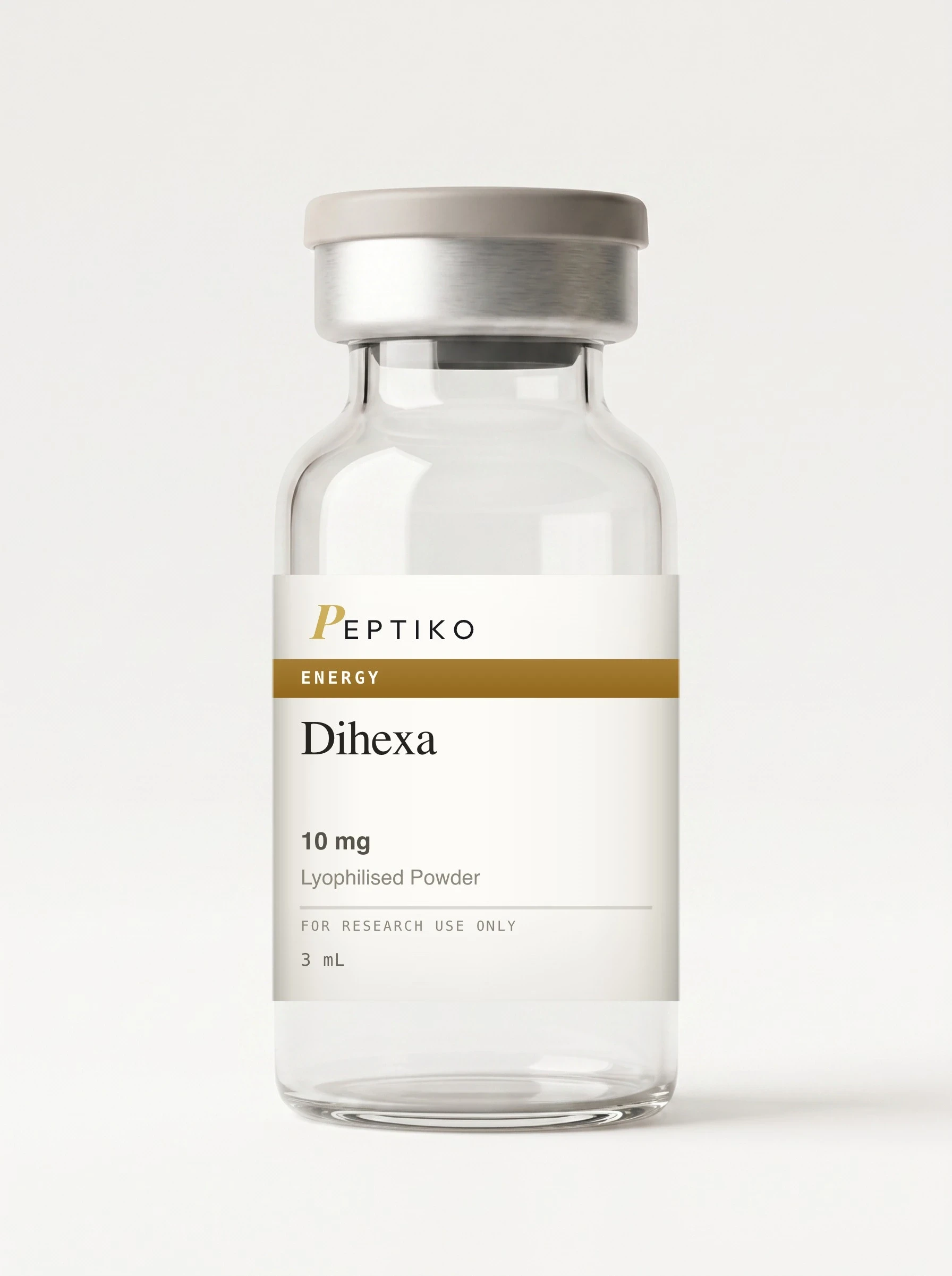
Dihexa
Angiotensin-IV-derived oligopeptide. Studied for HGF/c-Met signalling and synaptogenesis pathways — a research reagent for cognition-focused in-vitro work.
For in-vitro research and laboratory use only. Not for human or animal consumption.
- ≥99% purity by HPLC-MS · lot number on every vial
- Delivery in Moldova: 1 business day
- Cash to the courier on delivery
- + bacteriostatic water free with this order
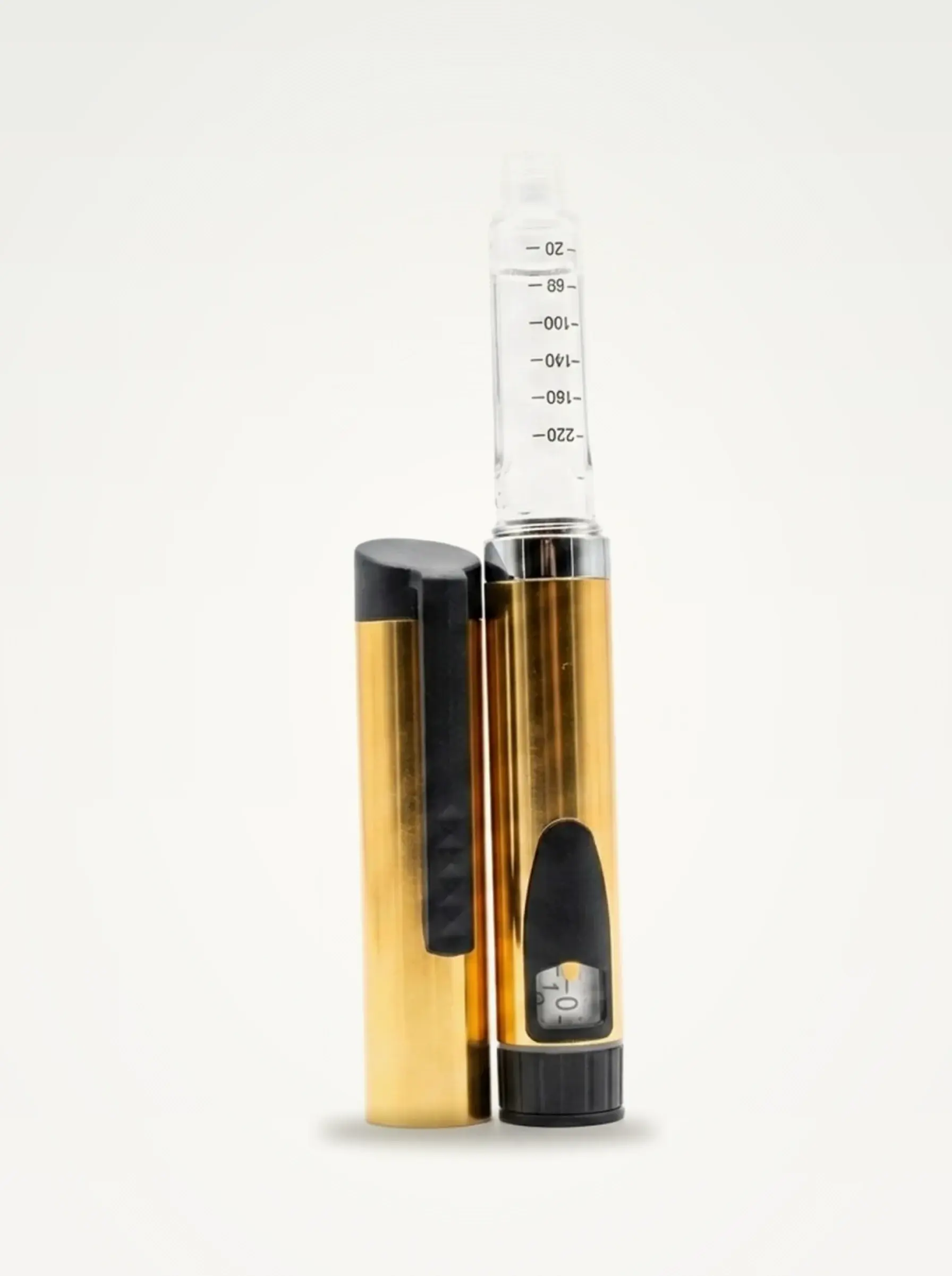 Injection Penreusable device · 800 lei
- Purity
- ≥98% HPLC-MS verified
- CAS
- 1401708-83-5
- Storage
- Lyophilised: 2–8 °C, protect from light (−20 °C for long-term, ≥24 months). Reconstituted: 2–8 °C.
- Formats
- 5mg vial · 10mg vial
Courier delivery anywhere in Moldova. Lyophilized peptides travel at ambient temperature.
Overview
In laboratory tests, Dihexa built new connections between brain cells far more powerfully than BDNF, one of the body's own best-known nerve-growth factors — a finding that placed it among the most striking cognition compounds researchers have measured. Derived from angiotensin IV, a signalling molecule the body makes naturally, it is studied for sharper memory and learning, especially where age or injury has weakened the brain's wiring.
Mechanism
Dihexa is a synthetic small molecule built on a fragment of angiotensin IV, the endogenous hexapeptide of the brain renin–angiotensin system: two residues of that peptide (Tyr-Ile) are retained and the molecule is capped at both ends by non-proteinogenic hexanoyl and 6-aminohexanoyl groups — a design meant to resist peptidase cleavage and to cross the blood–brain barrier, which native hepatocyte growth factor (HGF) does not. The mechanism proposed in the cited literature is allosteric rather than agonist: Dihexa is described as dimerising with endogenous HGF to form a functional ligand for the c-Met receptor, so its action is conditional on the growth factor already being present. From there the signal runs into the canonical c-Met branches — PI3K/Akt, mTOR and MEK — and co-treatment with inhibitors of those branches partially attenuates the observed effect; the HGF antagonist 6-AH attenuates it as well. In a transgenic Alzheimer's mouse model it is specifically the PI3K/Akt arm that the authors tie to the anti-inflammatory and anti-apoptotic readouts, since the PI3K inhibitor wortmannin reversed them, alongside a rise in tissue Ang IV. The structural requirements appear narrow: in the hair-cell work, adding an amino group at the N-terminus was enough to attenuate the response.
Molecular identity
- Sequence
- N-hexanoyl-Tyr-Ile-(6)-aminohexanoic amide — a Tyr-Ile dipeptide core capped at the N-terminus by hexanoic acid and at the C-terminus by 6-aminohexanoic acid amide (C27H44N4O5, 504.7 g/mol; CAS 1401708-83-5)
- Formula
- C27H44N4O5
- Molecular weight
- 504.7 g/mol
- CAS
- 1401708-83-5
- PubChem CID
- 129010512
What it acts on
- HGF/c-Met receptor axis — the cited work describes Dihexa as a synthetic HGF mimetic that dimerises with endogenous hepatocyte growth factor to form a functional ligand for the c-Met receptor, making it an amplifier of an existing signal rather than a receptor agonist in its own right.
- PI3K/Akt — in a transgenic Alzheimer's mouse model the compound activated PI3K/AKT signalling, and the PI3K inhibitor wortmannin reversed the reported anti-inflammatory and anti-apoptotic readouts, which is the paper's basis for placing this branch on the causal path.
- mTOR and MEK branches downstream of c-Met — in the zebrafish hair-cell work, co-treatment with inhibitors of Akt, TOR and MEK partially attenuated the protective effect, consistent with several parallel effectors rather than a single one.
- Brain renin–angiotensin system — the molecule is an analogue of angiotensin IV, the endogenous hexapeptide of the central RAS, and tissue Ang IV was reported to rise in treated mice relative to wild-type animals.
- Glial activation and cytokine balance — the same mouse study reports reduced astrocyte and microglial activation with lower IL-1β and TNF-α and higher IL-10, readouts that the PI3K inhibitor wortmannin reversed.
What the studies report
Each item below summarises the paper it is numbered to, written from that paper's own abstract. The badge says how the evidence was produced.
- 1.
A 2026 narrative review of therapeutic peptides written from an orthopaedic perspective. Dihexa appears only in passing, grouped with selank and semax among neuroactive peptides the authors describe as acting on BDNF and HGF/c-Met pathways relevant to neuroplasticity; no primary data on the compound are presented. The review states explicitly that, although preclinical work is promising, clinical trials are currently lacking.
- 2.animal modelBrain Sci (2021)
A study in APP/PS1 transgenic mice — a genetic model of Alzheimer's disease — using several dose levels. The authors report restored spatial learning in the Morris water maze, more neuronal cells and higher synaptophysin expression on Nissl staining, reduced astrocyte and microglial activation, lower IL-1β and TNF-α with raised IL-10, and increased tissue Ang IV relative to wild-type animals. Causality is assigned to PI3K/AKT on the strength of a single pharmacological block — wortmannin reversed the anti-inflammatory and anti-apoptotic effects — and the entire result rests on one transgenic mouse line.
- 3.animal modelAnn Med Surg (Lond) (2021)
A rat sciatic nerve transection-repair study: ten groups of six to eight male Lewis rats comparing mesenchymal stem cells, G-CSF and Dihexa, alone and in combination, against vehicle over sixteen weeks. Sensory function returned to near-normal by eight weeks across all groups pooled, including controls, so it discriminates nothing; the significant motor gain on walking-footprint grading appeared only for stem cells combined with G-CSF or with Dihexa. The compound is therefore reported as an adjunct within a combination rather than as effective on its own, and the group sizes are small.
- 4.animal modelFront Cell Neurosci (2015)
A protection screen in the larval zebrafish lateral line, whose hair cells are homologous to mammalian inner-ear hair cells, using the aminoglycosides neomycin and gentamicin as the insult. A concentration–response relationship was established; pretreatment did not change how much fluorescently tagged gentamicin entered the cells, so the authors attribute protection to intracellular signalling rather than blocked entry. Co-treatment with the HGF antagonist 6-AH attenuated the protection, as did adding an amino group at the N-terminus; co-treatment with inhibitors of the downstream targets Akt, TOR and MEK attenuated it only partially, so part of the effect is left unexplained by the HGF cascade.
Used in research on
What this does not establish
There are no controlled human trials in the cited literature: the only review among these references states outright that clinical trials are lacking, and every primary paper here is rodent or zebrafish. The mechanism is inferred indirectly — from attenuation by an HGF antagonist and by downstream inhibitors, not from a demonstrated Dihexa–HGF complex — and those inhibitors attenuate the effect only partially. In the nerve-repair study the compound reached significance only in combination with stem cells, not alone. Claims circulating elsewhere about synaptogenic potency relative to BDNF are not established by any of the papers cited here.
Research applications
As an angiotensin-IV-derived oligopeptide, Dihexa is used in vitro as a reference compound for the HGF/c-Met signalling axis and synaptogenesis pathways: hepatocyte-growth-factor/c-Met receptor-activation assays, synaptic-density readouts in cultured hippocampal neurons, and side-by-side comparisons against BDNF as a benchmark nerve-cell growth factor. It appears across neuronal cell-culture models of synapse formation and neuroprotection, where laboratories treat it as a reference point for how synaptogenesis can be pharmacologically driven.
Reconstitution
Supplied lyophilised. For laboratory preparation, reconstitute the lyophilised powder with sterile bacteriostatic water to a working stock, keep the reconstituted solution at 4 degrees C, and prepare assay dilutions in the buffer specified by your protocol. For in-vitro research use only, not for human or animal administration.
Storage & handling
Lyophilised: 2–8 °C, protect from light (−20 °C for long-term, ≥24 months). Reconstituted: 2–8 °C.
Research literature
Selected peer-reviewed literature describing this compound. Peptiko supplies peptides for in-vitro research; these papers characterise the compound, not this product.
- 1.Therapeutic Peptides in Orthopaedics: Applications, Challenges, and Future Directions. J Am Acad Orthop Surg Glob Res Rev (2026)
- 2.AngIV-Analog Dihexa Rescues Cognitive Impairment and Recovers Memory in the APP/PS1 Mouse via the PI3K/AKT Signaling Pathway. Brain Sci (2021)
- 3.Stem cell, Granulocyte-Colony Stimulating Factor and/or Dihexa to promote limb function recovery in a rat sciatic nerve damage-repair model: Experimental animal studies. Ann Med Surg (Lond) (2021)
- 4.Hepatocyte growth factor mimetic protects lateral line hair cells from aminoglycoside exposure. Front Cell Neurosci (2015)
Frequently asked questions
What is Dihexa?
A synthetic angiotensin-IV-derived oligopeptide studied for the HGF/c-Met signalling axis and synaptogenesis pathways, supplied as a lyophilised reagent for in-vitro laboratory research.
Is it for human use?
No. It is a research-use-only reagent for in-vitro laboratory study. It is not a pharmaceutical, supplement, or medicine, and not for human or veterinary use.
How is purity verified?
Purity is at least 99% by HPLC-MS.
What is the CAS number?
CAS 1401708-83-5.
Do you ship from Moldova?
Yes. We deliver by courier anywhere in Moldova, one business day after we confirm the order, and you pay the courier in cash. Lyophilized peptides travel at ambient temperature: a freeze-dried cake needs no cold chain.
Reviews
Be the first to review Dihexa.
Order on Telegram, or add it to the cart and check out on the site. Cash to the courier on delivery — nothing is paid in advance.