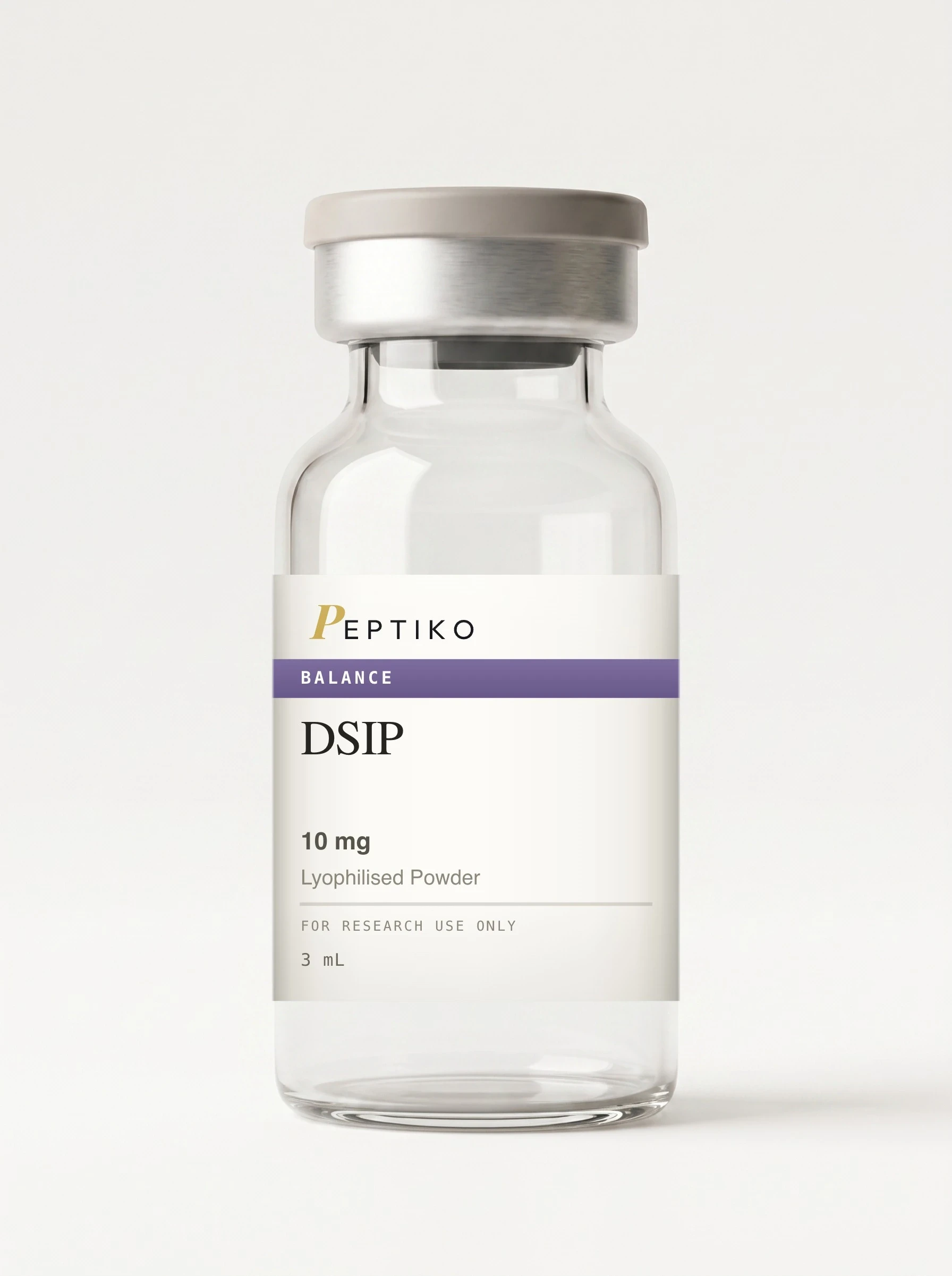
DSIP
Delta sleep-inducing peptide (DSIP). Studied for sleep-regulation and neuromodulatory pathways — a naturally-occurring research nonapeptide.
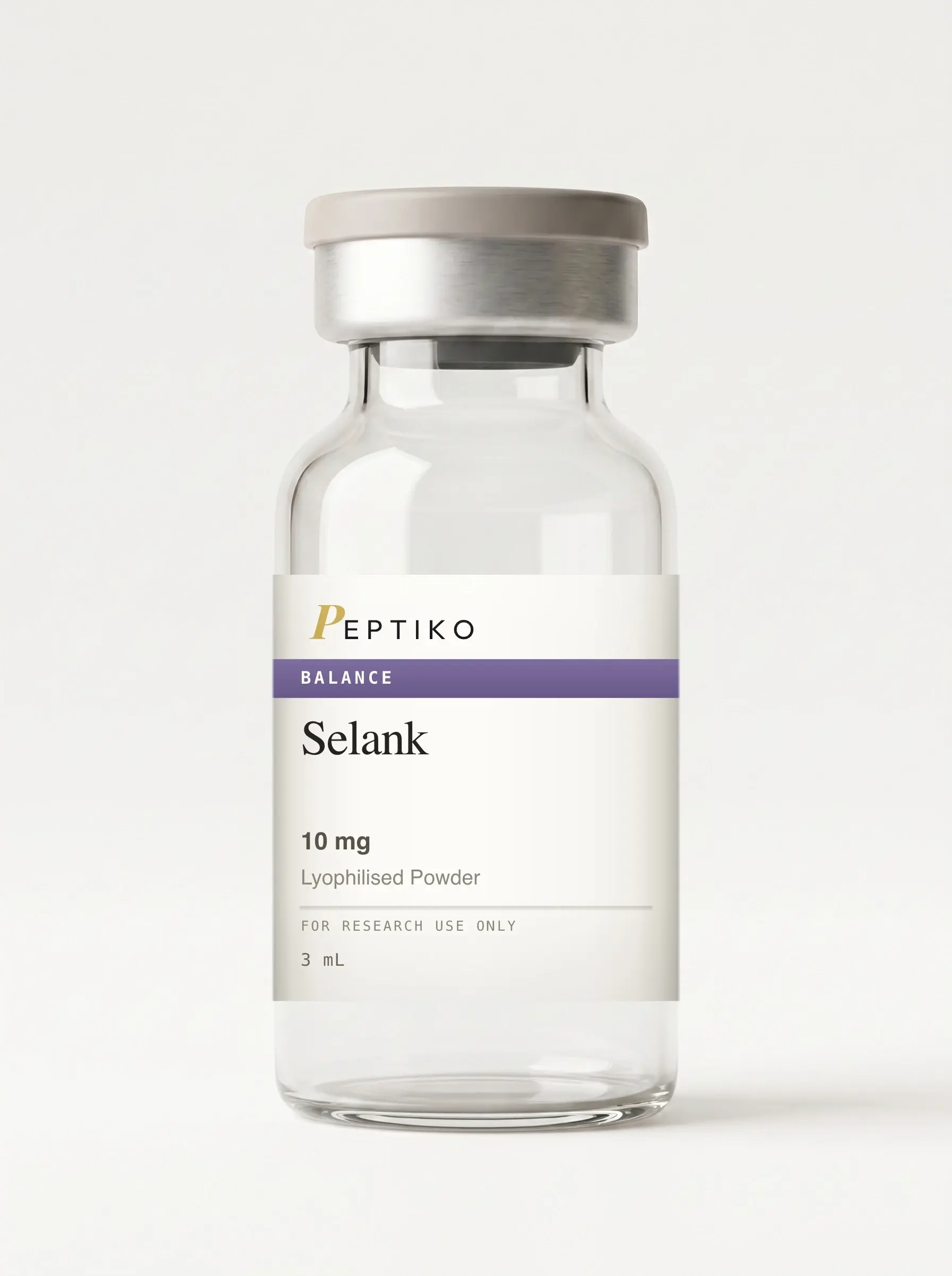
For in-vitro research and laboratory use only. Not for human or animal consumption.
- ≥99% purity by HPLC-MS · lot number on every vial
- Delivery in Moldova: 1 business day
- Cash to the courier on delivery
- + bacteriostatic water free with this order
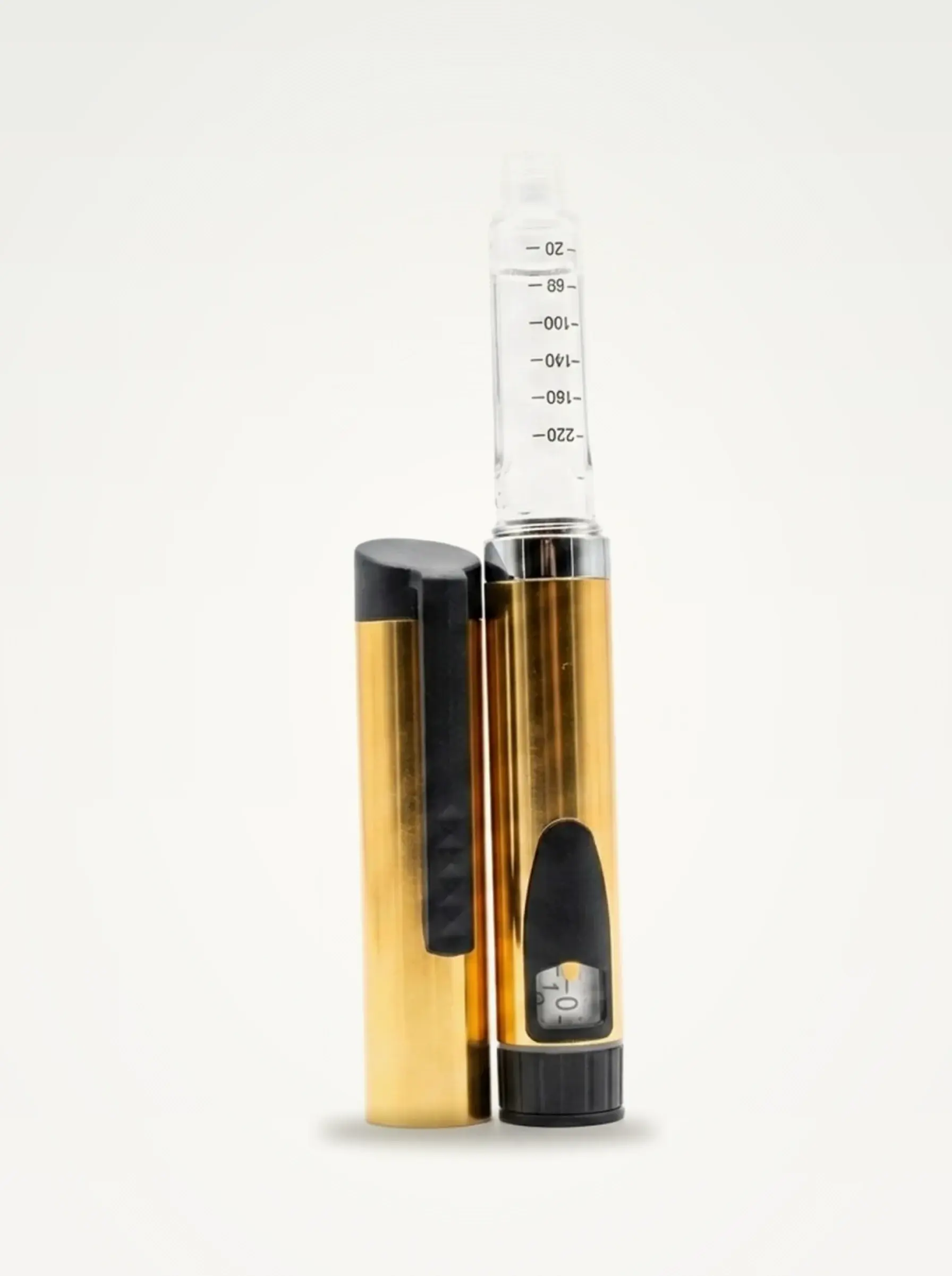 Injection Penreusable device · 800 lei
- Purity
- ≥99% HPLC-MS verified
- CAS
- 62568-57-4
- Storage
- Lyophilised: 2–8 °C, protect from light (−20 °C for long-term, ≥24 months). Reconstituted: 2–8 °C.
- Formats
- 5mg vial · 10mg vial
Courier delivery anywhere in Moldova. Lyophilized peptides travel at ambient temperature.
Overview
Deeper, more restful sleep is what DSIP is named and studied for — the peptide was first discovered in the brain blood of animals in their deepest sleep, the slow "delta"-wave stage. Research explores whether it can steady sleep patterns and calm the body's response to stress, two things that often go hand in hand. Because it crosses easily into the brain, it remains a favoured tool for studying how rest and stress are regulated.
Mechanism
DSIP is a nonapeptide, Trp-Ala-Gly-Gly-Asp-Ala-Ser-Gly-Glu, of molecular weight 849, isolated in 1977 by the Schoenenberger–Monnier group in Basel from the cerebral venous blood of rabbits and named for the delta-wave sleep it was reported to induce. Its structure matches no other known peptide family, and that isolation is essentially where the mechanistic account stops: the 2006 review cited here states that the DSIP gene, its protein and any possible related receptor have never been isolated, so no receptor-to-effector cascade can be written for it. What the literature offers instead is a distribution and a list of effects. DSIP-like material was detected by radioimmunoassay and immunohistochemistry in brain, and by radioimmunoassay in peripheral organs of the rat and in the plasma of several mammals, with the immunoreactivity concentrated most specifically in hypothalamic neurosecretory nuclei that the 2006 review describes as not particularly relevant for sleep regulation; the reported effects run well past sleep, to electrophysiological activity, brain neurotransmitter levels, circadian and locomotor patterns, hormone levels and the action of neuropharmacological drugs. The dose–response is not monotonic but U-shaped, and the same U-shape was described for the timing of administration, which makes the older experiments hard to read as a simple concentration effect. The single mechanistic proposal on record — modulation of adrenergic transmission — was already described as unestablished in 1986 and has not been closed since; and by 2006 a review argued that at least part of the immunoreactivity and activity attributed to DSIP may in fact belong to a structurally similar but different peptide, noting that certain synthetic DSIP analogues promoted slow-wave sleep in rabbits and rats where DSIP itself did not.
Molecular identity
- Sequence
- Trp-Ala-Gly-Gly-Asp-Ala-Ser-Gly-Glu
- Formula
- C35H48N10O15
- Molecular weight
- 848.8 g/mol
- CAS
- 62568-57-4
- PubChem CID
- 68816
What it acts on
- A cognate receptor — none has ever been isolated. The 2006 review states that the DSIP gene, its protein and any possible related receptor were never isolated, and gives that as part of the reason the link between DSIP and sleep was never characterised further; with no receptor in hand, no signalling pathway can be assigned to this peptide.
- Adrenergic transmission — the 1986 update names modulation of adrenergic transmission as the one proposed mechanism of action, and states in the same sentence that it remains to be established.
- Hypothalamic neurosecretory nuclei — DSIP-like immunoreactivity is distributed with high specificity in these nuclei across vertebrate species, nuclei the 2006 review describes as not particularly relevant for sleep regulation. The review offers this as the first of its four grounds for hypothesising a separate DSIP-like peptide, whose possible role in neuroendocrine regulation it lists as a question for future work.
- Brain neurotransmitter levels and electrophysiological activity — the 1984 review reports changes in neurotransmitter content in the brain and in electrophysiological activity, with delta sleep predominating in rabbits, rats and mice while in cats the effect fell mainly on REM sleep.
- Circadian, locomotor and endocrine output — the same review lists shifts in circadian and locomotor patterns and in hormone levels among the reported effects outside sleep, alongside altered action of neuropharmacological drugs, including their withdrawal.
What the studies report
Each item below summarises the paper it is numbered to, written from that paper's own abstract. The badge says how the evidence was produced.
- 2.
A narrative review of the sleep-factor literature as of 1984, written when only two candidate sleep peptides had been purified to homogeneity. It records DSIP as a nonapeptide of molecular weight 849 reported to induce mainly delta sleep in rabbits, rats, mice and humans, while in cats the effect on REM sleep was the more pronounced one — a species split the review does not resolve. It describes a U-shaped activity curve for dose and for timing; DSIP-like material found by radioimmunoassay and immunohistochemistry in brain and by radioimmunoassay in rat peripheral organs and mammalian plasma; and effects reaching well past sleep, into electrophysiology, brain neurotransmitter levels, circadian and locomotor patterns, hormone levels, psychological performance and the action of neuropharmacological drugs. It is a summary of other groups' primary work, not primary work itself.
- 3.reviewJ Neurochem (2006)
A mini-review whose title already calls DSIP a still unresolved riddle. It dates the isolation to 1977, from rabbit cerebral venous blood, and states flatly that the link between DSIP and sleep was never characterised further, in part because the gene, the protein and any related receptor were never isolated — the sleep-factor hypothesis is called extremely poorly documented and still weak. The author proposes instead that a DSIP-like peptide accounts for at least part of the immunoreactivity and activity, on four grounds: the highly specific localisation of that immunoreactivity in hypothalamic neurosecretory nuclei not particularly relevant to sleep; the breadth of activity seen in biochemical and in vitro physiological studies; the finding that certain artificial structural analogues — but not DSIP itself — promoted slow-wave sleep in rabbits and rats; and a naturally occurring dermorphin decapeptide sharing five of nine positions that promoted slow-wave sleep, while its optical isomer suppressed sleep.
- 4.reviewPeptides (1986)
An update covering the two years after the 1984 review. It reports further sleep-inducing or sleep-supporting effects in animals, and notes that a considerable volume of work at the time was directed at possible clinical applications — a line of enquiry outside the scope of this entry, and one that nothing cited here settles. Immunohistochemical and radioimmunochemical studies extended the map of DSIP-like material in the body and were read as suggesting relations to certain diseases. The most useful part for a mechanism section is the authors' own closing statement: the various physiological functions of the peptide, and a possible mechanism of action involving modulation of adrenergic transmission, remain to be established.
Used in research on
What this does not establish
Every source cited here is a review; there is no primary experiment in this reference set, and the newest of them dates from 2006. There are no controlled human trials to cite — the human observations reach these pages second-hand, through narrative summaries written decades ago, and one of the four references carries no abstract at all. More fundamentally, the 2006 review calls the sleep hypothesis itself extremely poorly documented and still weak, records that the DSIP gene, its protein and any possible related receptor have never been isolated, and raises the possibility that at least part of the biological activity attributed to DSIP may belong to a different, structurally similar peptide — with the awkward detail that some synthetic analogues promoted slow-wave sleep where DSIP itself did not. The proposed adrenergic mechanism was unestablished in 1986 and nothing cited here establishes it.
Research applications
In vitro, DSIP serves as a reference nonapeptide for studying the neurochemistry of slow-wave, delta-stage sleep-regulation and the related neuromodulatory pathways it was named for. Laboratories use it as a benchmark compound in stress-response signalling studies — characterising its interaction with cortisol and other stress-hormone pathways — and in oxidative-stress and antioxidant-marker assays. Because the peptide is documented to cross the blood-brain barrier, it is also employed as a model compound in blood-brain-barrier permeability and CNS-uptake characterisation. Across these contexts it functions purely as a comparison and calibration reference for sleep-, stress- and hormone-signalling research.
Reconstitution
Supplied lyophilised. For laboratory preparation, reconstitute the lyophilised powder with sterile bacteriostatic water to a working stock, keep the reconstituted solution at 4 degrees C, and prepare assay dilutions in the buffer specified by your protocol. Protect from light, and store the unopened vial at −20 °C. For in-vitro research use only, not for human or animal administration.
Storage & handling
Lyophilised: 2–8 °C, protect from light (−20 °C for long-term, ≥24 months). Reconstituted: 2–8 °C.
Research literature
Selected peer-reviewed literature describing this compound. Peptiko supplies peptides for in-vitro research; these papers characterise the compound, not this product.
Frequently asked questions
What is DSIP?
DSIP (delta sleep-inducing peptide) is a naturally-occurring research nonapeptide, first identified in the 1970s in the brain blood of animals in the deepest, slow delta-wave stage of sleep. As a laboratory reagent it is studied in vitro as a reference compound for sleep-regulation and neuromodulatory pathways, and for stress-response and hormone-signalling research.
Is it for human use?
No. It is a research-use-only reagent for in-vitro laboratory study. It is not a pharmaceutical, supplement, or medicine, and not for human or veterinary use.
How is purity verified?
Purity is at least 99% by HPLC-MS.
What is the CAS number?
CAS 62568-57-4.
Do you ship from Moldova?
Yes. We deliver by courier anywhere in Moldova, one business day after we confirm the order, and you pay the courier in cash. Lyophilized peptides travel at ambient temperature: a freeze-dried cake needs no cold chain.
Reviews
Be the first to review DSIP.
Order on Telegram, or add it to the cart and check out on the site. Cash to the courier on delivery — nothing is paid in advance.