NAD+ in plain English: a coenzyme, not a peptide
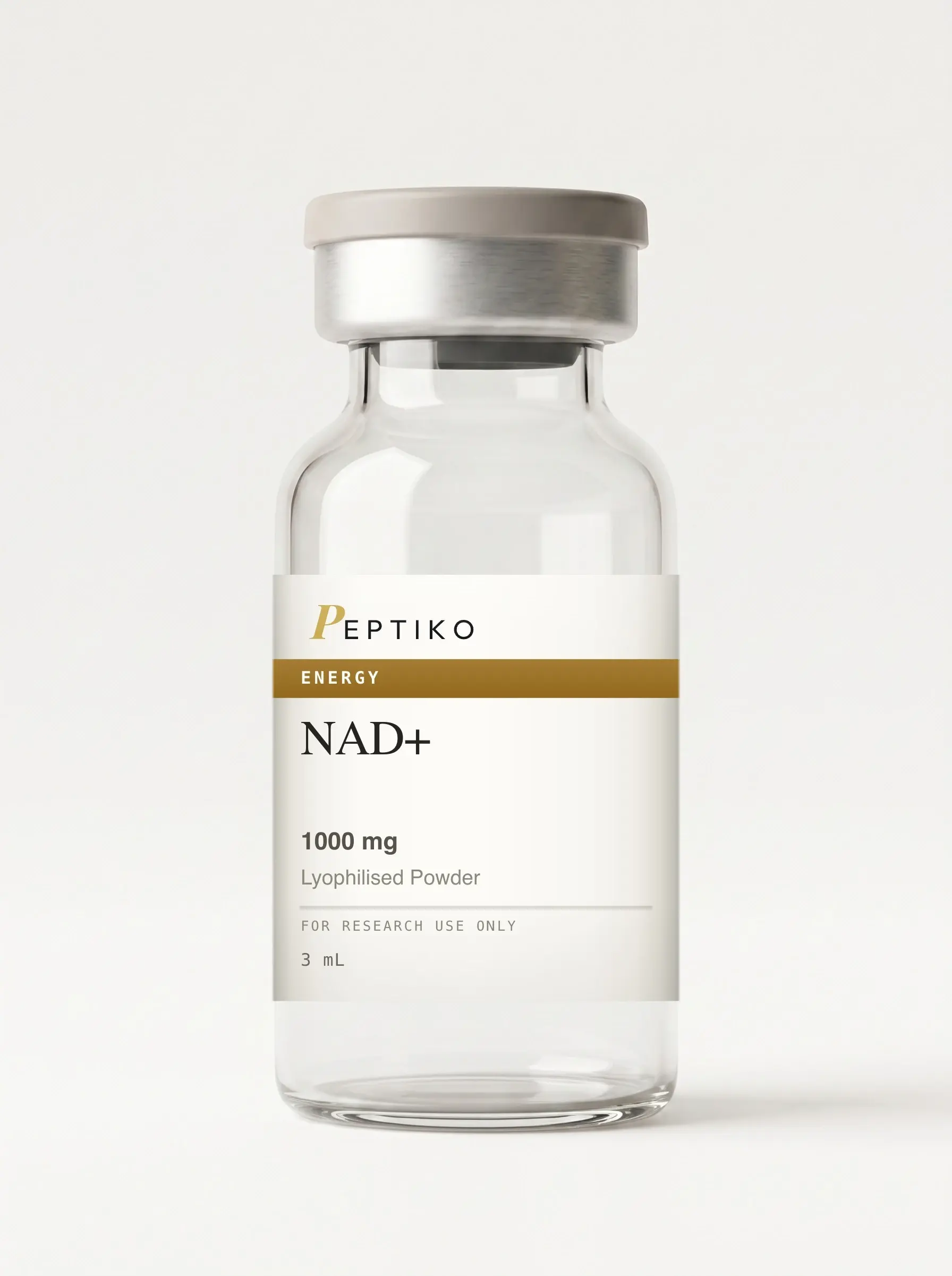
In short: NAD+ (nicotinamide adenine dinucleotide) is not a peptide but a coenzyme: a molecule made of two nucleotides, with a mass of 663.4 Da. NAD+ is present in every living cell. It carries electrons, switching to NADH and back, and it is used up by enzymes: the sirtuins, PARPs and CD38. It is studied in connection with ageing, metabolism and neurodegeneration. We supply NAD+ in a 1000 mg vial (lyophilised powder) for in-vitro laboratory research only.
A few words that make the rest clear
- A nucleotide is a building block of DNA and RNA: a nitrogen-containing base, a sugar and a phosphate.
- A dinucleotide is two nucleotides linked together. That is how NAD+ is built: nicotinamide mononucleotide (NMN) and adenosine monophosphate (AMP), joined by a pyrophosphate bridge made of one phosphate from each.
- A coenzyme is a small helper molecule without which an enzyme (a protein that speeds up a reaction) cannot do its job. NAD+ works like a shuttle: it picks up electrons in one reaction and drops them off in another.
- A peptide is a short chain of amino acids. NAD+ contains no amino acids at all, so it is not a peptide.
Why NAD+ is researched
The first link between NAD+ and a disease was found almost a century ago: in 1937 the biochemist Conrad Elvehjem established that pellagra (dermatitis, diarrhoea, dementia) is caused by a lack of niacin, vitamin B3, in the diet, and that the disease leaves NAD+ levels low (2021 review, PMID 33353981).
- Ageing. The same review reports that tissue NAD+ levels fall with age, in rodents and in humans alike. The authors link the decline to age-related diseases: cognitive decline, cancer, metabolic disease, sarcopenia (age-related loss of muscle mass) and frailty. CD38, an enzyme that breaks NAD+ down, has been proposed as the main cause: it becomes more abundant in mammalian tissues with age.
- Metabolism. A 2023 review reports that raising NAD+ with precursors in laboratory animals improved glucose and fat metabolism and attenuated diet-induced diabetes, diabetic kidney disease and fatty liver, or hepatic steatosis (PMID 37364580).
- Neurodegeneration. Low NAD+ has been described in Alzheimer's disease, Parkinson's disease, amyotrophic lateral sclerosis and in models of accelerated ageing. In mice, when an axon (the long projection of a nerve cell) is injured, the enzyme SARM1 rapidly breaks NAD+ down, a key step in the axon's degeneration (PMID 33353981).
The human trials listed below tested not NAD+ itself but its precursors, NMN and NR. All four were randomised and placebo-controlled:
- NMN (2021), 10 weeks: 25 postmenopausal women with prediabetes and overweight or obesity; 13 in the NMN group and 12 on placebo. Muscle insulin sensitivity rose; on placebo it did not (PMID 33888596).
- NR (2018), 12 weeks: 40 men aged 40–70 with obesity. No serious adverse events due to NR were seen, and safety blood tests stayed normal (PMID 29992272).
- NR (2019), 21 days: 12 older men. Products of NAD+ metabolism rose in muscle and inflammatory cytokines fell in the blood. The authors conclude that NR reaches the muscle of older people and has anti-inflammatory effects (PMID 31412242).
- NR (2022), 30 days, the phase 1 NADPARK trial: 30 people with newly diagnosed Parkinson's disease. NR was well tolerated, brain NAD rose significantly, and inflammatory cytokines fell in the blood and cerebrospinal fluid. In those whose brain NAD rose, the authors noted "mild clinical improvement" and called for NR to be tested in a larger trial (PMID 35235774).
What is known today. According to the 2023 review, early human studies show that NAD+ levels in blood and some tissues can be raised safely with precursors. The authors see these findings as grounds for adequately powered randomised trials (PMID 37364580). The FDA's database of approved drugs (US) lists no product containing NAD+.
These are research and clinical-trial results as the authors reported them. They do not describe our reagent and are not a recommendation.
What NAD+ does in the cell
It carries electrons: NAD+ and NADH. NAD+ accepts a hydride ion (two electrons and a proton) and becomes NADH. These are the oxidised and the reduced form of the same molecule; the "+" in the name is the positive charge on the nicotinamide ring of the oxidised form. Dehydrogenases work with NAD+: enzymes that take part in breaking down glucose, fatty acids and other molecules. NADH then hands its electrons to the respiratory chain in the mitochondria, where ATP is made. In this job the molecule is not used up; it goes round in a cycle.
It is used up by enzymes: sirtuins, PARPs, CD38. For them NAD+ is a raw material: the enzymes cut the molecule, and nicotinamide is split off.
- Sirtuins remove acetyl and other acyl groups from proteins; every such reaction uses up one molecule of NAD+.
- PARPs (poly(ADP-ribose) polymerases), above all PARP1, respond to DNA damage in the nucleus and take part in its repair, so heavy damage sends NAD+ consumption sharply up.
- CD38, CD157 and SARM1 are NAD+ glycohydrolases, enzymes that break NAD+ down; some of CD38's products act as signalling molecules.
Where the cell gets NAD+: the salvage pathway
According to the 2021 review, ready-made NAD+ does not cross the cell membrane, so the cell makes its own. Liver cells do most of the building from the amino acid tryptophan; most other cells use nicotinamide, which is left over by sirtuins, PARPs and CD38 and also arrives in the blood from the liver. Recycling nicotinamide in this way is called the salvage pathway:
- the enzyme NAMPT turns nicotinamide into NMN, the step that sets the pace of the whole pathway;
- the enzymes NRK1 and NRK2 turn nicotinamide riboside (NR) into NMN, a route described in 2004 (PMID 15137942);
- the enzymes NMNAT1–3 finish the job, turning NMN into NAD+.
| Molecule | Mass |
|---|---|
| NAD+ (NMN + AMP) | 663.4 Da |
| NMN, nicotinamide mononucleotide | 334.22 Da |
| NR, nicotinamide riboside | 255.25 Da |
| Nicotinamide (niacinamide), a form of vitamin B3 | 122.12 Da |
All of this describes metabolism in a living cell as the reviews report it, not the action of our reagent.
How the molecule is built
| Parameter | Value |
|---|---|
| What it is | A dinucleotide coenzyme, not a peptide |
| Other names | Nadide, coenzyme I, diphosphopyridine nucleotide (DPN) |
| Formula | C21H27N7O14P2 |
| Molecular weight | 663.4 Da (the dalton is the unit of molecular mass) |
| CAS | 53-84-9 (its number in the international chemical registry) |
| Our vial | 1000 mg, lyophilised |
What laboratories do with it
Typical experiments with NAD+:
- dehydrogenase assays: NAD+ is added as the coenzyme, and its conversion to NADH is followed as a rise in light absorbance at 340 nm; aldehyde dehydrogenase activity, for example, is measured this way (PMID 2222842);
- sirtuin, PARP and CD38 assays: NAD+ is the substrate, and the enzyme's activity is read from the reaction products, such as the nicotinamide released, or from the glow of the product that a fluorescent version of NAD+ yields (PMID 30097862, PMID 12893171);
- measuring NAD+ in samples of blood, urine and cerebrospinal fluid by liquid chromatography with mass spectrometry; accurate quantification needs standards, that is, reference substances (PMID 34073099).
This is in-vitro work, "in the test tube": with purified enzymes, solutions and samples. The dry reagent is dissolved once to make a working solution for the experiment.
NAD+, MOTS-c and SS-31
Next to NAD+ in our catalogue sit MOTS-c and SS-31. They too are studied in connection with mitochondria, but they are peptides: MOTS-c is a chain of 16 amino acids encoded in mitochondrial DNA, and SS-31 a synthetic chain of 4 amino acids. More in "MOTS-c, plainly: the peptide from mitochondria" and "SS-31 (elamipretide) in plain English: what it is".
Frequently asked questions
Is NAD+ a peptide?
No. A peptide is a chain of amino acids, while NAD+ is built from two nucleotides.
How does NAD+ differ from NADH?
They are two forms of one molecule: NAD+ is the oxidised form, ready to accept electrons, and NADH is the reduced form, which has already taken them on. We supply the oxidised form, NAD+.
Are NMN, NR and niacinamide the same as NAD+?
No. They are precursors the cell builds NAD+ from: niacinamide (nicotinamide) is one form of vitamin B3, NR is nicotinamide plus ribose, and NMN is NR plus a phosphate. NAD+ itself is not a vitamin. We do not supply NMN or NR.
How should an NAD+ vial be stored?
Keep the dry vial at −20 °C, away from light and moisture: stored like this, the powder keeps for at least 24 months. Once dissolved, the solution goes in the fridge at 2–8 °C. Ordinary temperatures in transit do the dry vial no harm. The details are in the peptide storage guide.
Do you advise on use?
No. Our NAD+ is a reagent for in-vitro laboratory research only, and we do not advise on use.
How to order
Price and availability are on the NAD+ page and in the block below this article. You can order on the site or through the Telegram bot. We deliver within Moldova in 1 business day, you pay the courier on delivery, and delivery is free from 1000 lei. Before delivery we call you to confirm the order. Bacteriostatic water comes free with NAD+, as with peptides: one bottle per 1–3 vials.
Sources
- NAD(+) metabolism and its roles in cellular processes during ageing. Nat Rev Mol Cell Biol, 2021. PMID 33353981
- Nicotinamide Adenine Dinucleotide in Aging Biology: Potential Applications and Many Unknowns. Endocr Rev, 2023. PMID 37364580
- Nicotinamide mononucleotide increases muscle insulin sensitivity in prediabetic women. Science, 2021. PMID 33888596
For in-vitro research and laboratory use only. Not for human or animal consumption.