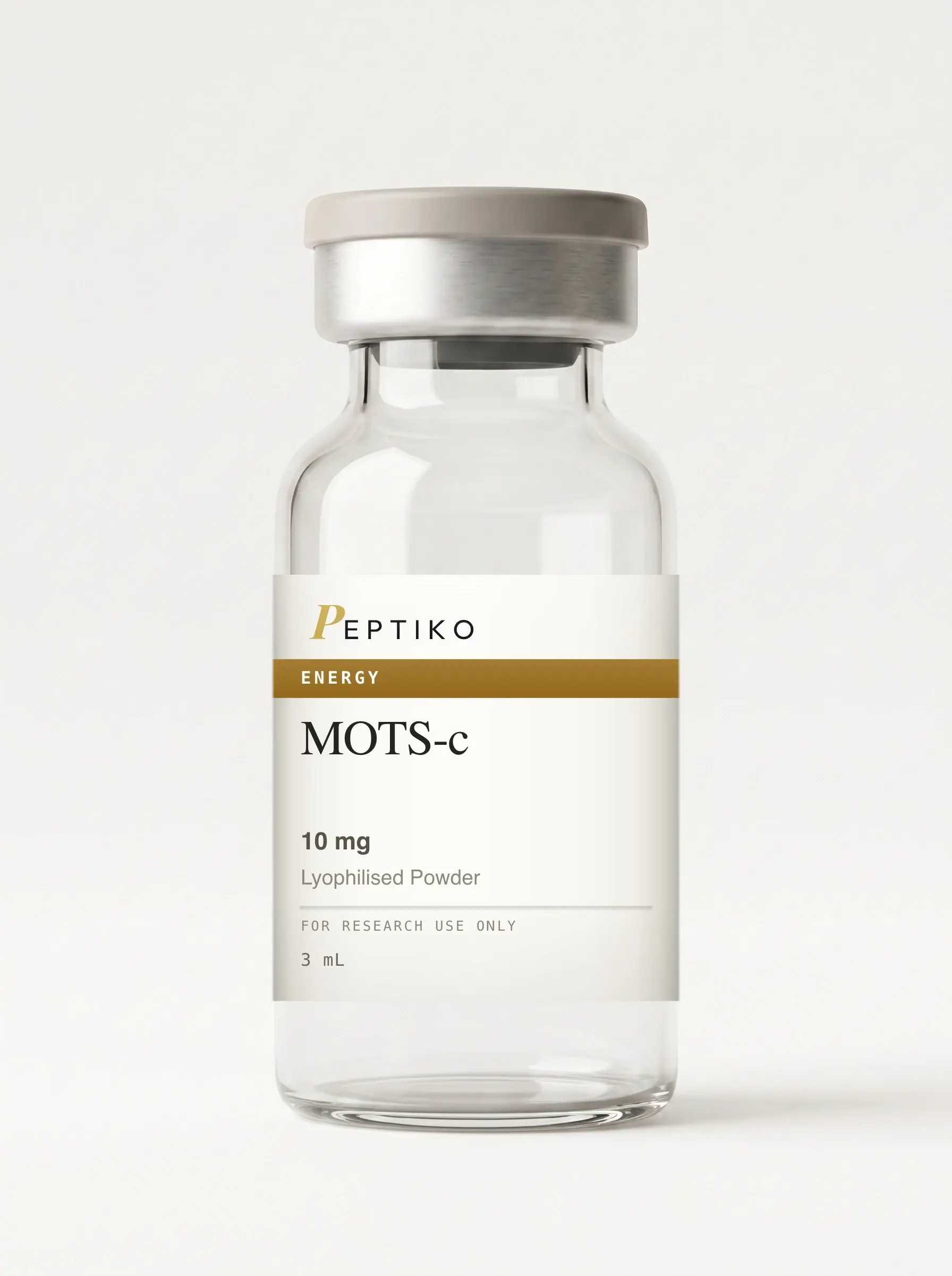
MOTS-c, plainly: the peptide from mitochondria
In short: MOTS-c is a short peptide of 16 amino acids. What makes it unusual is that its "instructions" are written not in the cell nucleus, like almost every protein's, but in the mitochondria's own DNA. It was described in 2015. Laboratories study MOTS-c as a signalling molecule linked to AMPK, the cell's "energy sensor". We supply MOTS-c for in-vitro laboratory research only.
What mitochondria are, and where DNA comes in
Mitochondria are tiny structures inside almost every cell. They are often called "power stations": this is where nutrients are turned into the energy the cell uses.
Mitochondria have their own small DNA, separate from the DNA in the nucleus. For a long time it was thought to code only for a few dozen parts the mitochondrion itself needs. Then it turned out that short peptides acting as signals are "hidden" in it too. They are called mitochondrial-derived peptides. Humanin was the first to be described, MOTS-c came later.
The name MOTS-c stands for mitochondrial open reading frame of the 12S rRNA type-c. In plain terms: its code sits inside the 12S rRNA gene of mitochondrial DNA.
How the molecule is built
MOTS-c is a chain of 16 amino acids. Amino acids are the building blocks every protein is made of, and a peptide is a short chain of them. Our reagent is synthetic: it is assembled chemically, one amino acid at a time, not extracted from cells.
| Parameter | Value |
|---|---|
| Chain length | 16 amino acids |
| Sequence | Met-Arg-Trp-Gln-Glu-Met-Gly-Tyr-Ile-Phe-Tyr-Pro-Arg-Lys-Leu-Arg |
| Formula | C101H152N28O22S2 |
| Molecular weight | 2174.6 Da (the dalton is the unit of molecular mass) |
| CAS | 1627580-64-6 (its number in the international chemical registry) |
| Where it is encoded | Mitochondrial DNA, the 12S rRNA gene |
| Our vial | 10 mg, lyophilised |
| Purity | ≥99% by HPLC-MS |
The chain contains two methionines (Met). This amino acid oxidises easily, so MOTS-c should be kept dry, cold and away from unnecessary contact with air.
What is studied: AMPK, the "energy sensor"
The main line of work on MOTS-c is the enzyme AMPK. It is the cell's "energy sensor": it switches on when energy runs low and shifts the cell towards producing more. In cell models MOTS-c is linked to AMPK activation through the folate cycle, a chain of reactions in which the cell processes folic-acid derivatives.
The second line is the link between mitochondria and the nucleus. A 2019 paper describes MOTS-c moving into the cell nucleus under stress and influencing how genes work (PMID 31378979). In other words, the mitochondrion does not only take orders from the nucleus; it can send signals back.
The third is metabolism in animal models. The original 2015 paper studied MOTS-c in mice, in models of insulin resistance and weight gain on a high-fat diet (PMID 25738459). Insulin resistance is a state in which cells respond less to insulin. These are results from animal and cell experiments; they do not carry over directly to people.
MOTS-c and SS-31: not the same thing
Both peptides are linked to mitochondria, so they are often mentioned together. But they are very different molecules:
| What we compare | MOTS-c | SS-31 |
|---|---|---|
| Origin | Natural: encoded in mitochondrial DNA | Fully synthetic |
| Size | 16 amino acids | 4 amino acids |
| Where it works | Signalling molecule: cell, nucleus, AMPK | The inner mitochondrial membrane |
| What it binds | Studied through the AMPK pathway | Cardiolipin, a lipid of the mitochondrial membrane |
A detailed comparison is in "MOTS-c and SS-31: two mitochondrial peptides compared". An overview of the peptides studied in ageing research is in the article on SS-31, MOTS-c, epithalon and humanin.
What laboratories do with it
MOTS-c is used as a reference compound for the AMPK pathway, a standard with a known action. Typical in-vitro ("in glass") experiments are cell cultures in which AMPK activity, glucose handling and mitochondrial function are measured, and experiments that track the peptide moving between parts of the cell. The dry reagent is dissolved once to make a working stock, which is then diluted in whatever buffer the laboratory's protocol calls for.
How to store the vial
Keep the dry vial at 2–8 °C (an ordinary fridge). For the long term, −20 °C keeps the powder for at least 24 months. Once dissolved, the solution is kept at 2–8 °C. Ordinary temperatures in transit do the dry vial no harm. The details are in the peptide storage guide.
Frequently asked questions
Is MOTS-c a hormone?
The literature sometimes calls it a "mitochondrial hormone" because it acts as a signal. Strictly speaking, it is a mitochondrial-derived peptide. Our reagent is a synthetic copy of it.
How does MOTS-c differ from humanin?
Both are mitochondrial-derived peptides, but they are encoded in different genes: MOTS-c in the 12S rRNA gene, humanin in the 16S rRNA gene. They are also studied in different models.
Is it a supplement or a medicine?
Neither. MOTS-c is not registered as a medicine. We supply it as a reagent for in-vitro laboratory research only.
Do you advise on use?
No. We do not advise on use: our compounds are for laboratory research only.
How to order
Price and availability are on the MOTS-c page and in the block below this article. You can order on the site or through the Telegram bot. We deliver within Moldova in 1 business day and you pay the courier on delivery. Before delivery we call you to confirm the order. Bacteriostatic water comes free with peptides: one bottle per 1–3 vials.
Sources
- The mitochondrial-derived peptide MOTS-c promotes metabolic homeostasis and reduces obesity and insulin resistance. Cell Metab, 2015. PMID 25738459
- MOTS-c: A Mitochondrial-Encoded Regulator of the Nucleus. Bioessays, 2019. PMID 31378979
- MOTS-c: A promising mitochondrial-derived peptide for therapeutic exploitation. Front Endocrinol, 2023. PMID 36761202
For in-vitro research and laboratory use only. Not for human or animal consumption.