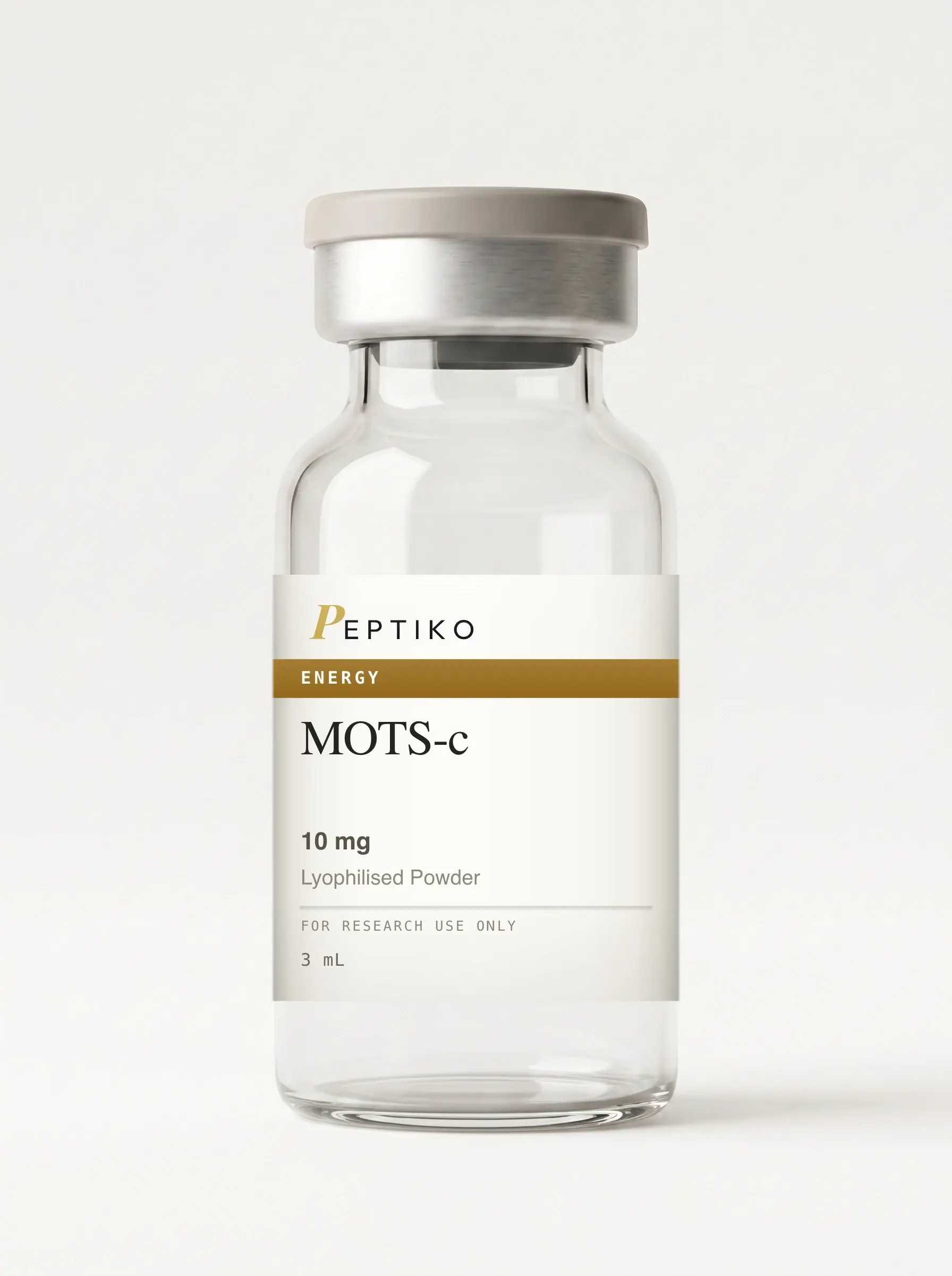
MOTS-c vs SS-31: two mitochondrial peptides compared
TL;DR: MOTS-c (CAS 1627580-64-6) is a 16-residue mitochondrial-derived peptide studied in AMPK-signalling and metabolic-regulation research models. SS-31 is a synthetic mitochondria-targeting tetrapeptide. Both are supplied as ≥99% HPLC-MS research reagents for in-vitro laboratory use only.
Over the past decade the mitochondrion has been reframed in the research literature from a passive “powerhouse” into a signalling hub. Two compounds sit at the centre of that shift: MOTS-c, a peptide encoded by the mitochondrial genome itself, and SS-31 (elamipretide), a synthetic peptide engineered to accumulate at the inner mitochondrial membrane. They are often mentioned together, yet they belong to different categories. This overview covers the mitochondrial-derived-peptide concept, the pathways each compound is studied in, and how research-grade purity is documented.
What is a mitochondrial-derived peptide?
Mitochondrial-derived peptides (MDPs) are short peptides encoded by small open reading frames hidden within the mitochondrial ribosomal-RNA genes rather than in nuclear DNA. The best-characterised examples are Humanin (encoded within the 16S rRNA region) and MOTS-c (encoded within the 12S rRNA region), alongside the SHLP1–6 family. In the published literature they are discussed as mediators of “retrograde” signalling — messages that travel from the mitochondrion outward to the nucleus and the wider cell. This concept is what distinguishes an MDP such as MOTS-c from a synthetic mitochondria-targeting molecule such as SS-31.
MOTS-c: a genome-encoded metabolic signal
MOTS-c (Mitochondrial ORF of the 12S rRNA type-c) is a 16-amino-acid peptide first described by researchers at the University of Southern California in 2015. Because it is transcribed from the mitochondrial 12S rRNA locus, it is one of the few peptides reported to be both mitochondrially encoded and detectable in systemic circulation.
In research models MOTS-c is studied primarily as an activator of AMPK (AMP-activated protein kinase), the cell’s central energy-sensing pathway. Under metabolic stress the literature describes its translocation to the nucleus, where it is reported to interact with stress-response transcription factors and antioxidant-response elements, together with effects on folate and one-carbon metabolism. For that reason MOTS-c appears repeatedly in metabolic-regulation, insulin-signalling and mitochondrial-communication research — always as an in-vitro / laboratory research subject, never as a therapeutic.
SS-31: a mitochondria-targeting tetrapeptide
SS-31 (elamipretide, CAS 736992-21-5) is a synthetic tetrapeptide with the sequence D-Arg-Dmt-Lys-Phe-NH₂. Its alternating aromatic-cationic design lets it concentrate selectively at the inner mitochondrial membrane, where the literature describes an association with cardiolipin, a phospholipid required for the structural integrity of the electron-transport-chain complexes. In oxidative-stress and bioenergetics research models, SS-31 is studied for its reported effect on cardiolipin stability, electron-transport efficiency and reactive-oxygen-species handling.
What’s the difference between MOTS-c and SS-31?
The simplest framing: MOTS-c is a signal, SS-31 is a target-seeker. MOTS-c is a naturally genome-encoded peptide studied as an upstream regulator of metabolic pathways such as AMPK. SS-31 is a designed molecule whose defining property is where it goes — its accumulation at the inner membrane. One is categorised as a mitochondrial-derived peptide; the other as a mitochondria-targeting peptide. The table below summarises the documented facts.
| Property | MOTS-c | SS-31 (elamipretide) |
|---|---|---|
| Origin | Mitochondrial genome (12S rRNA) | Synthetic |
| Length | 16 residues | 4 residues (tetrapeptide) |
| Sequence | MRWQEMGYIFYPRKLR | D-Arg-Dmt-Lys-Phe-NH₂ |
| CAS | 1627580-64-6 | 736992-21-5 |
| Category | Mitochondrial-derived peptide | Mitochondria-targeting peptide |
| Studied pathway | AMPK signalling, metabolic regulation | Cardiolipin / electron-transport-chain stability |
| Purity spec | ≥99% HPLC-MS | ≥99% HPLC-MS |
Studied pathways at a glance
- MOTS-c — AMPK activation; nuclear translocation under metabolic stress; folate / one-carbon metabolism; antioxidant-response signalling.
- SS-31 — inner-membrane localisation; cardiolipin association; electron-transport-chain efficiency; reactive-oxygen-species handling.
- Shared context — both feature in the broader mitochondrial-biology literature that also includes Humanin and Epithalon.
How is research-grade purity verified?
Signalling studies depend on knowing exactly what is in the vial. Every Peptiko research reagent is supplied at ≥99% HPLC-MS verified purity. A proper COA reports HPLC purity, mass-spectrometry identity confirmation and the batch identifier, so a laboratory can match the document to the physical vial before any work begins. We do not currently issue a third-party certificate of analysis, and would rather say so than imply one.
If reconstitution is required, treat it as a one-time preparation of an in-vitro working stock following your institution’s protocol; store and handle strictly as a laboratory reagent.
Ordering
Explore the compounds discussed here: MOTS-c and SS-31.
Research Use Only. MOTS-c and SS-31 are research peptide reagents for in-vitro laboratory use only by qualified researchers and laboratories. They are not medicines and are not intended for human or animal use, diagnostic or therapeutic application. All mechanisms described are as reported in the scientific literature and in research models.
For in-vitro research and laboratory use only. Not for human or animal consumption.