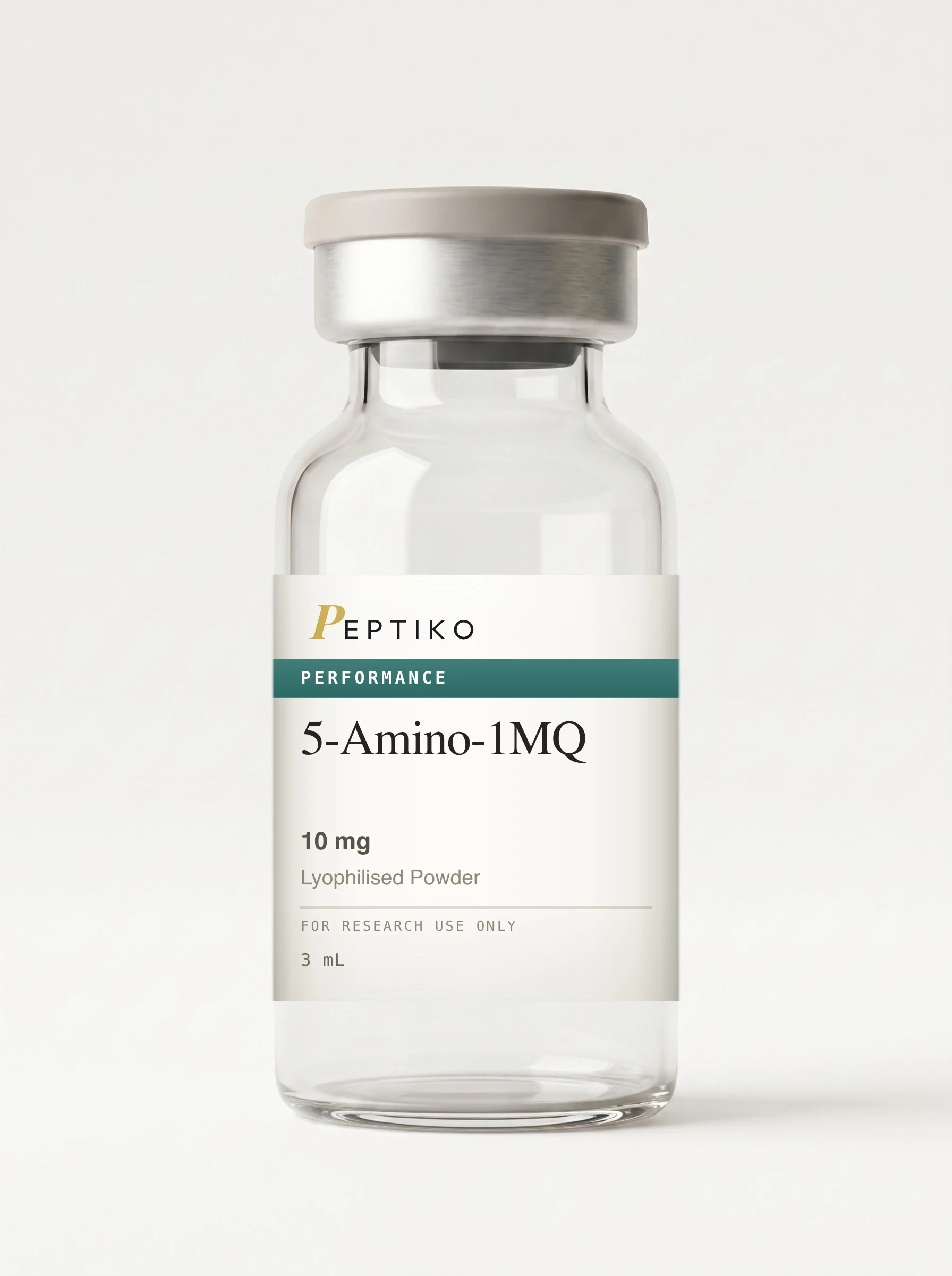
5-Amino-1MQ
Small-molecule NNMT inhibitor. Studied for adipocyte-metabolism and NAD-salvage pathways — a membrane-permeable metabolic research reagent.
For in-vitro research and laboratory use only. Not for human or animal consumption.
- ≥99% purity by HPLC-MS · lot number on every vial
- Delivery in Moldova: 1 business day
- Cash to the courier on delivery
- + bacteriostatic water free with this order
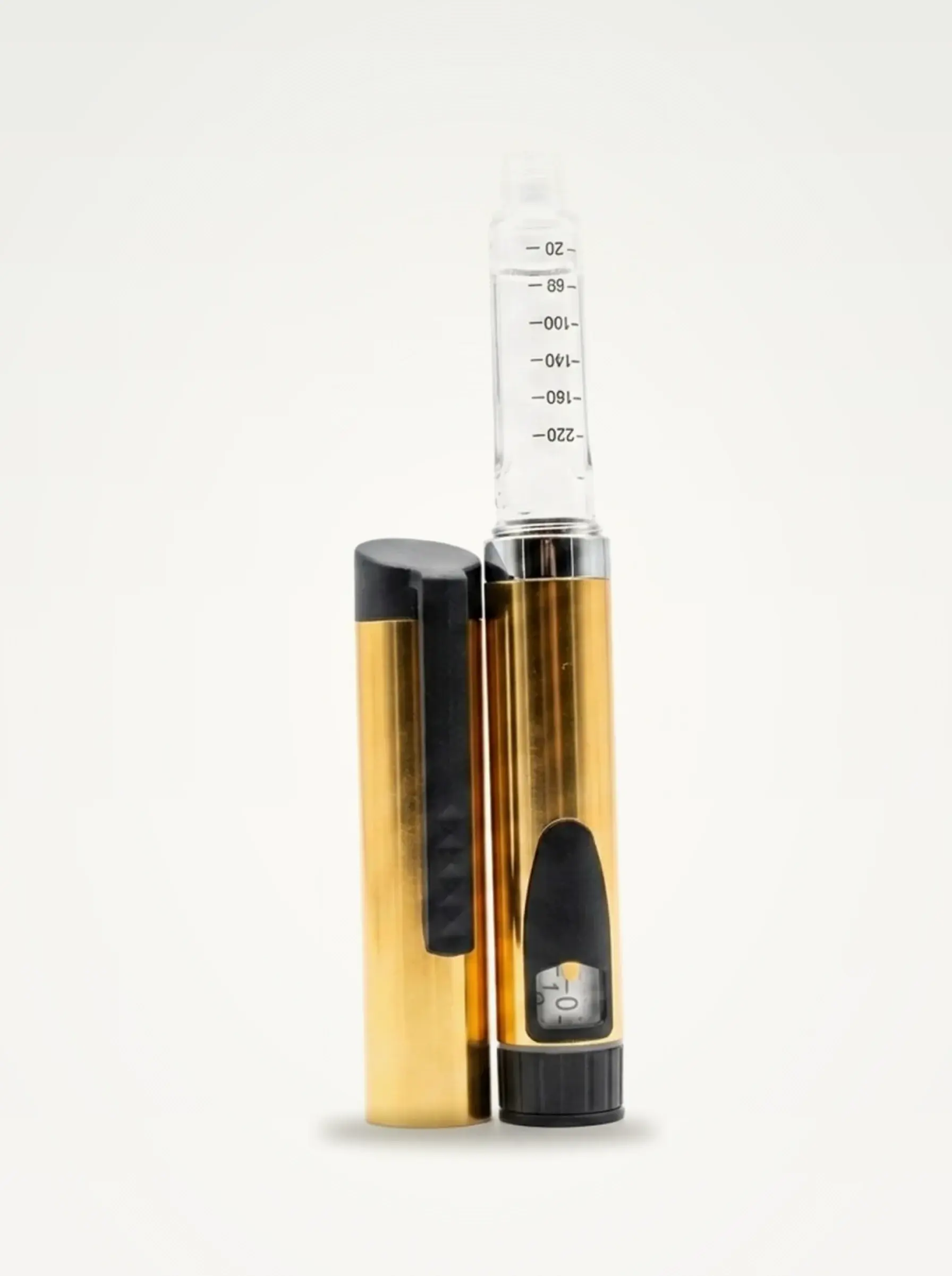 Injection Penreusable device · 800 lei
- Purity
- ≥98% HPLC-MS verified
- CAS
- 57165-43-2
- Storage
- −20 °C, protect from light and moisture. ≥24 months.
- Formats
- 50mg vial · 100mg vial
Courier delivery anywhere in Moldova. Lyophilized peptides travel at ambient temperature.
Overview
5-Amino-1MQ shifts fat cells toward burning energy rather than storing it, which is why laboratories study it as a fat-loss and metabolism reagent. It works by blocking NNMT, an enzyme that runs overactive in fat tissue in obesity, freeing up NAD+ — the coenzyme cells use to power their metabolism. In animal studies, treated subjects lost body weight and fat mass without eating less, and that finding is what keeps it near the front of obesity research.
Mechanism
5-Amino-1MQ is not a peptide. It is a small quaternary quinolinium cation — 5-amino-1-methylquinolinium, C10H11N2+, formula weight about 159 — a permanently charged, N-methylated heteroaromatic ring that echoes the N-methylated product released by nicotinamide N-methyltransferase (NNMT), the structural logic behind product-like inhibitors of that enzyme. NNMT itself sits at the junction of two metabolic currencies: it transfers a methyl group from S-adenosylmethionine (SAM) onto nicotinamide, so every turn of the enzyme consumes both the cell's universal methyl donor and a precursor of NAD+. The cited literature reads the consequences from the opposite direction, by taking the enzyme away. In white adipose tissue and liver, Nnmt knockdown is reported to raise SAM and NAD+, to act through histone H3 lysine 4 methylation, and to upregulate the polyamine enzymes ODC and SSAT, with measurable polyamine flux — diacetylspermine excretion and adipocyte secretion — and an increase in adipocyte oxygen consumption that is dependent on ODC, SSAT and polyamine oxidase; NAD+-dependent SIRT1 signalling is named as a fourth arm. In tumour stroma the same SAM drain is reported to lower repressive histone marks and switch on fibroblast secretory programmes. The described cascade is therefore not receptor signalling at all: it is a methyl-transfer bottleneck, and what gets measured downstream are metabolite pools, chromatin marks and cellular oxygen consumption.
Molecular identity
- Sequence
- Non-peptide small molecule — 5-amino-1-methylquinolinium cation (C10H11N2+, MW 159.21, CAS 57165-43-2); a quaternary N-methylated quinoline, so no amino-acid sequence exists.
- Formula
- C10H11N2+
- Molecular weight
- 159.21 g/mol
- CAS
- 57165-43-2
- PubChem CID
- 950107
What it acts on
- Nicotinamide N-methyltransferase (NNMT) — the SAM-dependent enzyme that methylates nicotinamide to 1-methylnicotinamide; it is the single node all of the papers cited here converge on, though the direction differs between them: in adipose tissue the described effects follow from removing the enzyme, while in tumour stroma and in drug-resistant tumour cells they follow from its high expression and are reversed by knockout or inhibition.
- NAD+ salvage pool and SIRT1 signalling — nicotinamide spared from methylation is a NAD+ precursor; the adipose knockdown study reports raised tissue NAD+ and names NAD+-dependent SIRT1 signalling among the affected arms.
- S-adenosylmethionine pool and histone methylation — because the enzyme spends the cell's methyl donor, the cited papers report shifts in different tissues: in adipose tissue knockdown raises SAM and acts through histone H3 lysine 4 methylation, while lowered H3K27me3 is reported in tumour stroma where the enzyme is highly expressed, and lowered H3K9me3 together with H3K27me3 in EGFR-TKI-resistant lung-cancer cells.
- Polyamine flux through ODC, SSAT and polyamine oxidase — knockdown is reported to raise the expression and activity of ODC and SSAT, with measurable diacetylspermine output and an increase in adipocyte oxygen consumption that disappears when ODC, SSAT or polyamine oxidase is blocked; no change in polyamine oxidase itself is reported.
- Fibroblast secretory programme in tumour stroma — in ovarian-cancer models NNMT in cancer-associated fibroblasts is reported to drive complement secretion and the recruitment of myeloid-derived suppressor cells, with knockout or inhibition restoring CD8+ T-cell activation.
What the studies report
Each item below summarises the paper it is numbered to, written from that paper's own abstract. The badge says how the evidence was produced.
- 1.animal modelNature (2025)
A 2025 Nature study combining spatial transcriptomics and single-cell RNA sequencing of high-grade serous ovarian cancer with mouse genetics. NNMT in cancer-associated fibroblasts is reported to cause H3K27me3 hypomethylation and complement secretion that attracts myeloid-derived suppressor cells; Nnmt knockout in immunocompetent mice impaired tumour growth in syngeneic ovarian, breast and colon models through enhanced CD8+ T cell activation. The authors then developed, by high-throughput screening, their own potent and specific NNMT inhibitor — a distinct compound, not this reagent — which reduced tumour burden and metastasis in several mouse models and restored immune-checkpoint-blockade efficacy. All efficacy data are murine, and the paper opens by stating that CAF-targeted therapies do not exist.
- 2.animal modelNature (2019)
The 2019 proteomics paper that nominated NNMT as a stromal regulator. A label-free workflow able to work from as few as 5,000 microdissected formalin-fixed cells separated tumour from stroma in human high-grade serous ovarian carcinoma: the tumour proteome stayed stable from in situ lesions to metastatic disease, while metastasis-associated stroma carried a highly conserved signature headed by NNMT. In fibroblasts, NNMT expression was reported as necessary and sufficient for cancer-associated fibroblast markers and for cytokine and matrix secretion, depleting S-adenosyl methionine and reducing histone methylation, with supporting growth and metastasis experiments done in vivo. The tissue-level part is descriptive and associative, and the functional work spans cultured fibroblasts and mouse experiments; the authors conclude that NNMT is a central metabolic regulator of cancer-associated fibroblast differentiation that may be therapeutically targeted.
- 3.animal modelNature (2014)
The foundational obesity paper and the only cited work that touches energy metabolism. DNA arrays comparing adipose-specific Glut4-knockout and adipose-specific Glut4-overexpressing mice with their respective controls identified Nnmt as the most strongly reciprocally regulated gene, and NNMT was elevated in white adipose tissue and liver of obese and diabetic mice. Knockdown in those tissues protected against diet-induced obesity by augmenting cellular energy expenditure, and raised adipose SAM and NAD+, ODC and SSAT expression and activity, urinary and adipocyte diacetylspermine, and adipocyte oxygen consumption in an ODC-, SSAT- and PAO-dependent manner. It is a genetic knockdown study in mice: it nominates and validates the enzyme as a target, it does not test any small molecule.
- 4.animal modelMol Cancer (2025)
A 2025 study of acquired EGFR-TKI resistance in non-small-cell lung cancer. Bioinformatics found NNMT upregulated in resistant cells and tissues through EGR1-mediated transcriptional activation, with high levels correlating with poorer prognosis in EGFR-mutant patients. Mechanistically the enzyme's consumption of S-adenosyl methionine lowered H3K9me3 and H3K27me3 and de-repressed EGR1 and ALDH3A1; ALDH3A1 raised lactate, which fed back on NNMT expression via p300-mediated H3K18 lactylation, closing two positive feedback loops. Combining a small-molecule NNMT inhibitor with osimertinib was tested in an osimertinib-resistant mouse xenograft. The prognostic part is correlative, and the therapeutic part rests on a single xenograft model with an NNMT inhibitor the abstract does not identify; nothing in it indicates the compound was this reagent.
Used in research on
What this does not establish
The decisive gap is that none of the papers cited here reports testing this compound. They establish NNMT as a node using genetic knockdown or knockout, or using other small-molecule NNMT inhibitors — one developed by the authors themselves, one that the source abstract does not name — so what this literature validates is the enzyme, not this reagent; the potency and selectivity of 5-Amino-1MQ itself are not characterised anywhere in this set. The metabolic reading rests essentially on a single 2014 mouse knockdown study; there are no controlled human trials in this set, and no regulator has approved the compound for anything. NNMT biology is also context-dependent rather than uniformly one-directional: the same enzyme appears as an obesity target in adipose tissue and as a tumour-stroma and drug-resistance factor in the oncology papers, and the consequences of inhibiting it systemically are not established.
Research applications
In vitro, 5-Amino-1MQ is used as a reference small-molecule NNMT inhibitor for studying nicotinamide N-methyltransferase and the NAD+ salvage pathway: enzyme-inhibition and NNMT-activity assays, NAD+ quantification in treated cells, and adipocyte lipid-storage and energy-metabolism read-outs in cultured fat cells. Because it is membrane-permeable, laboratories apply it in cell-culture systems as a comparator for probing how NNMT activity and NAD+ availability shape adipocyte metabolism. It serves as a benchmark tool for in-vitro research into adipocyte metabolism, insulin-signalling and energy-metabolism pathways, used only in cell-culture laboratory systems.
Reconstitution
Supplied as a lyophilised powder. For laboratory preparation, reconstitute with sterile bacteriostatic water to a working stock, keep the reconstituted solution at 4 degrees C, and prepare assay dilutions in the buffer specified by your protocol. Store the unopened lyophilised vial at −20 °C, protected from light and moisture. For in-vitro research use only, not for human or animal administration.
Storage & handling
−20 °C, protect from light and moisture. ≥24 months.
Research literature
Selected peer-reviewed literature describing this compound. Peptiko supplies peptides for in-vitro research; these papers characterise the compound, not this product.
- 1.NNMT inhibition in cancer-associated fibroblasts restores antitumour immunity. Nature (2025)
- 2.Proteomics reveals NNMT as a master metabolic regulator of cancer-associated fibroblasts. Nature (2019)
- 3.Nicotinamide N-methyltransferase knockdown protects against diet-induced obesity. Nature (2014)
- 4.NNMT promotes acquired EGFR-TKI resistance by forming EGR1 and lactate-mediated double positive feedback loops in non-small cell lung cancer. Mol Cancer (2025)
Frequently asked questions
What is 5-Amino-1MQ?
5-Amino-1MQ is a membrane-permeable, small-molecule inhibitor of nicotinamide N-methyltransferase (NNMT), supplied as a lyophilised research reagent. In vitro it is studied as a reference NNMT inhibitor in cell-based adipocyte-metabolism and NAD+ salvage-pathway research.
Is it for human use?
No. It is a research-use-only reagent for in-vitro laboratory study. It is not a pharmaceutical, supplement, or medicine, and not for human or veterinary use.
How is purity verified?
Purity is at least 99% by HPLC-MS.
What is the CAS number?
CAS 57165-43-2.
Do you ship from Moldova?
Yes. We deliver by courier anywhere in Moldova, one business day after we confirm the order, and you pay the courier in cash. Lyophilized peptides travel at ambient temperature: a freeze-dried cake needs no cold chain.
Reviews
Be the first to review 5-Amino-1MQ.
Order on Telegram, or add it to the cart and check out on the site. Cash to the courier on delivery — nothing is paid in advance.