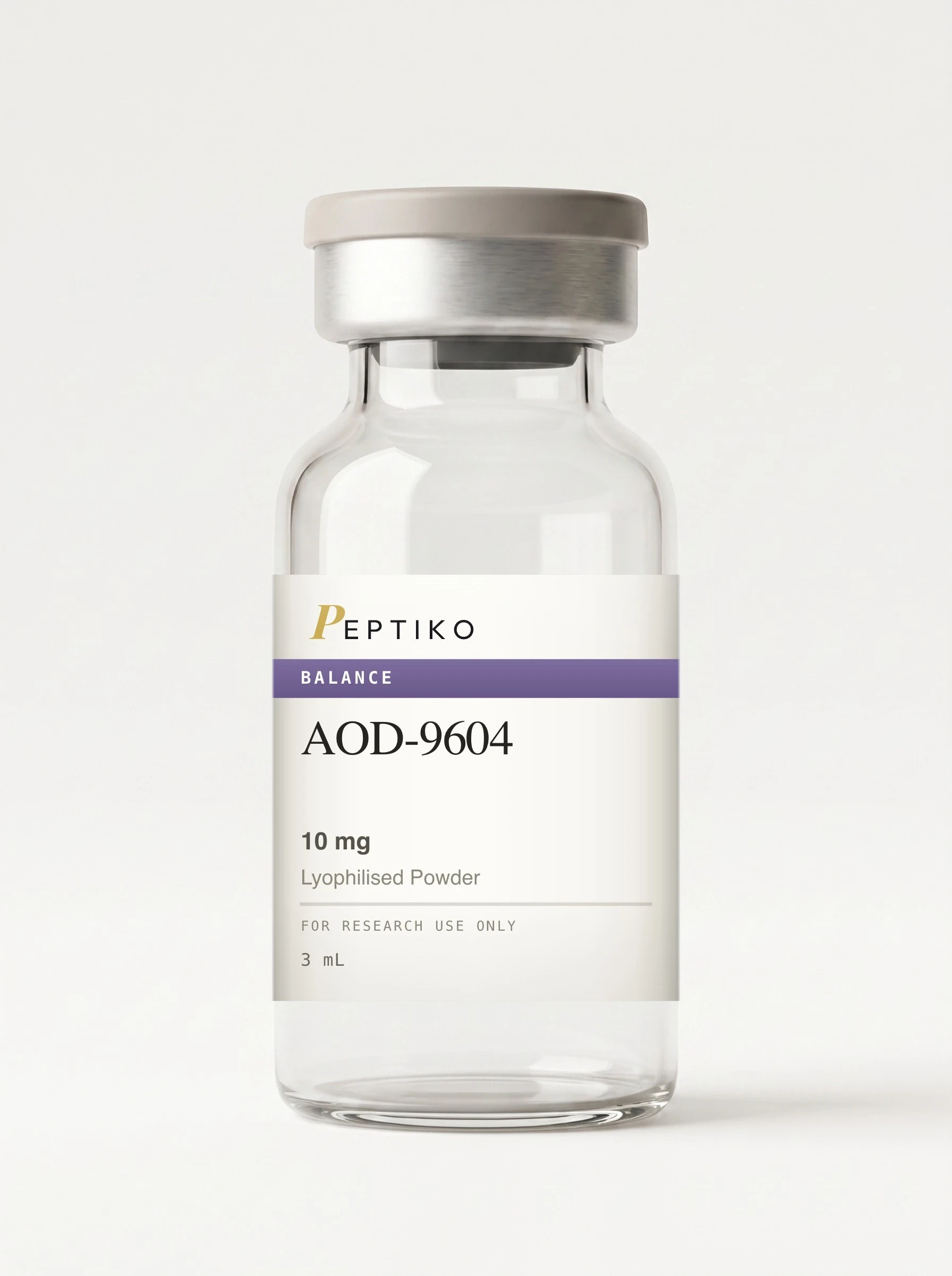
AOD-9604
Modified C-terminal fragment (176-191) of human growth hormone. Studied for lipolysis and fat-metabolism pathways — a research peptide with no reported IGF-1 or blood-glucose signaling in studies.
For in-vitro research and laboratory use only. Not for human or animal consumption.
- ≥99% purity by HPLC-MS · lot number on every vial
- Delivery in Moldova: 1 business day
- Cash to the courier on delivery
- + bacteriostatic water free with this order
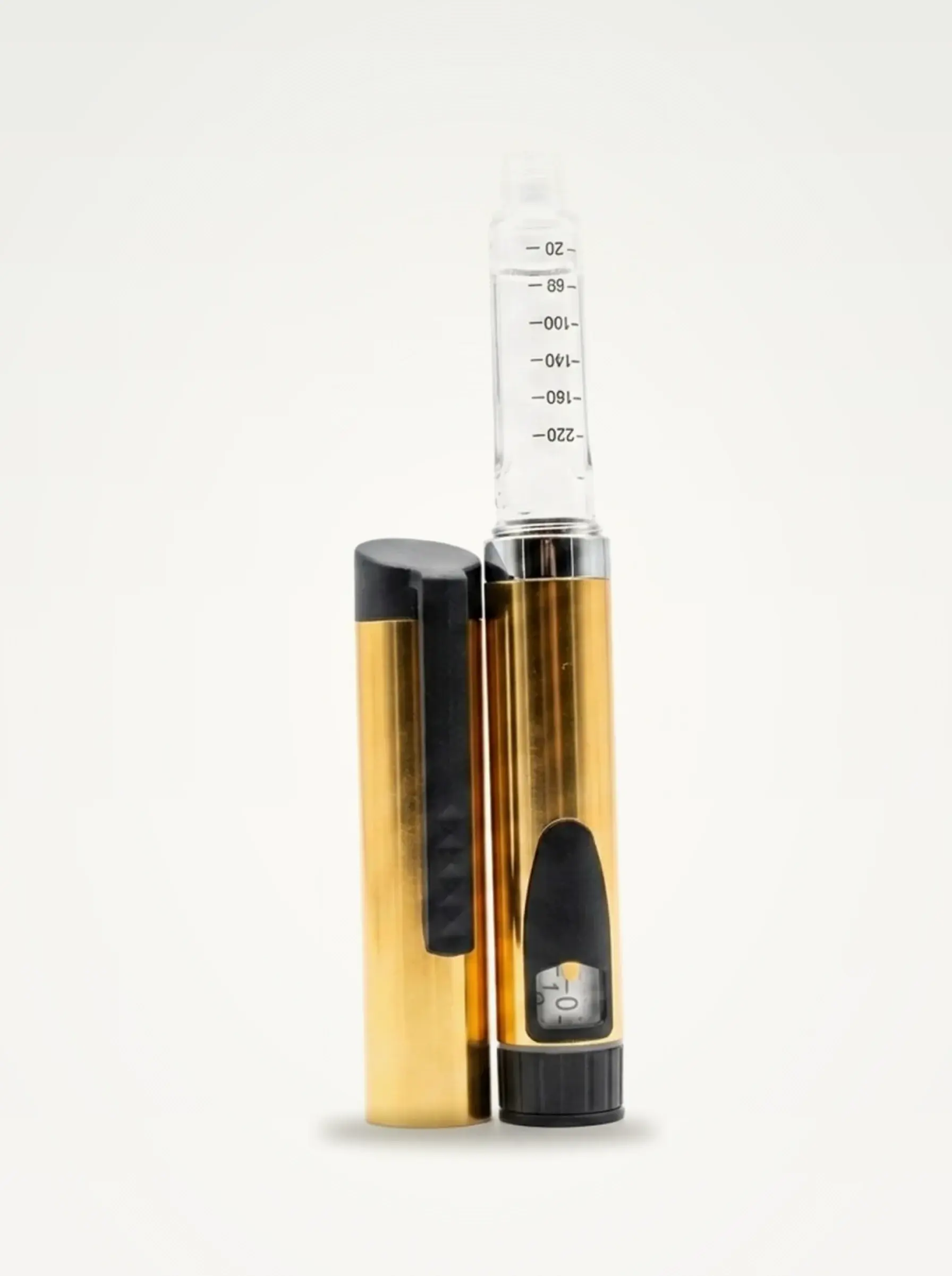 Injection Penreusable device · 800 lei
- Purity
- ≥99% HPLC-MS verified
- CAS
- 221231-10-3
- Storage
- Lyophilised: 2–8 °C, protect from light (−20 °C for long-term, ≥24 months). Reconstituted: 2–8 °C.
- Formats
- 2mg vial · 5mg vial · 10mg vial
Courier delivery anywhere in Moldova. Lyophilized peptides travel at ambient temperature.
AOD-9604: the modified hGH 176-191 fragment →Overview
In laboratory studies, AOD-9604 broke down stored fat and slowed the formation of new fat, which is why it is researched as a targeted fat-burning compound. It copies only the fat-metabolism tail of human growth hormone, so in those studies it acted on body fat without raising blood sugar or triggering the hormone's growth effects. That selective profile of burning fat while leaving the rest alone is what keeps it in weight-loss and metabolic research.
Mechanism
AOD-9604 is a synthetic 16-residue peptide: the C-terminal fragment of human growth hormone, residues 177-191, carried on an added N-terminal tyrosine and closed by a disulfide bridge between its two cysteines, which gives the fragment its loop. The design logic is subtractive. The intact 191-residue hormone acts through the growth hormone receptor and produces a fat-mobilising effect together with the growth and glucose effects that come with it; this fragment reproduces only the C-terminal region long associated with fat mobilisation, and was built to keep that behaviour without the receptor-mediated growth arm. The fat-cell and obese-animal readouts usually attached to it — an increase in the breakdown of stored fat, a decrease in the formation of new fat, a fall in body fat, and no rise in IGF-1 or disturbance of glucose handling — come from literature outside this reference set: none of the abstracts cited here reports any of them, and the two 2026 reviews mention the compound only inside class lists. The step between the peptide and the adipocyte — the receptor or enzyme it actually engages — is likewise not identified in any abstract in this reference set, and a 2026 orthopaedic review in fact files the compound with growth hormone secretagogues said to act through IGF-1 signalling, so even the direction of the mechanism is unsettled in the cited literature. It entered clinical development as an anti-obesity candidate and reached phase IIa; that unfinished programme is why it remains a metabolic research compound rather than an established one.
Molecular identity
- Sequence
- Tyr-Leu-Arg-Ile-Val-Gln-Cys-Arg-Ser-Val-Glu-Gly-Ser-Cys-Gly-Phe (Cys7–Cys14 disulfide)
- Formula
- C78H123N23O23S2
- Molecular weight
- 1815.1 g/mol
- CAS
- 221231-10-3
- PubChem CID
- 71300630
What it acts on
- Adipocyte lipolysis and lipogenesis — the fragment corresponds to the region of human growth hormone associated with fat mobilisation, and increased breakdown of stored fat and reduced formation of new fat in fat-cell models are described in literature outside this reference set; no abstract cited here reports either observation, and no enzyme step is named.
- Growth hormone receptor signalling — the growth and glucose effects that the intact hormone carries through this receptor are described as absent from the fragment in literature outside this reference set; no abstract cited here reports that comparison, nor binding or receptor-occupancy data either way.
- IGF-1 signalling — contested inside this reference set: the 2026 orthopaedic review lists the compound among agents said to activate IGF-1 signalling and satellite-cell repair, while the fragment is described elsewhere, outside this reference set, as leaving IGF-1 unchanged. No cited abstract reports an actual measurement.
- PI3K/Akt, mTOR, MAPK, TGF-β and AMPK — named by the 2026 orthopaedic review as the networks through which the whole peptide class it surveys is said to act; the review attributes none of them to this molecule specifically.
What the studies report
Each item below summarises the paper it is numbered to, written from that paper's own abstract. The badge says how the evidence was produced.
- 1.
A two-sentence development note in a drug-pipeline digest. It records only that the company Metabolic was developing AOD-9604 for the potential treatment of obesity and that phase IIa trials were under way by February 2002. No mechanism, no cohort, no outcome figures — a status entry rather than a study, and nothing in it establishes an effect.
- 2.
A 2026 narrative review of therapeutic peptides in orthopaedics. It attributes the activity of the class to PI3K/Akt, mTOR, MAPK, TGF-β and AMPK signalling, and places AOD-9604 in a group with ipamorelin, CJC-1295, tesamorelin and sermorelin described as activating IGF-1 signalling and satellite-cell repair — a class assignment rather than compound-specific data, and one that sits awkwardly against the fragment's usual description as IGF-1-sparing. The authors state directly that although preclinical studies are promising, clinical trials are currently lacking.
- 3.reviewSports Med (2026)
A 2026 narrative review in Sports Med covering approved and unapproved peptides marketed direct to patients, with AOD-9604 named first in that list. Its conclusion about the unapproved group is the substance of the paper: favourable tissue-repair and metabolic outcomes in animal models, but scarce rigorous human safety data and real potential for serious harm. The authors also treat the placebo effect as a mediator of apparent peptide efficacy and note how social media amplifies it. This is class-level narrative synthesis, not primary data on this compound.
Used in research on
What this does not establish
This reference set contains no primary experimental paper on the compound: a two-sentence 2004 development note, two 2026 narrative reviews that handle it inside a class list, and a 2013 letter whose abstract is not available here. The lipolysis, lipogenesis and body-fat observations are not reported in this set at all — not even second-hand: neither cited review states them, so they rest entirely on literature outside these references, and the result of the phase IIa obesity programme is reported nowhere here either. No controlled human efficacy data appear here at all: one cited review states outright that clinical trials are lacking, the other that rigorous human safety data are scarce among the unapproved peptides it surveys, though its abstract does not say which of the compounds it lists — this one included — it counts as unapproved; no cited abstract records a regulatory approval. Even the direction of the mechanism is unsettled — that same orthopaedic review assigns the compound IGF-1 signalling, the opposite of the IGF-1-sparing profile by which it is described outside this set.
Research applications
In vitro, AOD-9604 is used as a reference compound for studying the lipolysis and fat-metabolism pathways associated with the C-terminal region of human growth hormone (residues 176-191). Laboratories apply it in adipocyte cell-culture assays that read out the breakdown of stored fat (lipolysis) and the formation of new fat (lipogenesis), and in comparative panels that set its selective fat-metabolism signalling against the whole growth-hormone molecule. Because in published laboratory work it did not raise IGF-1 or disturb glucose signalling, it also appears as a selectivity reference across adipocyte and lipid-metabolism research.
Reconstitution
Supplied lyophilised. For laboratory preparation, reconstitute with sterile bacteriostatic water to a working stock, keep the reconstituted solution at 4 degrees C, and prepare assay dilutions in the buffer specified by your protocol. For in-vitro research use only, not for human or animal administration.
Storage & handling
Lyophilised: 2–8 °C, protect from light (−20 °C for long-term, ≥24 months). Reconstituted: 2–8 °C.
Research literature
Selected peer-reviewed literature describing this compound. Peptiko supplies peptides for in-vitro research; these papers characterise the compound, not this product.
- 1.AOD-9604 Metabolic. Curr Opin Investig Drugs (2004)
- 2.Therapeutic Peptides in Orthopaedics: Applications, Challenges, and Future Directions. J Am Acad Orthop Surg Glob Res Rev (2026)
- 3.Safety and Efficacy of Approved and Unapproved Peptide Therapies for Musculoskeletal Injuries and Athletic Performance. Sports Med (2026)
- 4.AOD-9604 does not influence the WADA hGH isoform immunoassay. Drug Test Anal (2013)
Frequently asked questions
What is AOD-9604?
A synthetic modified C-terminal fragment (residues 176-191) of human growth hormone, supplied as a lyophilised reagent for in-vitro laboratory research into lipolysis and fat-metabolism pathways.
Is it for human use?
No. It is a research-use-only reagent for in-vitro laboratory study. It is not a pharmaceutical, supplement, or medicine, and not for human or veterinary use.
How is purity verified?
Purity is at least 99% by HPLC-MS.
What is the CAS number?
CAS 221231-10-3.
Do you ship from Moldova?
Yes. We deliver by courier anywhere in Moldova, one business day after we confirm the order, and you pay the courier in cash. Lyophilized peptides travel at ambient temperature: a freeze-dried cake needs no cold chain.
Reviews
Be the first to review AOD-9604.
Order on Telegram, or add it to the cart and check out on the site. Cash to the courier on delivery — nothing is paid in advance.