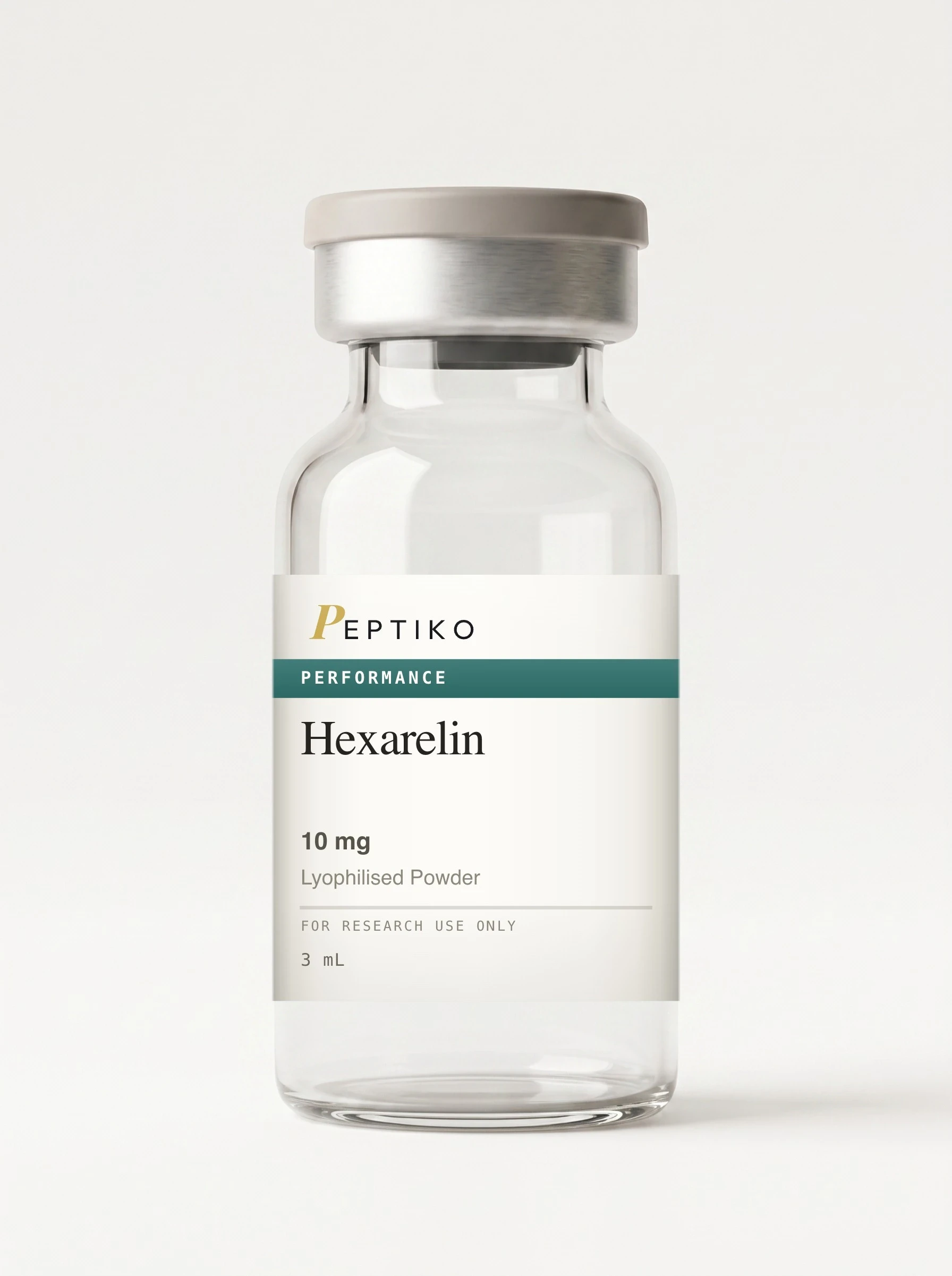
Hexarelin
Synthetic hexapeptide growth-hormone secretagogue, studied for the GHS-R1a and CD36 receptor signalling pathway.
For in-vitro research and laboratory use only. Not for human or animal consumption.
- ≥99% purity by HPLC-MS · lot number on every vial
- Delivery in Moldova: 1 business day
- Cash to the courier on delivery
- + bacteriostatic water free with this order
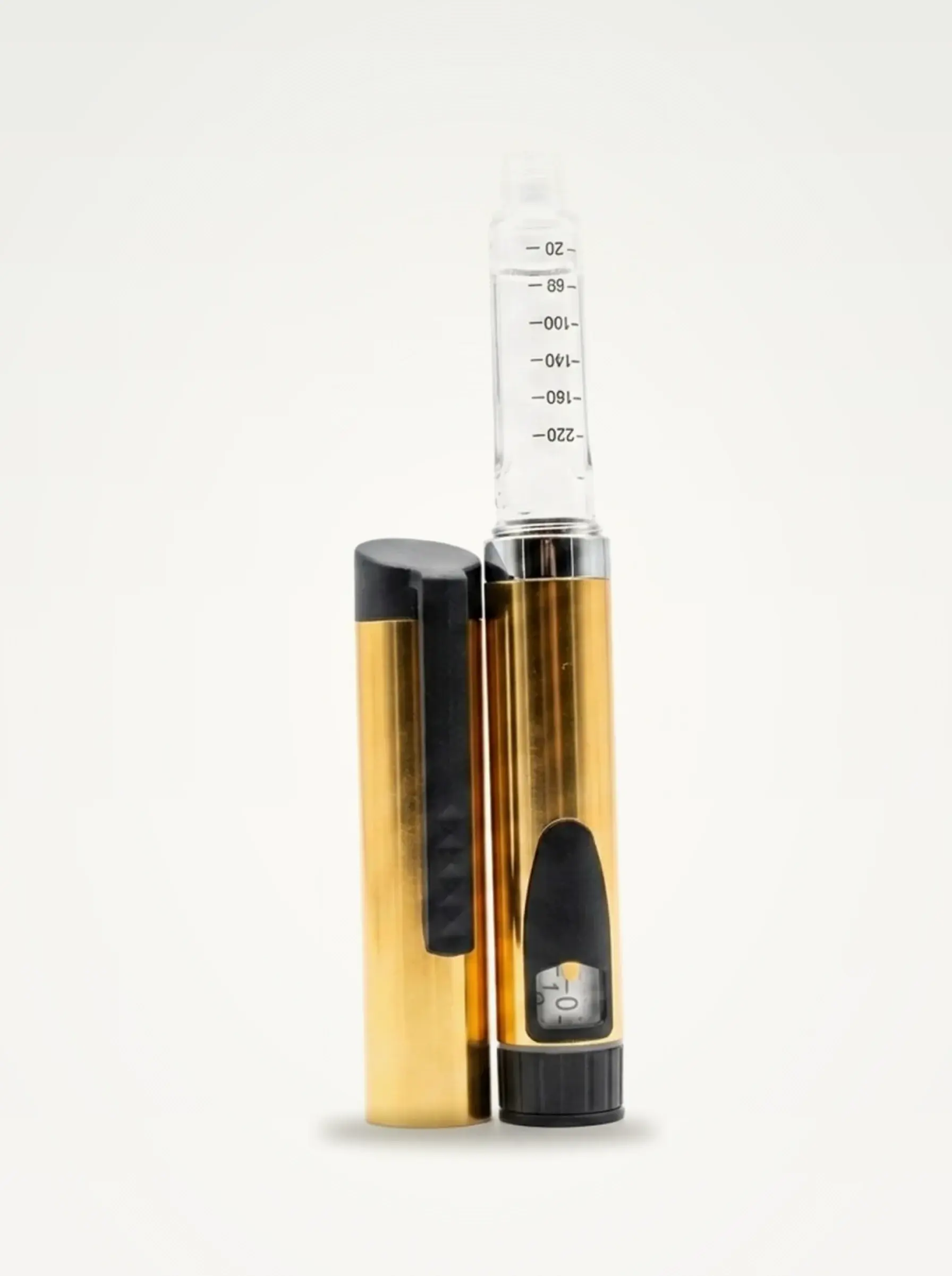 Injection Penreusable device · 800 lei
- Purity
- ≥99% HPLC-MS verified
- CAS
- 140703-51-1
- Storage
- Lyophilised: 2–8 °C, protect from light and moisture (−20 °C for long-term, ≥24 months). Reconstituted: 2–8 °C.
- Formats
- 5 mg vial
Courier delivery anywhere in Moldova. Lyophilized peptides travel at ambient temperature.
Overview
Hexarelin (CAS 140703-51-1) is a synthetic hexapeptide growth-hormone secretagogue supplied as a lyophilised reference reagent for in-vitro research. It is characterised in vitro as a dual ligand of the growth-hormone secretagogue receptor (GHS-R1a) and the CD36 scavenger receptor, and is used as a tool compound in growth-hormone-axis and cardiovascular signalling research.
Mechanism
Hexarelin is a synthetic hexapeptide of the growth-hormone-releasing-peptide (GHRP) family rather than a natural sequence: it carries D-configured residues and a methylated tryptophan and is amidated at the C-terminus, a backbone that departs from any natural sequence; the review literature calls it chemically more stable and functionally more potent than ghrelin, without stating in the cited text what that comparison rests on. The signal runs on two separate arms. The first is the ghrelin receptor GHS-R1a, a G-protein-coupled receptor of pituitary and hypothalamus; engagement is associated in vitro with Gq/phospholipase-C signalling and intracellular calcium mobilisation, and this is the route by which the GHRP class releases growth hormone. Mapping with radiolabelled Tyr-Ala-hexarelin, however, found binding sites well outside that axis — heart, adrenal, ovary, testis, lung and skeletal muscle, at higher density than in the hypothalamo-pituitary system, and within human cardiovascular tissue highest in ventricles, then atria, aorta, coronaries, carotid, endocardium and vena cava. The second arm was identified from that cardiac site: photoaffinity labelling and purification of rat cardiac membranes returned a glycoprotein of about 84 kDa whose N-terminal sequence was CD36, a scavenger receptor of cardiomyocytes and microvascular endothelium; peptidyl GHRPs compete for this site while the non-peptidyl secretagogue MK-677 does not, which is what makes hexarelin a reference ligand for separating GHS-R1a- from CD36-mediated effects. The two arms do not point the same way in the cited work: the GHS-R1a arm is associated with anti-apoptotic and interleukin-1-modulating readouts in cardiomyocytes, while CD36 activation in perfused hearts produced a dose-dependent rise in coronary perfusion pressure, that is, a vasoconstrictive response.
Molecular identity
- Sequence
- His-D-2-methyl-Trp-Ala-Trp-D-Phe-Lys-NH2
- Formula
- C47H58N12O6
- Molecular weight
- 887.0 g/mol
- CAS
- 140703-51-1
- PubChem CID
- 6918297
What it acts on
- GHS-R1a, the ghrelin receptor — the reviews describe hexarelin binding and activating this G-protein-coupled receptor much as ghrelin does; engagement is associated in vitro with Gq/phospholipase-C signalling and intracellular calcium mobilisation, and in the rat ischaemia/reperfusion study it was the IL-1β and IL-1Ra expression changes that were neutralised by a GHSR antagonist.
- CD36 scavenger receptor — photoaffinity labelling of rat cardiac membranes identified the hexarelin binding protein as a glycoprotein of about 84 kDa whose N-terminal sequence was CD36, expressed in cardiomyocytes and microvascular endothelial cells; the site is competed by peptidyl GHRPs but not by the non-peptidyl secretagogue MK-677.
- Coronary vascular tone through CD36 — in isolated perfused hearts, activation of CD36 by hexarelin raised coronary perfusion pressure in a dose-dependent manner, a response absent in CD36-null hearts and in CD36-deficient spontaneously hypertensive rats.
- Interleukin-1 signalling in ischaemic myocardium — the in vivo rat study reports down-regulated IL-1β and up-regulated IL-1Ra protein in reperfused myocardium, an effect neutralised by GHSR blockade.
- Pituitary hormone output — the class review notes that GHRPs release growth hormone strongly and reproducibly but also release prolactin and ACTH/cortisol, so the class is not endocrine-selective.
What the studies report
Each item below summarises the paper it is numbered to, written from that paper's own abstract. The badge says how the evidence was produced.
- 1.reviewJ Geriatr Cardiol (2014)
A concise narrative review of the cardiovascular literature. It sets out the two-receptor picture — GHS-R1a in the brain, as for ghrelin, plus peripheral GHSR distribution in heart and vessels, and the non-GHSR receptor CD36 described as the specific cardiac receptor mediating cardioprotective effects — and states that hexarelin is chemically more stable and functionally more potent than ghrelin. The therapeutic framing is explicitly prospective (the compound 'may be' a promising agent), and the piece assembles existing evidence rather than generating any of its own.
- 2.
A review of the GHRP class. It reports strong, dose-dependent and reproducible growth-hormone release but also significant prolactin and ACTH/cortisol release, so the class is not endocrine-selective; effects on food intake and sleep pattern are noted as well. Radiolabelled Tyr-Ala-hexarelin mapped binding to pituitary, hypothalamus and extra-hypothalamic brain regions, and to heart, adrenal, ovary, testis, lung and skeletal muscle at higher density than the hypothalamo-pituitary system, with human cardiovascular binding highest in ventricles; cardiac membrane binding was displaced by peptidyl GHRPs but not by MK-677. The review further cites anti-apoptotic activity in H9c2 cells, protection from ischaemia-induced myocardial damage in aged and GH-deficient rats, and a positive inotropic effect in human subjects — but only as summary statements, without the designs, sample sizes or controls of the underlying studies.
- 3.in vitroCirc Res (2002)
The paper that identified CD36. Rat cardiac membranes were labelled with a radioactive photoactivatable hexarelin derivative and purified by lectin affinity chromatography and preparative gel electrophoresis, yielding a binding protein of about 84 kDa whose deglycosylated N-terminal sequence was identical to rat CD36, a multifunctional glycoprotein expressed in cardiomyocytes and microvascular endothelial cells. In isolated perfused hearts, CD36 activation raised coronary perfusion pressure dose-dependently; the response was absent in hearts from CD36-null mice and from spontaneously hypertensive rats genetically deficient in CD36, and correlated with CD36 expression on immunoblot. This is receptor-identification work on membranes and perfused organs rather than whole-animal treatment, and the authors' extension to coronary vasospasm in hypercholesterolaemia and atherosclerosis is offered as a suggestion, not a demonstration.
- 4.animal modelInt Heart J (2017)
An in vivo rat study of myocardial ischaemia/reperfusion: male Sprague-Dawley rats underwent left coronary artery ligation followed by reperfusion, then received hexarelin, an equimolar comparison with ghrelin, or saline, with assessment by echocardiography, malondialdehyde measurement, histochemical staining and Western blot. The report describes improved cardiac systolic function, decreased malondialdehyde, more surviving cardiomyocytes, down-regulated IL-1β and up-regulated IL-1Ra in the reperfused myocardium, with the overall benefit called slightly superior to equimolar ghrelin; it is the IL-1β and IL-1Ra expression changes, not the functional readouts, that the report shows to be neutralised by the GHSR antagonist [D-Lys3]-GHRP-6. The authors themselves describe the mechanism as partial — protection 'partly by modification of the IL-1 signalling pathway' — and the study rests on a single species and a single model, with no human arm.
Used in research on
What this does not establish
The cited set is two narrative reviews, one receptor-identification study on rat cardiac membranes and isolated perfused hearts, and one rat in vivo ischaemia–reperfusion study; no primary controlled human trial appears here. The human observations that are mentioned — a positive inotropic effect in normal subjects and in GH-deficient patients — reach this page only as a sentence inside a review from 2000, with no design, sample size or control group reported, and cannot be read as evidence of efficacy. The relative contribution of GHS-R1a and CD36 is unresolved, and the two arms disagree in direction: the CD36 work reports a dose-dependent coronary vasoconstriction that its own authors link to vasospasm, while the GHSR work reports protection. In that GHSR work the antagonist was shown to neutralise the interleukin-1 expression changes, not the functional protective readouts. Nothing cited here establishes an outcome in humans.
Research applications
Hexarelin is used in vitro as a reference agonist for probing GHS-R1a receptor binding, GPCR signal transduction and receptor-desensitisation studies. Its CD36 affinity makes it a tool reagent for cardiovascular and scavenger-receptor pathway research. It also serves as a comparator ligand in structure-activity studies of the wider growth-hormone-secretagogue and ghrelin-system reagent class.
Reconstitution
For laboratory handling, the lyophilised reagent is reconstituted with bacteriostatic or sterile water added gently down the vial wall until fully dissolved, without vortexing. The resulting stock concentration is calculated from the vial mass and the chosen solvent volume to suit the assay. Prepared stock is kept cold, aliquoted to limit freeze–thaw cycles, and used only for in-vitro research.
Storage & handling
Lyophilised: 2–8 °C, protect from light and moisture (−20 °C for long-term, ≥24 months). Reconstituted: 2–8 °C.
Research literature
Selected peer-reviewed literature describing this compound. Peptiko supplies peptides for in-vitro research; these papers characterise the compound, not this product.
- 1.The cardiovascular action of hexarelin. J Geriatr Cardiol (2014)
- 2.Growth hormone-releasing peptides and the cardiovascular system. Ann Endocrinol (Paris) (2000)
- 3.CD36 mediates the cardiovascular action of growth hormone-releasing peptides in the heart. Circ Res (2002)
- 4.The Growth Hormone Secretagogue Hexarelin Protects Rat Cardiomyocytes From in vivo Ischemia/Reperfusion Injury Through Interleukin-1 Signaling Pathway. Int Heart J (2017)
Frequently asked questions
What is Hexarelin?
Hexarelin is a synthetic hexapeptide growth-hormone secretagogue (CAS 140703-51-1, C47H58N12O6, MW ≈ 887) supplied as a ≥99% HPLC-MS lyophilised reference reagent. It is characterised in vitro as a dual ligand of the GHS-R1a and CD36 receptors and is used as a tool compound in growth-hormone-axis and cardiovascular signalling research.
Is Hexarelin for human use?
No. Hexarelin is supplied strictly for in-vitro laboratory research use only and is intended for qualified researchers and laboratories. It is not a medicine, food or cosmetic and is not for human or animal use, consumption, or any diagnostic or therapeutic purpose.
How is purity verified?
Purity is at least 99% by HPLC-MS.
What is the CAS number?
CAS 140703-51-1.
Do you ship from Moldova?
Yes. We deliver by courier anywhere in Moldova, one business day after we confirm the order, and you pay the courier in cash. Lyophilized peptides travel at ambient temperature: a freeze-dried cake needs no cold chain.
Reviews
Be the first to review Hexarelin.
Order on Telegram, or add it to the cart and check out on the site. Cash to the courier on delivery — nothing is paid in advance.