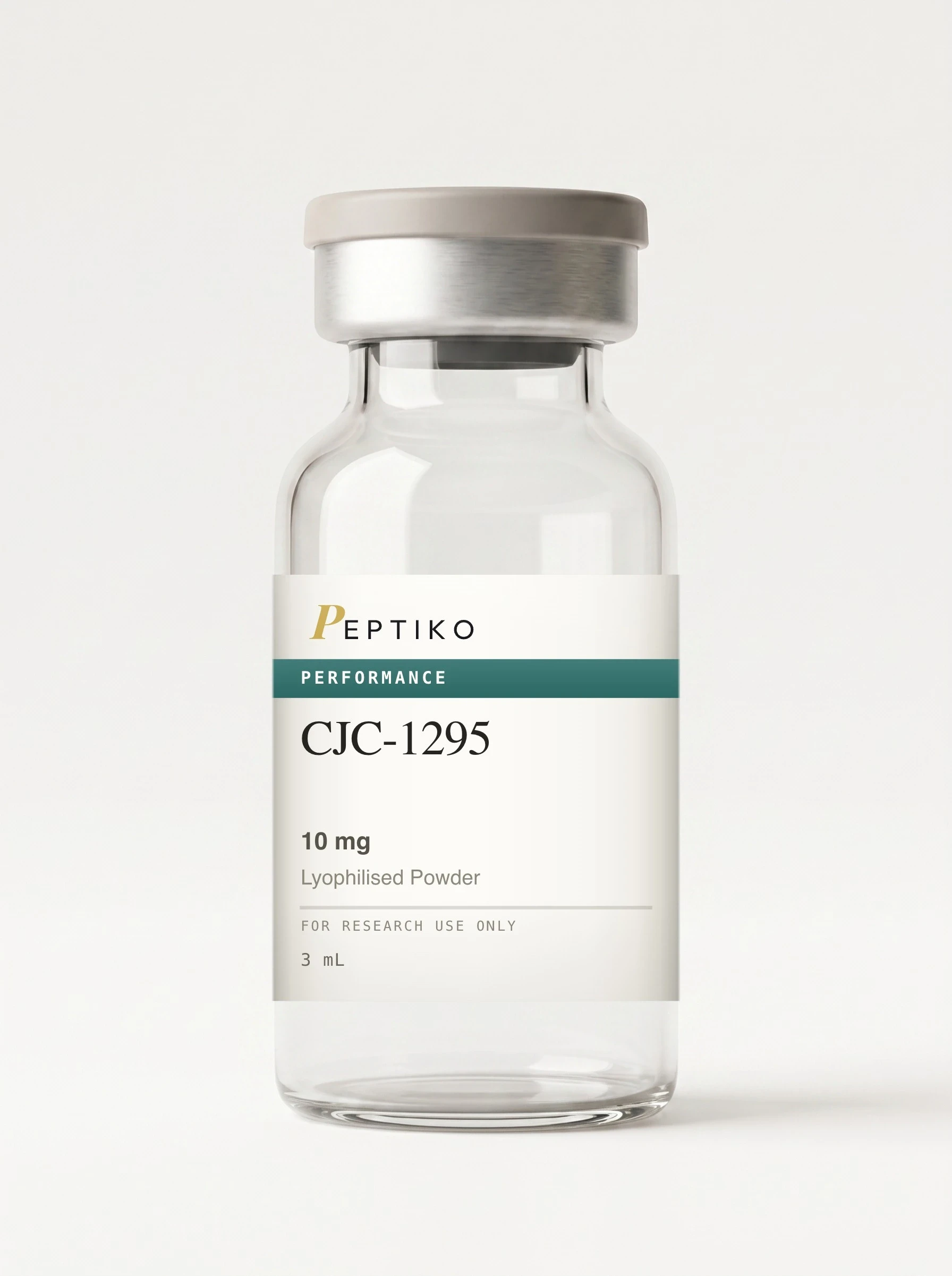
CJC-1295
Long-acting GHRH-analogue peptide (with DAC). Studied for growth-hormone-axis signalling pathways.
For in-vitro research and laboratory use only. Not for human or animal consumption.
- ≥99% purity by HPLC-MS · lot number on every vial
- Delivery in Moldova: 1 business day
- Cash to the courier on delivery
- + bacteriostatic water free with this order
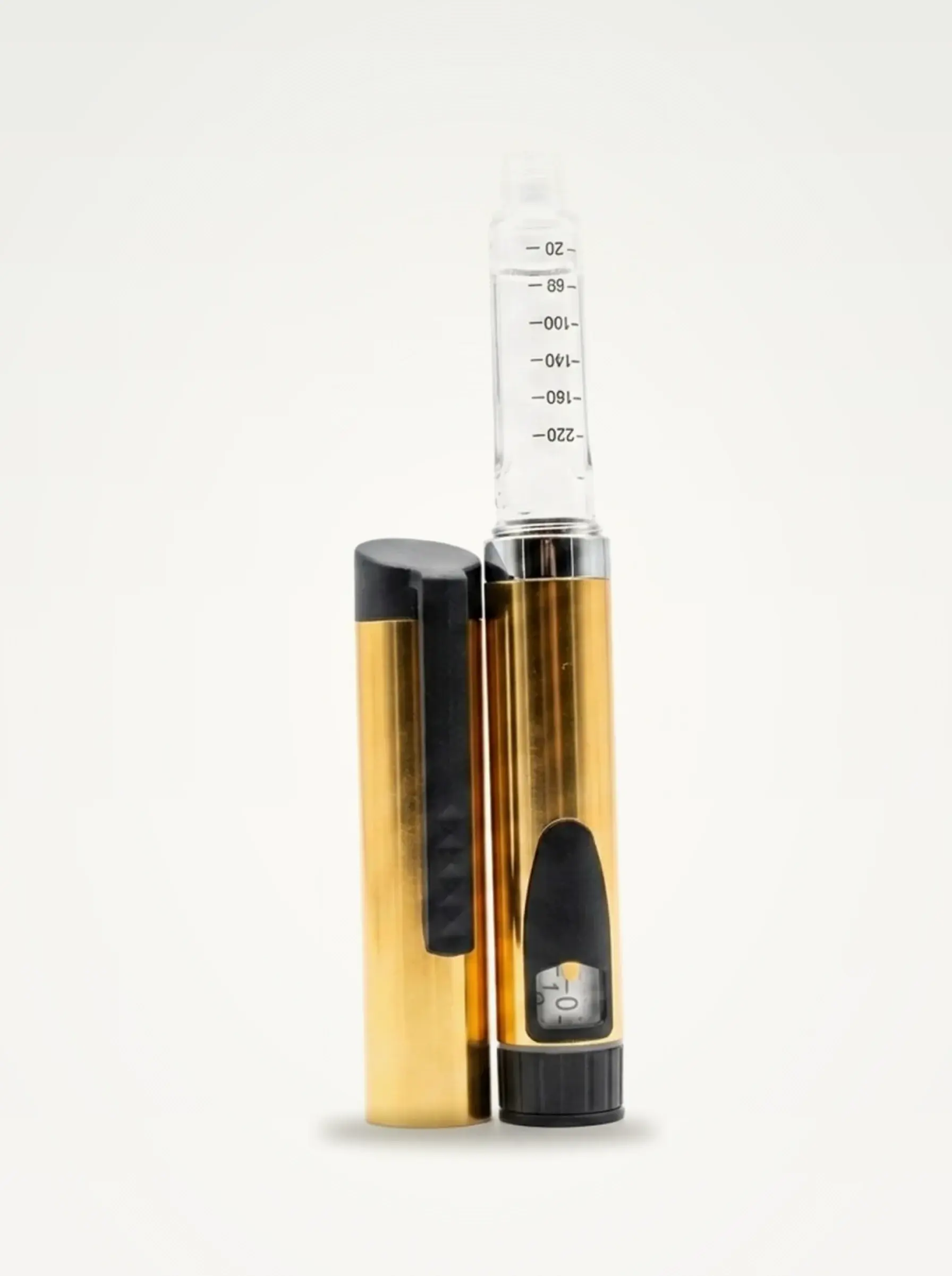 Injection Penreusable device · 800 lei
- Purity
- ≥99% HPLC-MS verified
- CAS
- 863288-72-6
- Storage
- Lyophilised: 2–8 °C (−20 °C for long-term, ≥24 months). Reconstituted: 2–8 °C.
- Formats
- 10mg vial
Courier delivery anywhere in Moldova. Lyophilized peptides travel at ambient temperature.
CJC-1295 and ipamorelin: DAC vs no-DAC explained →Overview
Duration is what sets CJC-1295 apart: one stable molecule that keeps signalling for days rather than minutes, because a Drug Affinity Complex binds it to serum albumin and slows clearance. Laboratories use it as a reference GHRH analogue in in-vitro studies of growth-hormone-releasing-hormone receptor signalling. Supplied lyophilised for in-vitro research use only.
Mechanism
CJC-1295 is a synthetic 30-residue analogue of GHRH(1-29), the N-terminal fragment that carries the growth-hormone-releasing activity of human GHRH. It differs from the native sequence at four positions — the second residue is the D-enantiomer of alanine, and residues 8, 15 and 27 are substituted, the sulfur-bearing methionine of native GHRH being absent, which is consistent with the sulfur-free molecular formula — and a thirtieth lysine is appended whose side-chain amine carries a maleimidopropionyl group. That maleimide is the Drug Affinity Complex: the analytical literature describes it binding covalently to circulating plasma proteins such as serum albumin, so what circulates is a peptide-protein conjugate rather than a free peptide. The consequence is recorded in the cited human trial — an estimated half-life on the order of a week, against the short duration of action the same paper names as the limitation of native GHRH. The signal itself is the ordinary GHRH one: the conjugate presents the pharmacophore to receptors on pituitary somatotrophs over days rather than minutes, plasma growth hormone rises several-fold, and hepatic IGF-1 follows and stays elevated well after growth hormone has returned toward baseline. Downstream of IGF-1, one of the two orthopaedic reviews cited here places the compound among growth-hormone secretagogues said to activate IGF-1 signalling and satellite-cell repair, inside a wider mechanistic map — PI3K/Akt, mTOR, MAPK, TGF-β and AMPK — that it draws for therapeutic peptides in general rather than for this class specifically; it offers that as mechanistic rationale, not as a demonstrated effect, and states that clinical trials are lacking.
Molecular identity
- Sequence
- Tyr-D-Ala-Asp-Ala-Ile-Phe-Thr-Gln-Ser-Tyr-Arg-Lys-Val-Leu-Ala-Gln-Leu-Ser-Ala-Arg-Lys-Leu-Leu-Gln-Asp-Ile-Leu-Ser-Arg-Lys-NH2 · Lys30 ε-amine acylated with 3-maleimidopropionic acid (the Drug Affinity Complex)
- Formula
- C165H269N47O46
- Molecular weight
- 3647.2 g/mol
- CAS
- 863288-72-6
- PubChem CID
- 91971820
What it acts on
- GHRH receptor on pituitary somatotrophs — the molecule is built on the GHRH(1-29) pharmacophore, and the cited literature describes it as a long-acting GHRH analogue that stimulates growth-hormone production from the pituitary gland.
- Serum albumin and other circulating plasma proteins — the C-terminal maleimido group binds them covalently, and the resulting conjugates are reported to have a far longer half-life than the unconjugated peptide.
- The growth-hormone → hepatic IGF-1 axis — in the cited human trial, IGF-1 rose 1.5- to 3-fold and stayed elevated for days after the growth-hormone response itself, with accumulation on repeated administration.
- IGF-1 signalling and satellite-cell repair — what one of the two cited orthopaedic reviews attributes to growth-hormone secretagogues as a class, on preclinical grounds rather than trial data. The PI3K/Akt, mTOR, MAPK, TGF-β and AMPK pathways that same review names belong to a broader mechanistic map it draws for therapeutic peptides in general, not to this class specifically; the other review makes no pathway claim for this compound at all.
What the studies report
Each item below summarises the paper it is numbered to, written from that paper's own abstract. The badge says how the evidence was produced.
- 1.human studyJ Clin Endocrinol Metab (2006)
Two randomised, double-blind, placebo-controlled ascending-dose trials in healthy adults aged 21 to 61, conducted across two investigational sites; one trial gave each subject a single administration, the other repeated administration. The endpoints were pharmacokinetic and hormonal, not clinical — plasma growth hormone rose dose-dependently by roughly 2- to 10-fold and stayed elevated for six days or more, IGF-1 by 1.5- to 3-fold for nine to eleven days, and the estimated half-life was on the order of a week. After repeated administration IGF-1 remained above baseline for up to about four weeks, which the authors read as a cumulative effect. No serious adverse reactions were reported, and the conclusion is framed as supporting potential utility rather than demonstrating benefit.
- 2.
A 2026 review of therapeutic peptides in orthopaedics. It groups CJC-1295 with the other growth-hormone secretagogues discussed there — ipamorelin, tesamorelin, sermorelin, AOD-9604 — as agents said to activate IGF-1 signalling and satellite-cell repair, inside a broader mechanistic map covering PI3K/Akt, mTOR, MAPK, TGF-β and AMPK pathways. The review states plainly that although the preclinical work is promising, clinical trials are currently lacking.
- 3.reviewAm J Sports Med (2026)
A narrative review written for orthopaedic and sports-medicine physicians, based on a PubMed search of biochemical and clinical studies of the most popular injectable peptides. The only evidence it reports for CJC-1295, and only in combination with ipamorelin, is murine: significantly improved maximum tetanic tension in mouse models of glucocorticoid-induced muscle loss, which the authors state is confined to animal studies. Their overall conclusion is that indications and treatment parameters remain unknown and that substantial safety and efficacy research is needed before any recommendation can be made.
- 4.in vitroDrug Test Anal (2019)
An anti-doping analytical study rather than a biology study: a confirmation method for CJC-1295 in equine plasma by LC-MS/MS after immunoaffinity capture and tryptic digestion, complementing an earlier immuno-PCR screen, with identification down to about 180 pg/mL. It matters here for two things. It describes the molecule itself — a C-terminal maleimido group that covalently binds plasma proteins such as serum albumin, conjugates with a much greater half-life than the free peptide, and stimulation of growth-hormone production reported for more than six days in humans after a single administration. And it documents a real difficulty: the conjugated form is hard to detect because it is low in abundance, high in molecular weight and distributed across a range of different protein substrates.
Used in research on
What this does not establish
The human evidence here is a single early-phase programme in healthy volunteers whose endpoints were hormone concentrations and pharmacokinetics: it establishes that growth hormone and IGF-1 rise and stay raised, and nothing about tissue, function or clinical outcome. Everything musculoskeletal rests on reviews rather than primary data, and the one preclinical result those reviews report for this compound is from mice and from a combination with another peptide, not the compound alone. The 2026 orthopaedic review of therapeutic peptides states that clinical trials are currently lacking; the 2026 sports-medicine primer states that indications and treatment parameters remain unknown and that substantial safety and efficacy research is needed before any recommendation. The circulating species is also not one defined molecule: the analytical work — a method-validation study in equine plasma, not a source of biological effect data — describes a heterogeneous set of covalent conjugates with a range of different plasma proteins.
Research applications
In vitro, CJC-1295 is used as a reference long-acting GHRH analogue for studying growth-hormone-releasing-hormone receptor (GHRHR) signalling: receptor-binding assays, cAMP-accumulation reporters in pituitary somatotroph cell models, and downstream IGF-1 pathway readouts. Because a Drug Affinity Complex binds the molecule to serum albumin, it also serves as a reference compound in in-vitro studies of albumin binding, molecular stability and extended clearance kinetics, and as an analytical standard for LC-MS/MS method development and receptor-selectivity panels across the growth-hormone axis.
Reconstitution
Supplied lyophilised. For laboratory preparation, reconstitute the lyophilised powder with sterile bacteriostatic water to a working stock, keep the reconstituted solution at 4 degrees C, and prepare assay dilutions in the buffer specified by your protocol. For in-vitro research use only, not for human or animal administration.
Storage & handling
Lyophilised: 2–8 °C (−20 °C for long-term, ≥24 months). Reconstituted: 2–8 °C.
Research literature
Selected peer-reviewed literature describing this compound. Peptiko supplies peptides for in-vitro research; these papers characterise the compound, not this product.
- 1.Prolonged stimulation of growth hormone (GH) and insulin-like growth factor I secretion by CJC-1295, a long-acting analog of GH-releasing hormone, in healthy adults. J Clin Endocrinol Metab (2006)
- 2.Therapeutic Peptides in Orthopaedics: Applications, Challenges, and Future Directions. J Am Acad Orthop Surg Glob Res Rev (2026)
- 3.Injectable Peptide Therapy: A Primer for Orthopaedic and Sports Medicine Physicians. Am J Sports Med (2026)
- 4.A method for confirming CJC-1295 abuse in equine plasma samples by LC-MS/MS. Drug Test Anal (2019)
Frequently asked questions
What is CJC-1295?
CJC-1295 is a research-use-only lyophilised peptide, a long-acting GHRH(1-29) analogue carrying a Drug Affinity Complex that binds it to serum albumin and slows clearance. It is supplied as a reference GHRH analogue for in-vitro study of growth-hormone-releasing-hormone receptor signalling.
Is it for human use?
No. It is a research-use-only reagent for in-vitro laboratory study. It is not a pharmaceutical, supplement, or medicine, and not for human or veterinary use.
How is purity verified?
Purity is at least 99% by HPLC-MS.
What is the CAS number?
CAS 863288-72-6.
Do you ship from Moldova?
Yes. We deliver by courier anywhere in Moldova, one business day after we confirm the order, and you pay the courier in cash. Lyophilized peptides travel at ambient temperature: a freeze-dried cake needs no cold chain.
Reviews
Be the first to review CJC-1295.
Order on Telegram, or add it to the cart and check out on the site. Cash to the courier on delivery — nothing is paid in advance.