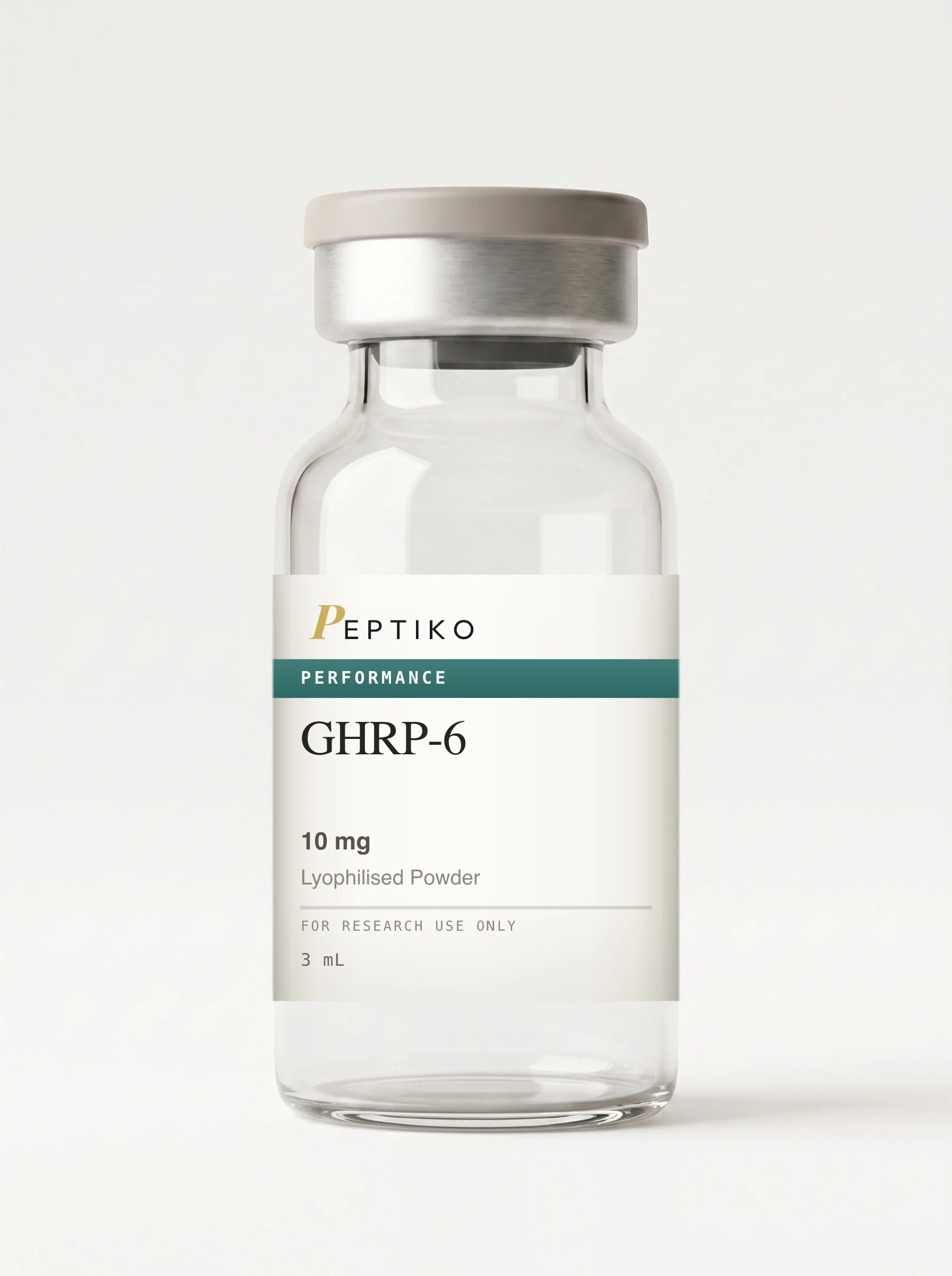
GHRP-6
First-generation growth-hormone-releasing hexapeptide and GHS-R1a (ghrelin) receptor agonist, studied for the somatotropic secretagogue pathway.
For in-vitro research and laboratory use only. Not for human or animal consumption.
- ≥99% purity by HPLC-MS · lot number on every vial
- Delivery in Moldova: 1 business day
- Cash to the courier on delivery
- + bacteriostatic water free with this order
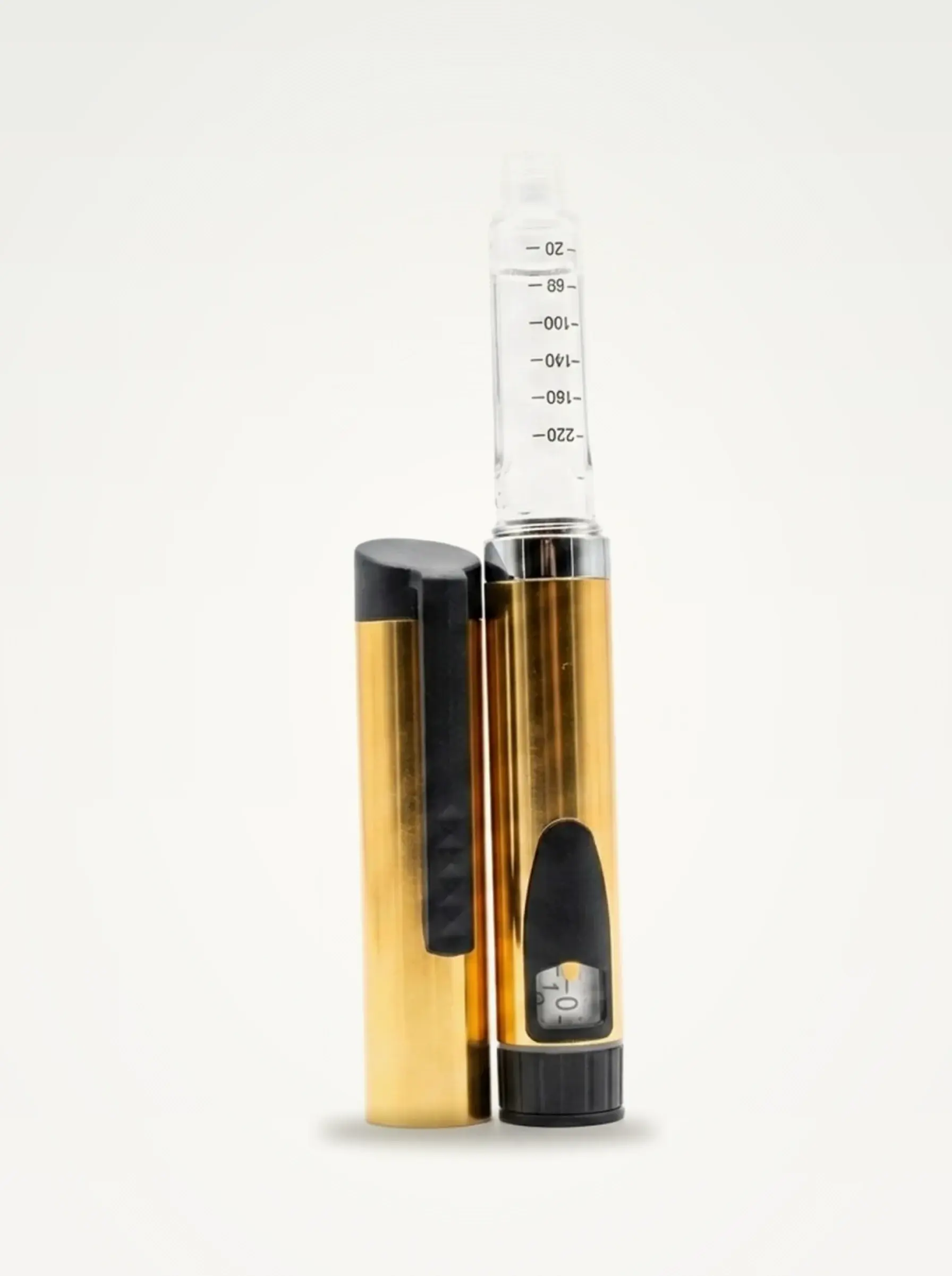 Injection Penreusable device · 800 lei
- Purity
- ≥99% HPLC-MS verified
- CAS
- 87616-84-0
- Storage
- Lyophilised: 2–8 °C, protect from light and moisture (−20 °C for long-term, ≥24 months). Reconstituted: 2–8 °C.
- Formats
- 10 mg lyophilised vial
Courier delivery anywhere in Moldova. Lyophilized peptides travel at ambient temperature.
Overview
GHRP-6 is a synthetic six-amino-acid peptide (CAS 87616-84-0) belonging to the first generation of growth-hormone-releasing peptides. In vitro it acts as an agonist at the ghrelin receptor (GHS-R1a) and serves as a classic reference reagent in growth-hormone secretagogue and receptor-signalling research. It is supplied as a lyophilised reagent for laboratory investigation only.
Mechanism
GHRP-6 is a synthetic hexapeptide and the original member of the growth hormone releasing peptide series — the compound the receptor was hunted with. It mimics ghrelin at the growth hormone secretagogue receptor, and its historical importance is that its activity is what led to the cloning and characterisation of that receptor in the first place. Because it came first, it is the yardstick: the 1998 paper introducing ipamorelin measures the new peptide against GHRP-6 on primary rat pituitary cells and reports similar potency and efficacy, with the distinction being selectivity rather than strength. The literature since has pulled in two unrelated directions — circadian phase in mice, antimicrobial transcription in fish — neither of which follows from the growth hormone story.
Molecular identity
- Sequence
- His-D-Trp-Ala-Trp-D-Phe-Lys-NH₂
- Formula
- C46H56N12O6
- Molecular weight
- 873.0 g/mol
- CAS
- 87616-84-0
- PubChem CID
- 9919153
What it acts on
- Growth hormone secretagogue receptor (GHS-R) — an orphan G-protein-coupled receptor when it was cloned, later shown to mediate the activity of the GHRPs and of non-peptide ligands such as MK-0677.
- Somatotroph growth hormone release — GHRP-6 is the reference agonist against which newer secretagogues are calibrated in primary pituitary cell assays.
- Suprachiasmatic nucleus and circadian phase — the 2014 mouse work locates a clock-shifting action here, and reports it only at one point in the cycle.
- Innate antimicrobial signalling — reported in fish, where the compound up-regulated piscidin-like peptides and granzyme; a distinct axis from the growth hormone one and evidenced in one species.
What the studies report
Each item below summarises the paper it is numbered to, written from that paper's own abstract. The badge says how the evidence was produced.
- 1.in vitroEur J Endocrinol (1998)
The paper introducing ipamorelin, in which GHRP-6 is the comparator. On primary rat pituitary cells the two released growth hormone with similar potency and efficacy; antagonist profiling showed both act through a GHRP-like mechanism rather than the growth-hormone-releasing-hormone receptor. GHRP-6 is characterised here as the reference, not as the subject.
- 2.reviewEndocrine (2001)
The receptor paper: the cloning and characterisation of the growth hormone secretagogue receptor, and a search for family members by low-stringency screening of human and pufferfish genomic libraries. It establishes what the receptor is and that it belongs to no known GPCR subfamily. Structural and genomic work — no functional readout for this compound.
- 3.animal modelFish Shellfish Immunol (2021)
In tilapia, with and without Pseudomonas aeruginosa infection, GHRP-6 raised transcription of three piscidin-like antimicrobial peptides and of granzyme in a tissue-dependent way, increased lysozyme and anti-protease activity in serum, and reduced bacterial load after infection. A fish immunology result, in a compound otherwise studied for growth hormone release.
- 4.animal modelAm J Physiol Endocrinol Metab (2014)
In male mice kept in constant darkness, a single dose of GHRP-6 given at the start of subjective night delayed the phase of free-running locomotor rhythms. Given at other points in the circadian cycle it produced no shift at all — an effect that exists only in a narrow window, in one sex, in one strain.
Used in research on
What this does not establish
There is no human study in this reference set at all. The in-vitro paper studies a different compound and uses this one as the yardstick; the receptor paper is genomics with no functional readout for it; and the two in-vivo results are in mice and in fish, one of them confined to a single point in the circadian cycle. Nothing here establishes an effect in a mammal outside those narrow conditions.
Research applications
Used in vitro as a reference GHS-R1a agonist in receptor-binding assays, GPCR signal-transduction studies, and calcium-flux and second-messenger read-outs. It serves as a comparator in growth-hormone secretagogue structure-activity research and in ghrelin-pathway characterisation. It is applied strictly within cell-based and biochemical laboratory systems.
Reconstitution
The lyophilised reagent is typically reconstituted in the laboratory with sterile bacteriostatic water to prepare a stock solution for in-vitro work; gentle swirling rather than vigorous shaking helps preserve the peptide. Allow the vial to reach room temperature before opening, and aliquot the resulting stock to limit freeze-thaw cycles. For research handling only — it is not a preparation for human or animal use.
Storage & handling
Lyophilised: 2–8 °C, protect from light and moisture (−20 °C for long-term, ≥24 months). Reconstituted: 2–8 °C.
Research literature
Selected peer-reviewed literature describing this compound. Peptiko supplies peptides for in-vitro research; these papers characterise the compound, not this product.
- 1.Ipamorelin, the first selective growth hormone secretagogue. Eur J Endocrinol (1998)
- 2.Growth hormone secretagogue receptor family members and ligands. Endocrine (2001)
- 3.Growth hormone secretagogue peptide-6 enhances oreochromicins transcription and antimicrobial activity in tilapia (Oreochromis sp.). Fish Shellfish Immunol (2021)
- 4.Activation of growth hormone secretagogue receptor induces time-dependent clock phase delay in mice. Am J Physiol Endocrinol Metab (2014)
Frequently asked questions
What is GHRP-6?
GHRP-6 (CAS 87616-84-0) is a first-generation growth-hormone-releasing hexapeptide that acts in vitro as an agonist of the ghrelin receptor (GHS-R1a). It is supplied as a lyophilised reference reagent for growth-hormone secretagogue and receptor-signalling research, with ≥99% HPLC-MS purity.
Is GHRP-6 for human use?
No. GHRP-6 is supplied strictly for in-vitro and laboratory research use only. It is not a medicine, supplement or diagnostic, and it is not intended for human or animal use, consumption or administration.
How is purity verified?
Purity is at least 99% by HPLC-MS.
What is the CAS number?
CAS 87616-84-0.
Do you ship from Moldova?
Yes. We deliver by courier anywhere in Moldova, one business day after we confirm the order, and you pay the courier in cash. Lyophilized peptides travel at ambient temperature: a freeze-dried cake needs no cold chain.
Reviews
Be the first to review GHRP-6.
Order on Telegram, or add it to the cart and check out on the site. Cash to the courier on delivery — nothing is paid in advance.