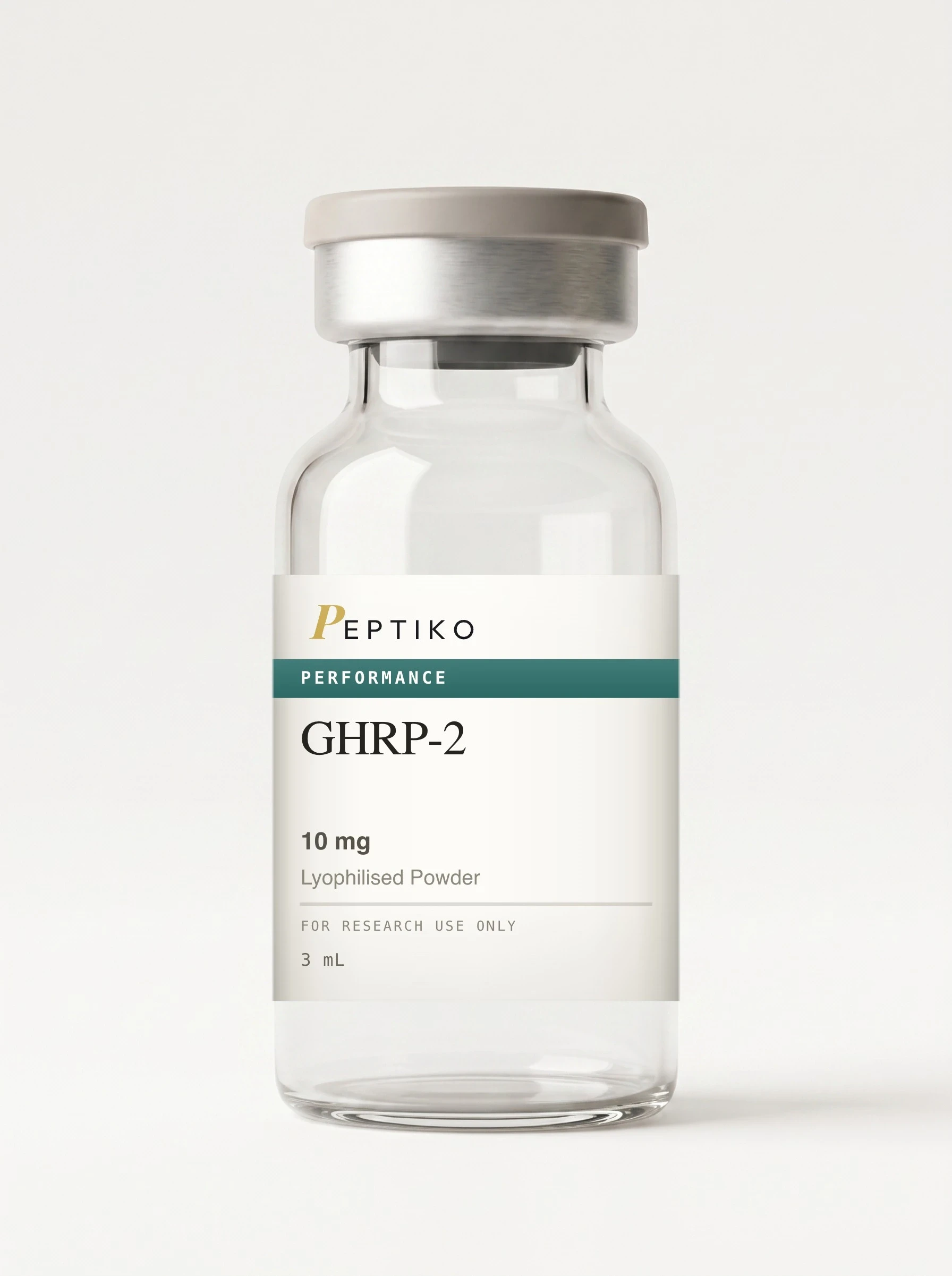
GHRP-2
Synthetic growth-hormone-releasing hexapeptide and ghrelin-receptor agonist, studied for the growth-hormone secretion-axis pathway.
For in-vitro research and laboratory use only. Not for human or animal consumption.
- ≥99% purity by HPLC-MS · lot number on every vial
- Delivery in Moldova: 1 business day
- Cash to the courier on delivery
- + bacteriostatic water free with this order
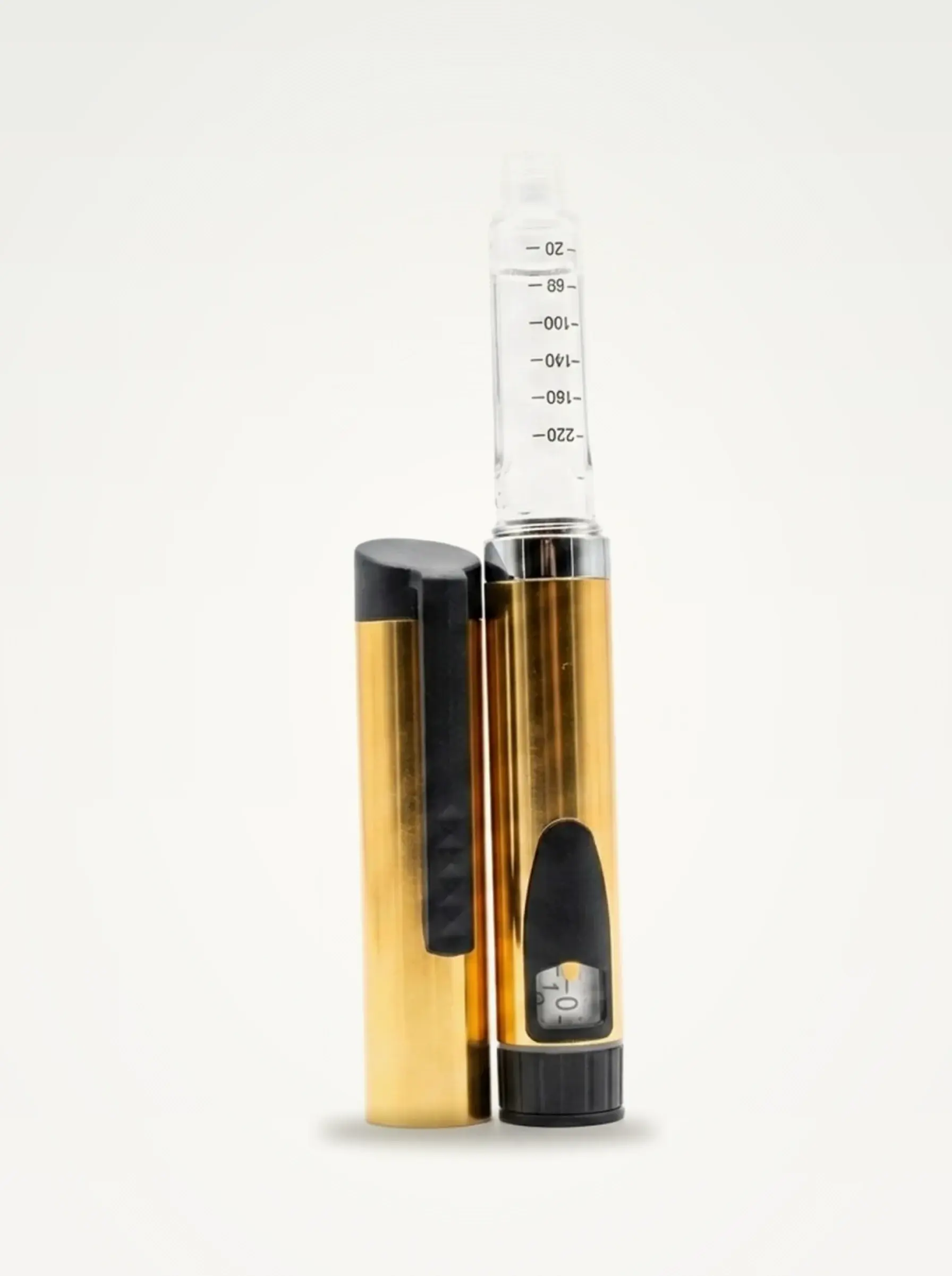 Injection Penreusable device · 800 lei
- Purity
- ≥99% HPLC-MS verified
- CAS
- 158861-67-7
- Storage
- Lyophilised: 2–8 °C (−20 °C for long-term, ≥24 months). Reconstituted: 2–8 °C.
- Formats
- 10 mg vial
Courier delivery anywhere in Moldova. Lyophilized peptides travel at ambient temperature.
Overview
GHRP-2 (Pralmorelin) is a synthetic growth-hormone-releasing hexapeptide that acts as an agonist of the ghrelin receptor (GHS-R1a). It serves as a reference secretagogue for in-vitro investigation of the growth-hormone secretion axis. Within research panels it complements CJC-1295 and Ipamorelin in the growth-hormone-secretagogue cluster.
Mechanism
GHRP-2, also called pralmorelin, is a synthetic hexapeptide built from a mix of D- and L-amino acids — the D-residues are what make it stable enough to survive as a peptide drug candidate. It acts as an agonist at the growth hormone secretagogue receptor, the receptor whose natural ligand is ghrelin, and it does two things through it: releases growth hormone from the pituitary, and drives appetite. It is not purely a research curiosity: the 2010 method paper notes it is used intravenously to diagnose growth hormone deficiency, and that the World Anti-Doping Agency prohibits it because athletes misuse it expecting a growth-promoting effect.
Molecular identity
- Sequence
- D-Ala-D-(β-naphthyl)-Ala-Ala-Trp-D-Phe-Lys-NH₂
- Formula
- C45H55N9O6
- Molecular weight
- 818.0 g/mol
- CAS
- 158861-67-7
- PubChem CID
- 6918245
What it acts on
- Growth hormone secretagogue receptor (GHS-R) — the ghrelin receptor; the 2005 paper describes GHRP-2 as a synthetic agonist of ghrelin acting at this site.
- Pituitary growth hormone release — the property the compound was developed for, and the reason it is used intravenously to diagnose growth hormone deficiency.
- Appetite and meal initiation — the second ghrelin-linked effect, and the one where the species results diverge sharply.
What the studies report
Each item below summarises the paper it is numbered to, written from that paper's own abstract. The badge says how the evidence was produced.
- 1.
An analytical chemistry paper, not a biology one: it develops an LC-MS/MS method to identify GHRP-2 and its metabolite in human urine for doping control, using stable-isotope-labelled GHRP-2 as an internal standard. Useful for identity work; it says nothing about what the compound does.
- 2.reviewSex Med Rev (2018)
A review of the safety and efficacy of growth hormone secretagogues as a class, including ibutamoren, the non-peptide member of the class. It frames the whole category against the known drawbacks of exogenous growth hormone, which the authors attribute partly to impaired regulatory feedback.
- 3.human studyJ Clin Endocrinol Metab (2005)
Seven lean healthy men received an infusion of GHRP-2 or of saline, then ate from an unrestricted buffet meal. They ate about 36% more on the compound than on saline, and every subject ate more. Seven participants is a very small study, and it measures a single meal.
- 4.animal modelEur J Pharmacol (2002)
The result that complicates the picture: injected into the brain ventricles of newly hatched chicks, GHRP-2 suppressed feeding rather than stimulating it, as did chicken, rat and bullfrog ghrelin. The same receptor family produces opposite behaviour in birds and mammals, which is a caution against reading any appetite finding across species.
Used in research on
What this does not establish
The only human study in this set had seven participants and measured one meal. The strongest signal in the references is not a biological result at all but an analytical method. The species results conflict outright — appetite up in men, down in chicks — and the class review is about growth hormone secretagogues generally rather than this compound. Note also that this compound is prohibited in sport by WADA, which the cited method paper states as its reason for existing.
Research applications
GHRP-2 is used as a reference reagent for in-vitro study of GHS-R1a receptor pharmacology and the growth-hormone secretion axis. It supports characterisation of ghrelin-receptor binding, downstream second-messenger signalling, and receptor-desensitisation dynamics in cell-based model systems. Researchers pair it with CJC-1295 and Ipamorelin to compare secretagogue mechanisms across the growth-hormone-signalling cluster.
Reconstitution
As supplied the reagent is a lyophilised powder. For laboratory handling it is typically reconstituted with bacteriostatic water added gently down the vial wall and swirled, not shaken, until fully dissolved to prepare a defined stock concentration for in-vitro work. The prepared stock is kept chilled and protected from repeated freeze–thaw cycles.
Storage & handling
Lyophilised: 2–8 °C (−20 °C for long-term, ≥24 months). Reconstituted: 2–8 °C.
Research literature
Selected peer-reviewed literature describing this compound. Peptiko supplies peptides for in-vitro research; these papers characterise the compound, not this product.
- 1.Determination of growth hormone secretagogue pralmorelin (GHRP-2) and its metabolite in human urine by liquid chromatography/electrospray ionization tandem mass spectrometry. Rapid Commun Mass Spectrom (2010)
- 2.The Safety and Efficacy of Growth Hormone Secretagogues. Sex Med Rev (2018)
- 3.Growth hormone releasing peptide-2 (GHRP-2), like ghrelin, increases food intake in healthy men. J Clin Endocrinol Metab (2005)
- 4.Chicken ghrelin and growth hormone-releasing peptide-2 inhibit food intake of neonatal chicks. Eur J Pharmacol (2002)
Frequently asked questions
What is GHRP-2 (Pralmorelin)?
GHRP-2 (Pralmorelin) is a synthetic growth-hormone-releasing hexapeptide and agonist of the ghrelin receptor (GHS-R1a). It is supplied as a lyophilised research reagent (≥99% HPLC-MS) used as a reference secretagogue for in-vitro study of the growth-hormone secretion axis.
Is GHRP-2 for human use?
No. GHRP-2 (Pralmorelin) is supplied strictly for in-vitro research and laboratory use only. It is not a medicine and is not intended for human or animal use, consumption, or any diagnostic or therapeutic application.
How is purity verified?
Purity is at least 99% by HPLC-MS.
What is the CAS number?
CAS 158861-67-7.
Do you ship from Moldova?
Yes. We deliver by courier anywhere in Moldova, one business day after we confirm the order, and you pay the courier in cash. Lyophilized peptides travel at ambient temperature: a freeze-dried cake needs no cold chain.
Reviews
Be the first to review GHRP-2.
Order on Telegram, or add it to the cart and check out on the site. Cash to the courier on delivery — nothing is paid in advance.