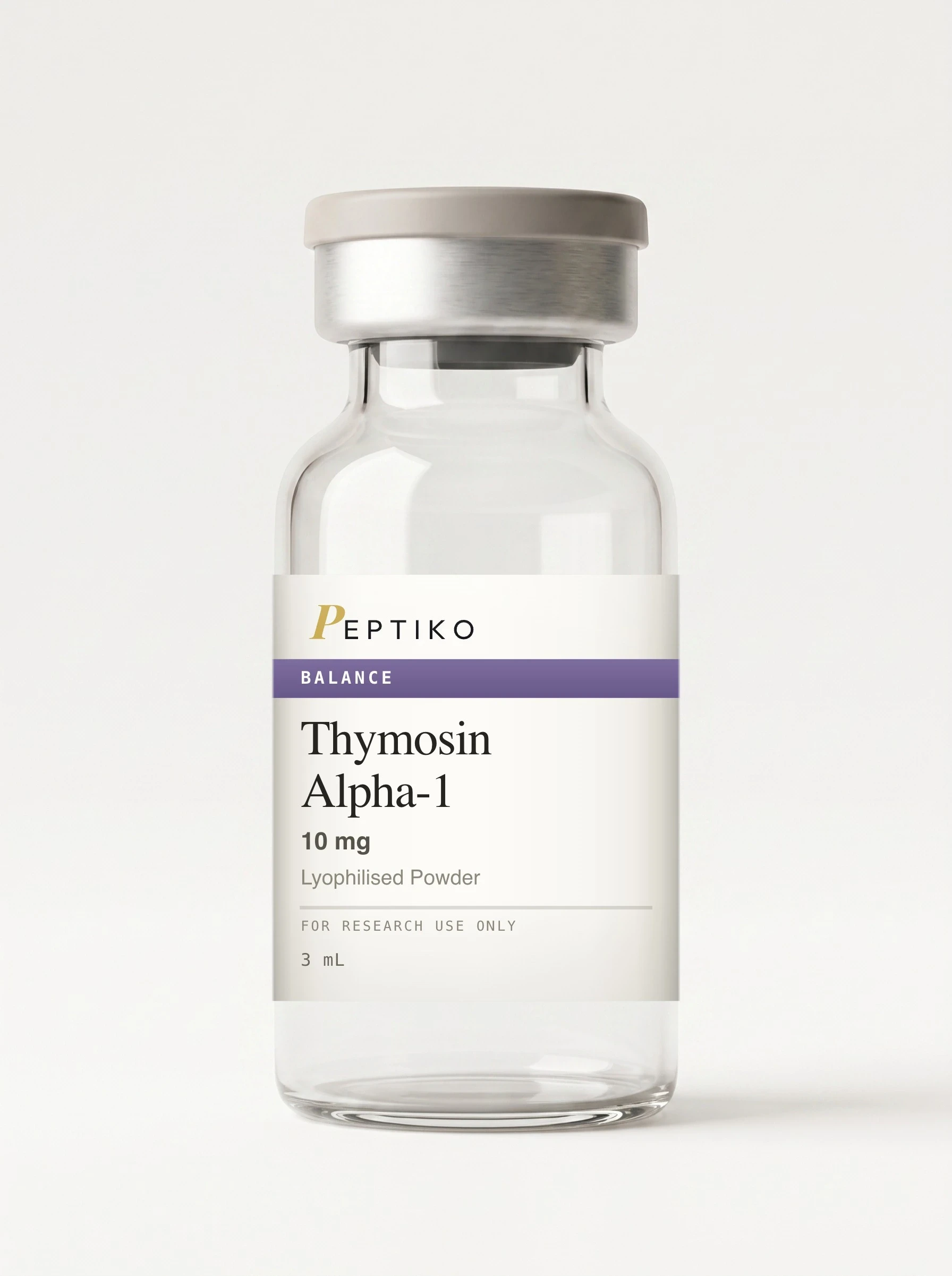
Thymosin Alpha-1
Immunomodulatory peptide. Studied for decades in inflammation and host-defense research.
Pay on deliveryDelivered in 1 business dayFree from 1000 lei
For in-vitro research and laboratory use only. Not for human or animal consumption.
- ≥99% purity by HPLC-MS · lot number on every vial
- Delivery in Moldova: 1 business day
- Cash to the courier on delivery
- + bacteriostatic water free with this order
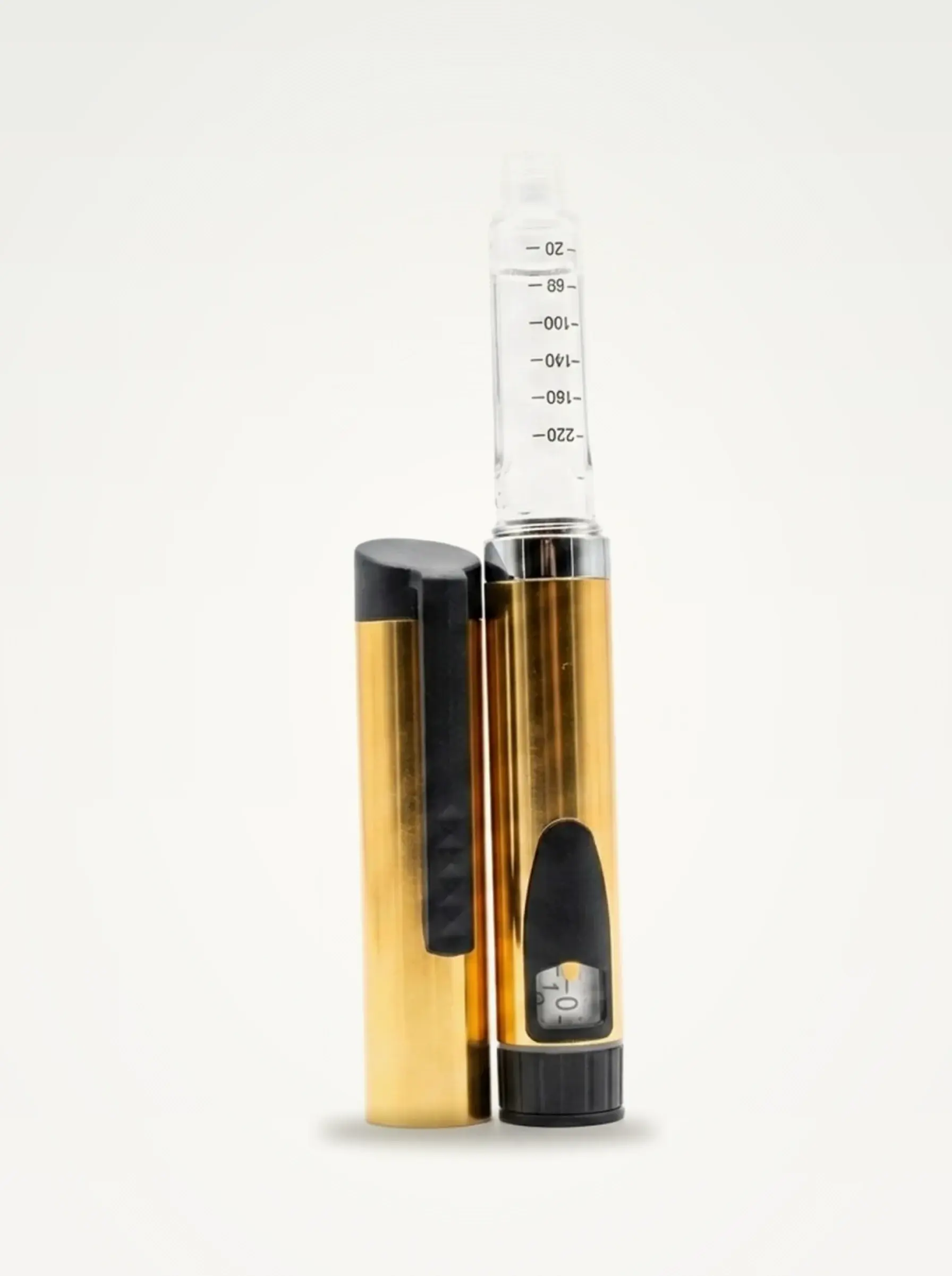 Injection Penreusable device · 800 lei
- Purity
- ≥99% HPLC-MS verified
- CAS
- 62304-98-7
- Storage
- Lyophilised: 2–8 °C (−20 °C for long-term). Reconstituted: 2–8 °C; avoid freeze-thaw cycles.
- Formats
- 10mg vial
Courier delivery anywhere in Moldova. Lyophilized peptides travel at ambient temperature.
Thymosin alpha-1 vs thymosin beta-4: the difference →Overview
Thymosin alpha-1 is a 28-amino-acid peptide first isolated from the thymus, the gland where T-cells mature. A synthetic copy is used in laboratory work, where it is studied as an immunomodulatory reagent in in-vitro assays of T-cell maturation, natural-killer-cell activity and cytokine signalling. Supplied lyophilised for in-vitro research use only.
Mechanism
Thymosin alpha-1 is a 28-residue peptide hormone produced by the thymus and first isolated from thymic tissue; the material used in laboratory work is a synthetic copy, acetylated at the N-terminus — which is what the stated formula C129H215N33O55 and mass of 3108.3 Da correspond to. The reviews cited here describe it as an immune modulator whose reported effect depends on the state of the system it meets, though the COPD meta-analysis words its own conclusion as boosting immune function. They place its point of action where thymocytes mature into T cells — the 2001 review says the peptide may stimulate their differentiation or their conversion into active T cells, and the aging review reports increased thymic output — with dendritic-cell and macrophage activity described as modulated further out, in the antigen-presenting compartment. The two clinical readouts summarised here sit downstream of that same step: the CD4+/CD8+ ratio in the COPD-exacerbation meta-analysis, and monocyte HLA-DR expression in the sepsis review — the latter a marker of restored antigen presentation in an immunosuppressed host, which is precisely why those authors argue the effect should be sought in immunosuppressed patients rather than across an unselected population. The top of that chain is the soft part: which surface receptor the peptide engages, with Toll-like receptor signalling the usual candidate, comes from the wider literature and is not addressed at all by any of the reviews cited here. The pharmacokinetics reported in the 2001 review are short — peak within about two hours, a serum half-life of roughly two hours, baseline within a day — and none of the cited work relates that exposure window to how long the described effects last.
Molecular identity
- Sequence
- Ac-Ser-Asp-Ala-Ala-Val-Asp-Thr-Ser-Ser-Glu-Ile-Thr-Thr-Lys-Asp-Leu-Lys-Glu-Lys-Lys-Glu-Val-Val-Glu-Glu-Ala-Glu-Asn
- Formula
- C129H215N33O55
- Molecular weight
- 3108.3 g/mol
- CAS
- 62304-98-7
- PubChem CID
- 16130571
What it acts on
- Thymocyte differentiation and T-cell maturation — the 2001 review says the peptide is thought to augment T-cell function and may act on thymocytes by stimulating their differentiation or converting them into active T cells; the aging review adds raised thymic output.
- CD4+/CD8+ T-lymphocyte balance — in the COPD-exacerbation meta-analysis, adding the peptide to routine treatment was associated with higher CD4+ counts, lower CD8+ counts and a raised CD4+/CD8+ ratio.
- Monocyte HLA-DR and antigen presentation — the sepsis review reports restored HLA-DR expression on monocytes, the conventional marker of recovered antigen-presenting capacity, alongside fewer secondary infections.
- Dendritic-cell and macrophage activity — the aging review lists modulation of dendritic-cell and macrophage activity among the mechanisms it attributes to the peptide, alongside T-cell differentiation and thymic output; it credits the peptide with anti-inflammatory and antioxidant properties separately, without locating them in this compartment.
- Toll-like receptor signalling — the receptor-level entry point usually invoked for this peptide's immunomodulation, and the weakest link in the chain: none of the reviews cited here establishes which receptor is engaged or with what affinity.
What the studies report
Each item below summarises the paper it is numbered to, written from that paper's own abstract. The badge says how the evidence was produced.
- 1.
A 2001 pharmacy-journal review, written while the compound was in Phase III trials for hepatitis C and Phase II for hepatitis B. It summarises pharmacokinetics — peak serum concentrations within about two hours, a serum half-life of roughly two hours, return to baseline within a day — and pools the trial data then available: four hepatitis B trials in 195 patients, in which one randomised controlled trial reported viral DNA clearance in two treated arms (40.6% and 25.6%) against 9.4% in untreated controls, and three hepatitis C trials in 162 patients, one of which found no significant difference from placebo in transaminase normalisation. Its own verdict is that the trial results were mixed and that effects on morbidity and mortality remained to be seen.
- 2.reviewInt J Mol Sci (2025)
A 2025 review framing the compound against thymic involution — the age-related shrinkage of the thymus that reduces T-cell production, sustains chronic inflammation and increases susceptibility to age-related disease. It credits the peptide with immunomodulatory, anti-inflammatory and antioxidant properties exerted through T-cell differentiation, thymic output and dendritic-cell and macrophage activity, and cites preclinical and clinical work reporting improved vaccine responses in older subjects and mitigation of immunosenescence. It also discusses Refnot, a fusion construct of TNFα with the peptide, presented as combining immunomodulation with antitumour activity at reduced toxicity. The authors close by stating that long-term efficacy and safety in geriatric use still require validation.
- 3.
A 2018 review of the clinical sepsis literature, covering the peptide alone and combined with anti-inflammatory treatment, with sources collected from English- and Chinese-language databases. The studies gathered reported reduced mortality, improved HLA-DR expression on monocytes and fewer secondary infections. The authors' own caveats are the substantive part: sepsis is so heterogeneous a syndrome that the results cannot be generalised to all septic patients, and the available studies were unable to isolate the immunosuppressed subgroup in which the authors expect the effect actually to reside — which is what they propose future trials should select for.
- 4.
A 2024 systematic review and meta-analysis of 39 randomised controlled trials, 3,329 patients in total, in acute exacerbation of chronic obstructive pulmonary disease; six databases were searched, three of them Chinese-language. Against routine treatment alone, the added peptide was associated with higher FEV1 and FEV1/FVC, higher arterial oxygen and lower carbon dioxide partial pressures, shorter hospital stay, higher CD4+ counts and CD4+/CD8+ ratio and lower CD8+ counts, all statistically significant. The authors themselves call for more high-quality randomised trials to confirm the effect; half the databases searched were regional Chinese ones, so the pooled trial base leans toward a single national literature.
Used in research on
What this does not establish
Every reference in this set is a review or a meta-analysis; there is no primary in-vitro or animal study among them, so both the mechanism and the clinical numbers reach the reader second-hand. The cited evidence does not establish the receptor step — no paper here names the binding target or its affinity — and the human results it summarises are openly mixed: the 2001 review calls its own trial data inconsistent with effects on morbidity and mortality unknown; the sepsis review states its results cannot be generalised and that the immunosuppressed subgroup could not be isolated; the COPD meta-analysis, positive on every outcome, rests on a trial pool weighted to one regional literature and ends by asking for higher-quality randomised trials. None of this work concerns this material as a laboratory reagent.
Research applications
In vitro, thymosin alpha-1 is used as an immunomodulatory reference reagent for studying host-defense and inflammation pathways rather than as a simple stimulant. It serves as a comparator compound in assays of T-cell maturation, natural-killer-cell activity and cytokine-signalling profiles, and in Toll-like-receptor signalling reporters. Researchers reach for it as a well-characterised 28-amino-acid thymic peptide when a reference point is needed in T-cell differentiation panels, cytokine-release readouts and receptor-pathway studies.
Reconstitution
Supplied lyophilised. For laboratory preparation, reconstitute the lyophilised powder with sterile bacteriostatic water to a working stock, keep the reconstituted solution at 4 degrees C, and prepare assay dilutions in the buffer specified by your protocol. For in-vitro research use only, not for human or animal administration.
Storage & handling
Lyophilised: 2–8 °C (−20 °C for long-term). Reconstituted: 2–8 °C; avoid freeze-thaw cycles.
Research literature
Selected peer-reviewed literature describing this compound. Peptiko supplies peptides for in-vitro research; these papers characterise the compound, not this product.
- 1.Thymosin alpha-1. Am J Health Syst Pharm (2001)
- 2.Aging and Thymosin Alpha-1. Int J Mol Sci (2025)
- 3.Thymosin alpha 1 treatment for patients with sepsis. Expert Opin Biol Ther (2018)
- 4.Thymosin Alpha 1 Plus Routine Treatment for the Acute Exacerbation of Chronic Obstructive Pulmonary Disease: A Systematic Review and Meta-Analysis. J Coll Physicians Surg Pak (2024)
Frequently asked questions
What is Thymosin Alpha-1?
Thymosin alpha-1 is a synthetic 28-amino-acid peptide, a copy of a peptide first isolated from the thymus. Peptiko supplies it lyophilised as an in-vitro reference reagent for immunomodulation research, where it is studied through T-cell maturation, natural-killer-cell activity, Toll-like-receptor signalling and cytokine profiles.
Is it for human use?
No. It is a research-use-only reagent for in-vitro laboratory study. It is not a pharmaceutical, supplement, or medicine, and not for human or veterinary use.
How is purity verified?
Purity is at least 99% by HPLC-MS.
What is the CAS number?
CAS 62304-98-7.
Do you ship from Moldova?
Yes. We deliver by courier anywhere in Moldova, one business day after we confirm the order, and you pay the courier in cash. Lyophilized peptides travel at ambient temperature: a freeze-dried cake needs no cold chain.
Reviews
Be the first to review Thymosin Alpha-1.
Order on Telegram, or add it to the cart and check out on the site. Cash to the courier on delivery — nothing is paid in advance.