Bacteriostatic water: what it is and why you need it
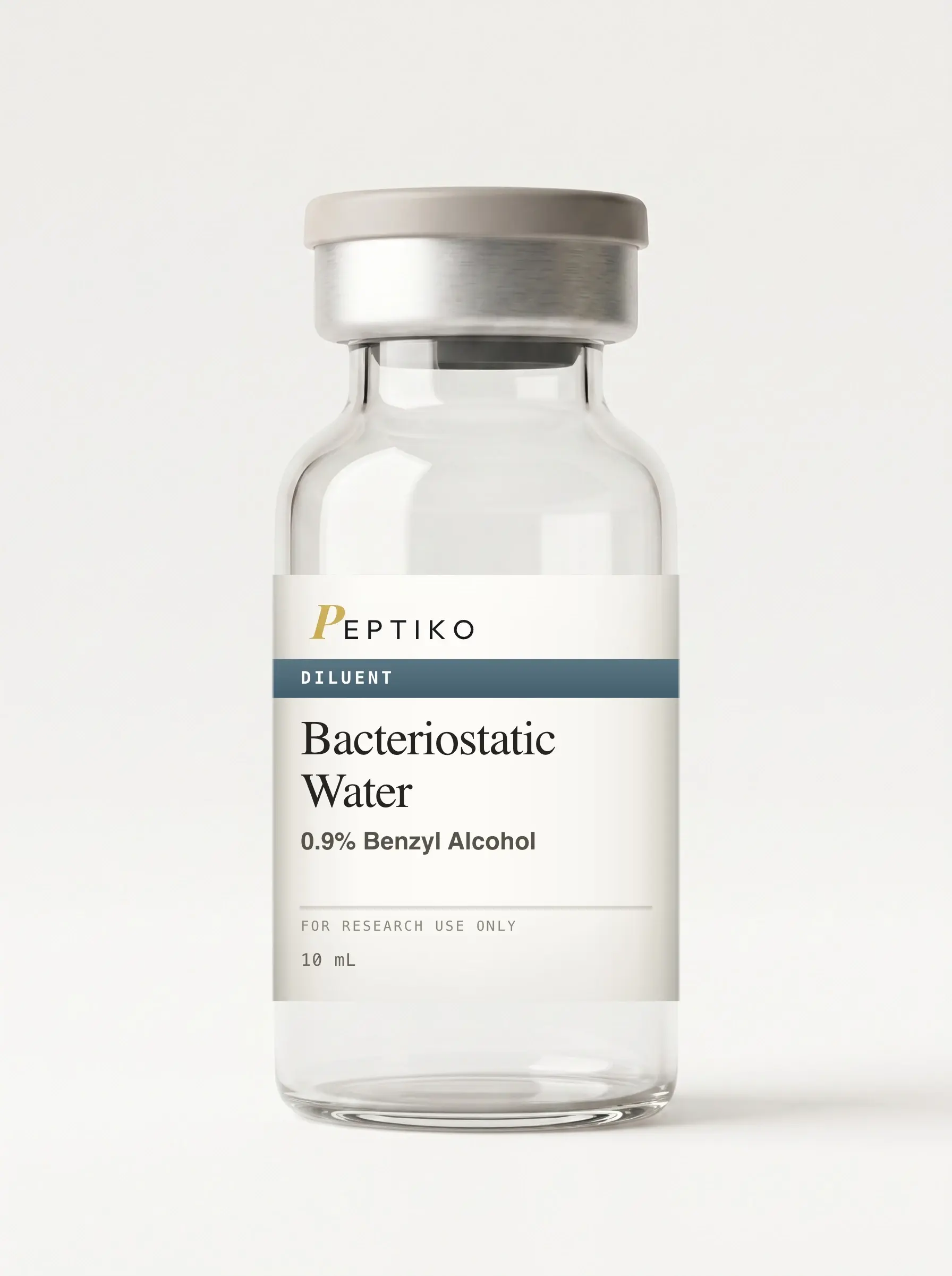
In short: bacteriostatic water is sterile water with 0.9% benzyl alcohol added. The alcohol stops bacteria from multiplying. That is why one bottle can be drawn from several times, and a peptide solution made with it keeps longer. Laboratories use it to dissolve lyophilised peptides.
What "bacteriostatic" means
The word has two parts: "bacteria" and "stasis", meaning standstill. A bacteriostatic substance does not necessarily kill bacteria, but it stops them multiplying. That is how it differs from a bactericidal one, which destroys them.
In bacteriostatic water the job is done by benzyl alcohol at 0.9%. It is a preservative: it keeps the water clean after the bottle has been opened, meaning after a needle has gone through its rubber stopper.
What it is made of
| Parameter | Our bottle |
|---|---|
| Base | Sterile, pyrogen-free water |
| Preservative | Benzyl alcohol, 0.9% |
| Volume | 10 mL |
| Storing the sealed bottle | 15–25 °C, i.e. room temperature |
| After the first puncture | 2–8 °C (fridge); use within 28 days |
Pyrogen-free means free of pyrogens, bacterial remnants that can cause false reactions in cell experiments. For laboratory work this matters as much as sterility.
Why peptides need it
Peptides are supplied dry, as a lyophilised (freeze-dried) powder, because that way they are far more stable. But to work with a peptide you have to dissolve it. This step is called dissolving, or reconstitution.
That takes a solvent, and laboratories usually have two options:
- Bacteriostatic water. Suitable when the solution will be kept longer than 7 days and drawn from several times. In the fridge, a solution of most peptides made with it typically keeps 30–60 days.
- Sterile water without a preservative. Suitable when everything happens the same day. It has no preservative, so it is not kept once opened.
For some peptides and experiments a laboratory's protocol may call for a different solvent. In that case the protocol wins.
How laboratories use it
- Let the peptide vial and the water reach room temperature.
- Wipe the rubber stoppers of both with isopropyl alcohol.
- Draw the volume of water needed with a clean needle and run it down the side of the peptide vial, not straight onto the powder.
- Swirl the vial gently without shaking, and wait 1–2 minutes for everything to dissolve.
- Keep the finished solution in the fridge. The bottle with the rest of the water goes there too: after the first puncture it is used within 28 days.
How much water to add depends on the concentration you need. For example, 10 mg of peptide in 2 mL of water gives a 5 mg/mL solution. The detailed maths is in the reconstitution guide, and the storage rules are in "How to store peptides".
What not to do
- Do not freeze the sealed bottle. It belongs at room temperature until the first puncture.
- Do not use the bottle for more than 28 days after the first puncture, even if the water looks clear.
- Do not use the water if it has turned cloudy, shows particles or the stopper is damaged.
- Do not confuse it with distilled water. Distilled water is neither sterile nor preserved, and it is not suitable for peptide work.
Bacteriostatic water, free with peptides
We include bacteriostatic water free with peptide orders: one bottle for 1–3 peptide vials, plus one for every 2 more. If you need more, the water can also be bought on its own, without peptides.
Our bottle is 10 mL. We do not have a 30 mL bottle. If you need one, you can leave a request on the 10 mL bottle's page and we will tell you when it arrives.
Frequently asked questions
How does bacteriostatic water differ from sterile water?
It contains a preservative, 0.9% benzyl alcohol. That is why the same bottle can be drawn from several times over 28 days. Sterile water without a preservative is meant for a single use.
Can boiled or distilled water replace it?
No. Boiled and distilled water are not sterile in the laboratory sense and contain no preservative.
How should the bottle be stored?
Sealed, at 15–25 °C. After the first puncture, in the fridge at 2–8 °C, and used within 28 days.
Why do you include it free with peptides?
A dry peptide is not ready for work without a solvent. To make the order complete, we add water to peptide orders: one bottle per 1–3 vials.
Is it a medical solvent?
We supply bacteriostatic water as a laboratory solvent for in-vitro work with research peptides. We do not advise on use in people or animals.
How to order
Price and availability are on the bacteriostatic water page and in the block below this article. The peptides it comes free with are in the catalogue. You can order on the site or through the Telegram bot. We deliver within Moldova in 1 business day and you pay the courier on delivery. Before delivery we call you to confirm the order.
For in-vitro research and laboratory use only. Not for human or animal consumption.