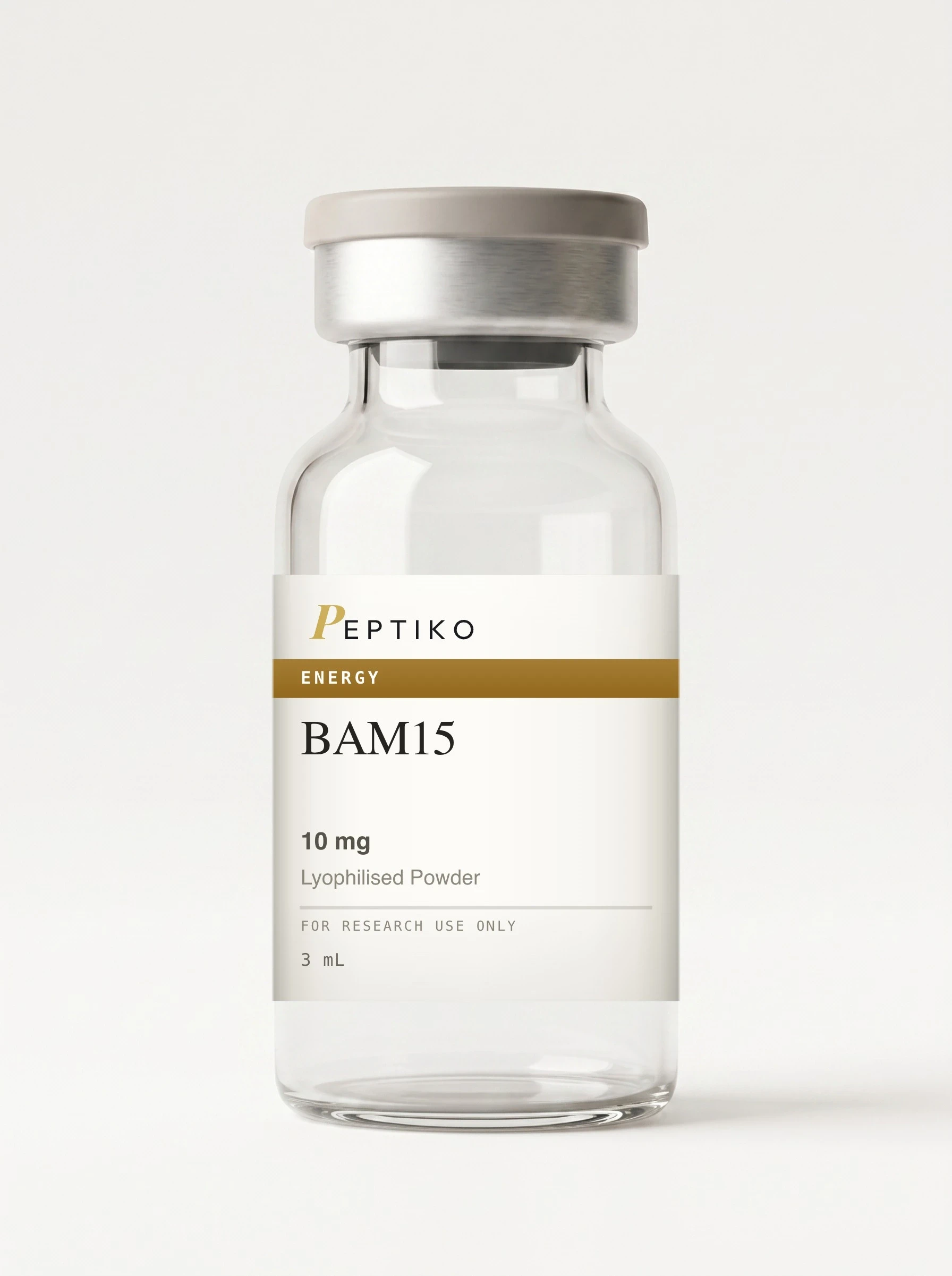
BAM15
Small-molecule mitochondrial protonophore uncoupler. Studied for mitochondrial-uncoupling and metabolic-flexibility pathways — a research reagent for in-vitro bioenergetics.
For in-vitro research and laboratory use only. Not for human or animal consumption.
- ≥99% purity by HPLC-MS · lot number on every vial
- Delivery in Moldova: 1 business day
- Cash to the courier on delivery
- + bacteriostatic water free with this order
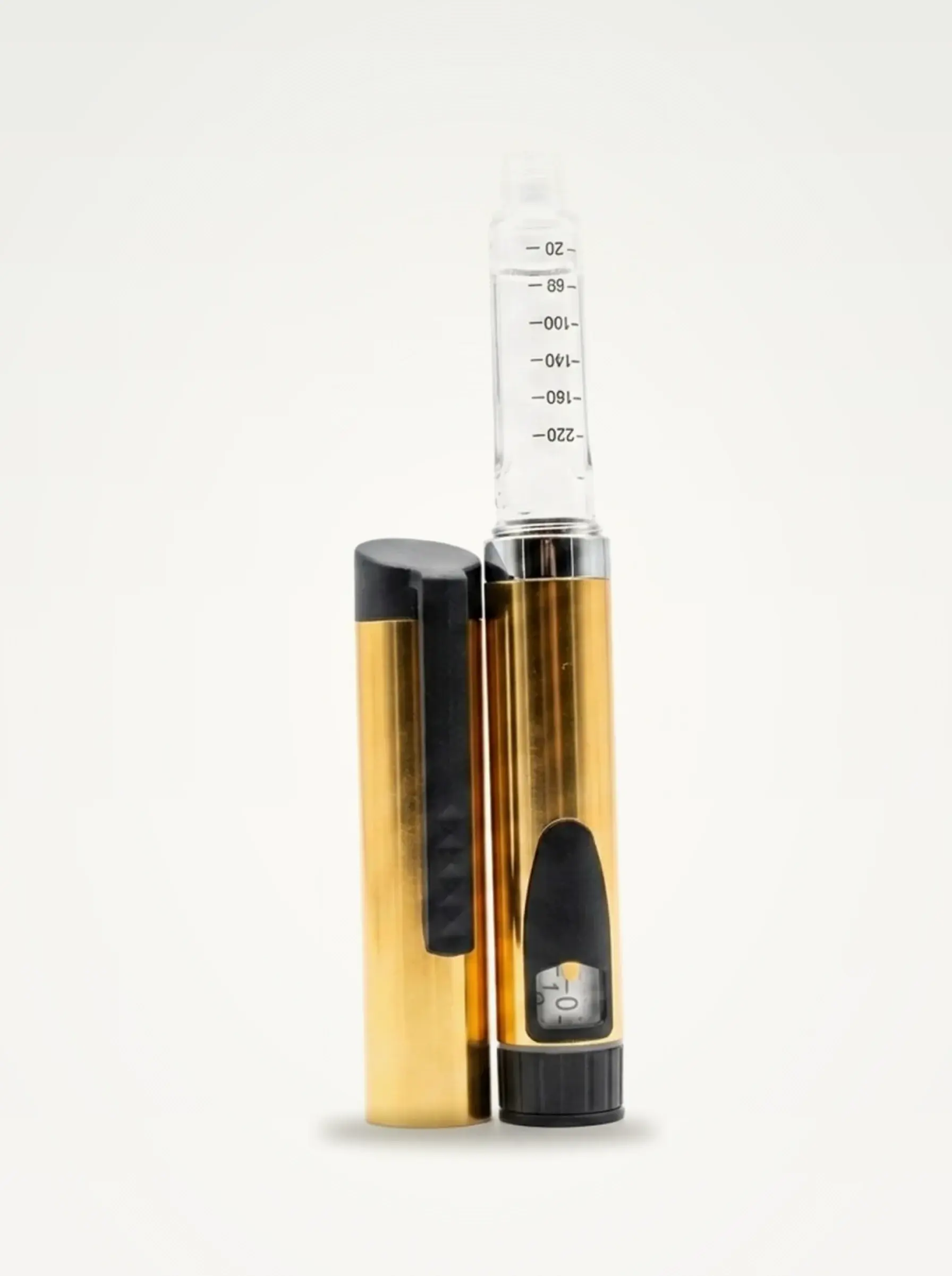 Injection Penreusable device · 800 lei
- Purity
- ≥98% HPLC-MS verified
- CAS
- 1830574-08-1
- Storage
- −20 °C, protect from light and moisture. ≥24 months.
- Formats
- 10mg vial · 25mg vial
Courier delivery anywhere in Moldova. Lyophilized peptides travel at ambient temperature.
Overview
BAM15 makes the cell's mitochondria - its tiny internal power plants - release energy as heat instead of storing it, which forces cells to burn more fuel around the clock. That is why laboratories study it as a stimulant-free approach to fat loss: in animals it lowered body fat without curbing appetite. Researchers also use it to explore fatty liver, insulin resistance and overall metabolic health.
Mechanism
BAM15 is not a peptide but a small synthetic molecule (C16H10F2N6O, 340.29 g/mol) developed as a selective mitochondrial uncoupler — a protonophore that carries protons back across the inner mitochondrial membrane. Normally the electron transport chain builds a proton gradient on that membrane and ATP synthase spends it; the cited work describes BAM15 short-circuiting the gradient, so electron transport keeps running while less of its output is captured as ATP, and respiration and energy expenditure rise to compensate. Two features are emphasised in this literature, and they are what the review has in mind when it calls the molecule a selective uncoupler. First, the sepsis study states that the gradient is dissipated without generating mitochondrial ROS, and the sepsis and atherosclerosis papers both report reduced mtROS — in the sepsis model alongside less mitochondrial DNA in plasma and urine, in the atherosclerosis model alongside less oxidised mitochondrial DNA and less release of it. Second, that is the point where the mechanism turns anti-inflammatory: the atherosclerosis paper ties that reduced release of oxidised mitochondrial DNA to less activation of the NLRP3/ASC/caspase-1 inflammasome and less GSDMD-driven pyroptosis in the endothelial model. The review characterises the molecule as highly lipophilic and names that as an unsolved formulation and delivery problem rather than an advantage.
Molecular identity
- Sequence
- Non-peptide small molecule — C16H10F2N6O, 340.29 g/mol (CAS 1830574-08-1); a lipophilic fluorinated heteroaromatic mitochondrial uncoupler, not an amino-acid sequence.
- Formula
- C16H10F2N6O
- Molecular weight
- 340.29 g/mol
- CAS
- 1830574-08-1
- PubChem CID
- 565708
What it acts on
- Proton gradient across the inner mitochondrial membrane — described as a chemical uncoupler that dissipates the gradient, disrupting the coupling between electron transport and ATP synthesis and, in the review literature, raising mitochondrial respiration and energy expenditure.
- Mitochondrial ROS output — the sepsis paper specifies that the gradient is dissipated without generating mtROS, and reports that BAM15 prevented septic-serum-driven mtROS overproduction in kidney tubule cells in vitro; the atherosclerosis paper reports lower mtROS and less oxidised mitochondrial DNA.
- Release of mitochondrial DNA as a damage signal — in the cecal-ligation-and-puncture mouse model, plasma and urinary mtDNA rose after the insult and fell after treatment, while injected exogenous mtDNA reproduced the inflammation and kidney injury on its own.
- NLRP3/ASC/caspase-1 inflammasome and GSDMD-mediated pyroptosis — in ApoE-deficient mice and in ox-LDL-treated primary aortic endothelial cells, inflammasome activation and pyroptosis markers were reported as reduced, and the NLRP3 activator nigericin partially reversed that effect.
- Hepatic lipid handling alongside thyroid hormone receptor-β signalling — in a mouse steatohepatitis model, combining BAM15 with a THR-β agonist outperformed either agent alone on energy expenditure and liver fat, with the body-fat component attributed to BAM15.
What the studies report
Each item below summarises the paper it is numbered to, written from that paper's own abstract. The badge says how the evidence was produced.
- 1.animal modelJ Clin Invest (2023)
An in vivo mouse study of polymicrobial sepsis induced by cecal ligation and puncture, with fluids and antibiotics as background care and BAM15 introduced either at the time of the insult or later, once the animals were already ill. The paper reports reduced mortality — including in the late group — along with less kidney damage and less splenic apoptosis. Plasma and urinary mitochondrial DNA rose after the insult and fell after treatment, and cultured kidney tubule cells exposed to septic serum showed mtROS overproduction and mtDNA release that the compound prevented. The authors mark their own boundaries: the benefit depended on neutrophils, since neutrophil depletion counteracted it, and a large exogenous mitochondrial DNA load reversed the protection. They position the compound as a candidate in experimental sepsis, not as an established treatment.
- 2.
A narrative review rather than primary data. It sets out the mechanism — disrupting the coupling between electron transport and ATP synthesis, dissipating the proton gradient, increasing mitochondrial respiration and energy expenditure — and surveys the preclinical literature across obesity, diabetes, non-alcoholic fatty liver disease, sepsis and cardiovascular disease. The authors call the reported tolerability encouraging, but name the obstacles themselves: high lipophilicity, the need for alternative delivery methods, and the fact that further research is required before therapeutic potential in clinical settings can be judged.
- 3.animal modelAtherosclerosis (2025)
ApoE-deficient mice on a high-fat diet served as the atherosclerosis model, with mouse primary aortic endothelial cells exposed to oxidised LDL as the parallel in vitro system. The report describes smaller plaques, less lipid deposition and lower serum IL-1β and IL-18 in treated animals, alongside reduced mitochondrial ROS and less oxidised mitochondrial DNA. Western blotting showed lower GSDMD-NT, NLRP3, ASC and cleaved caspase-1. The authors' own control is informative about the limits of the claim: the NLRP3 activator nigericin only partially reversed the protection, which supports a central role for the inflammasome without establishing it as the sole route. The work is entirely mouse and cell culture.
- 4.animal modelActa Physiol (Oxf) (2024)
A treatment study in male C57BL/6J mice fed the GAN diet to model metabolic dysfunction-associated steatohepatitis, comparing the THR-β agonist MGL-3196, BAM15, the combination, and untreated control. Treatments were admixed in the diet and animals were pair-fed so that drug intake could be controlled for. The combination outperformed either single agent on energy expenditure, liver fat loss, glucose control and fatty liver disease activity score, and the paper separates the contributions: ALT, liver mass and plasma cholesterol tracked with the THR-β agonist, while change in body fat tracked with BAM15. The authors state explicitly that no treatment altered liver fibrosis, and present the result as warranting further investigation rather than as a conclusion.
Used in research on
What this does not establish
Nothing in this reference set is a human study. Three of the four cited papers are rodent experiments, two of them with supporting cell culture, and the fourth is a narrative review of that same preclinical body of work; there are no controlled clinical trials and no regulatory approval. The favourable safety and tolerability language comes from animal data, and the review itself names high lipophilicity and unresolved delivery as open problems. The animal work also carries its own boundaries: in the sepsis model the protection was counteracted by neutrophil depletion and reversed by a large exogenous mitochondrial DNA load, and in the fatty liver model no treatment arm changed fibrosis.
Research applications
In vitro, BAM15 is used as a reference mitochondrial protonophore uncoupler for studying cellular bioenergetics and metabolic-flexibility pathways. Because it lets protons leak back across the inner mitochondrial membrane, it serves as a benchmark compound in oxygen-consumption-rate and respirometry assays, mitochondrial-membrane-potential readouts, and proton-leak measurements, where researchers probe how cultured cells raise energy turnover and dissipate the proton-motive force as heat rather than storing it. It anchors cell-culture models of mitochondrial function, substrate oxidation and cellular stress-response signalling, and is frequently included in selectivity panels as a mitochondria-selective alternative to older uncouplers. All such work is conducted strictly at the cell and biochemical-assay level.
Reconstitution
Supplied lyophilised. For laboratory preparation, note that BAM15 has low aqueous solubility; researchers typically prepare a concentrated stock in a suitable aprotic solvent such as DMSO and then dilute into the assay buffer specified by their protocol. Keep the prepared stock at 4 degrees C for short-term use, and store the unopened lyophilised vial at −20 °C, protected from light and moisture. For in-vitro research use only, not for human or animal administration.
Storage & handling
−20 °C, protect from light and moisture. ≥24 months.
Research literature
Selected peer-reviewed literature describing this compound. Peptiko supplies peptides for in-vitro research; these papers characterise the compound, not this product.
- 1.BAM15 treats mouse sepsis and kidney injury, linking mortality, mitochondrial DNA, tubule damage, and neutrophils. J Clin Invest (2023)
- 2.BAM15 as a mitochondrial uncoupler: a promising therapeutic agent for diverse diseases. Front Endocrinol (Lausanne) (2023)
- 3.BAM15 inhibits endothelial pyroptosis via the NLRP3/ASC/caspase-1 pathway to alleviate atherosclerosis. Atherosclerosis (2025)
- 4.Beneficial effects of MGL-3196 and BAM15 combination in a mouse model of fatty liver disease. Acta Physiol (Oxf) (2024)
Frequently asked questions
What is BAM15?
BAM15 is a small-molecule mitochondrial protonophore uncoupler supplied as a lyophilised research reagent. In vitro it lets protons leak back across the inner mitochondrial membrane, and it is studied as a reference compound for cellular bioenergetics, mitochondrial-uncoupling and metabolic-flexibility pathways in cell cultures and biochemical assays.
Is it for human use?
No. It is a research-use-only reagent for in-vitro laboratory study. It is not a pharmaceutical, supplement, or medicine, and not for human or veterinary use.
How is purity verified?
Purity is at least 99% by HPLC-MS.
What is the CAS number?
CAS 1830574-08-1.
Do you ship from Moldova?
Yes. We deliver by courier anywhere in Moldova, one business day after we confirm the order, and you pay the courier in cash. Lyophilized peptides travel at ambient temperature: a freeze-dried cake needs no cold chain.
Reviews
Be the first to review BAM15.
Order on Telegram, or add it to the cart and check out on the site. Cash to the courier on delivery — nothing is paid in advance.